




No products in the cart.
Peptide Storage and Handling: Avoid These Critical Peptide Handling Errors (2026)
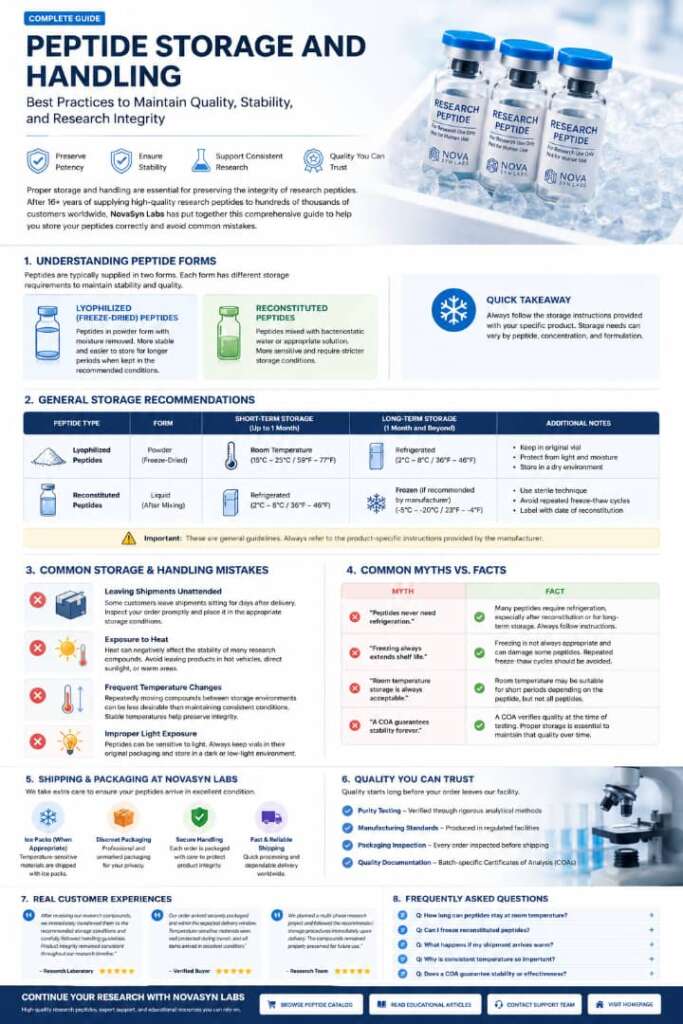
Table of Contents
Peptide Storage and Handling: Everything You Need to Know
Proper peptide storage and handling are essential for preserving the quality and integrity of research compounds. Even peptides manufactured to high purity standards can be compromised if they are exposed to unsuitable temperatures, excessive light, moisture, or poor handling practices after delivery.
One of the most common questions we receive at NovaSyn Labs is:
“How should I store my peptides to maintain their quality?”
After supplying laboratory-grade research peptides for more than 16 years to hundreds of thousands of customers worldwide, we’ve found that correct storage practices are just as important as purchasing from a reputable supplier.
This guide explains how to store research peptides, avoid common mistakes, and maintain product quality throughout your research project.
Disclaimer: Storage recommendations may vary depending on the specific peptide, formulation, and manufacturer. Always follow the instructions provided with your product.
Why Proper Peptide Storage Matters
Peptides are complex molecules that can be sensitive to environmental conditions. Factors such as heat, moisture, direct sunlight, and repeated temperature fluctuations may affect their stability over time.
Good storage practices help preserve the integrity of research materials and support consistent experimental conditions.
Lyophilized vs. Reconstituted Peptides
Understanding the difference between these forms is the first step toward proper storage.
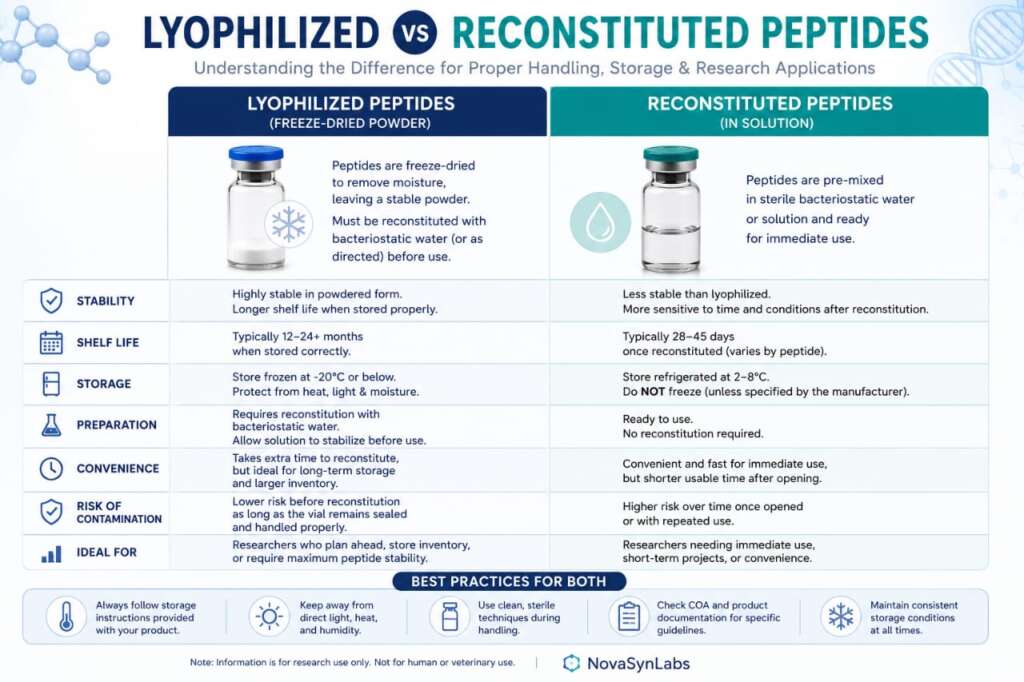
| Peptide Form | Short-Term Storage | Long-Term Storage | Key Considerations |
| Lyophilized | Follow product instructions | Often refrigerated for extended storage | Protect from moisture and light |
| Reconstituted | Commonly refrigerated | Follow manufacturer guidance | Avoid repeated freeze-thaw cycles |
Lyophilized (Freeze-Dried) Peptides
Many research peptides are supplied in a freeze-dried powder form. Depending on the manufacturer’s recommendations, these may often be stored at room temperature for limited periods or refrigerated for longer-term storage. They should be protected from hear, moisture and direct light.
Reconstituted Peptides
After a peptide has been mixed with an appropriate solution, storage requirements generally become more stringent. Refrigeration is commonly recommended by manufacturers for many reconstituted peptides, and storage conditions should be maintained consistently.
| Lyophilized | Reconstituted |
| Freeze-dried | Liquid |
| Longer stability | More temperature sensitive |
| Easier shipping | Requires stricter storage |
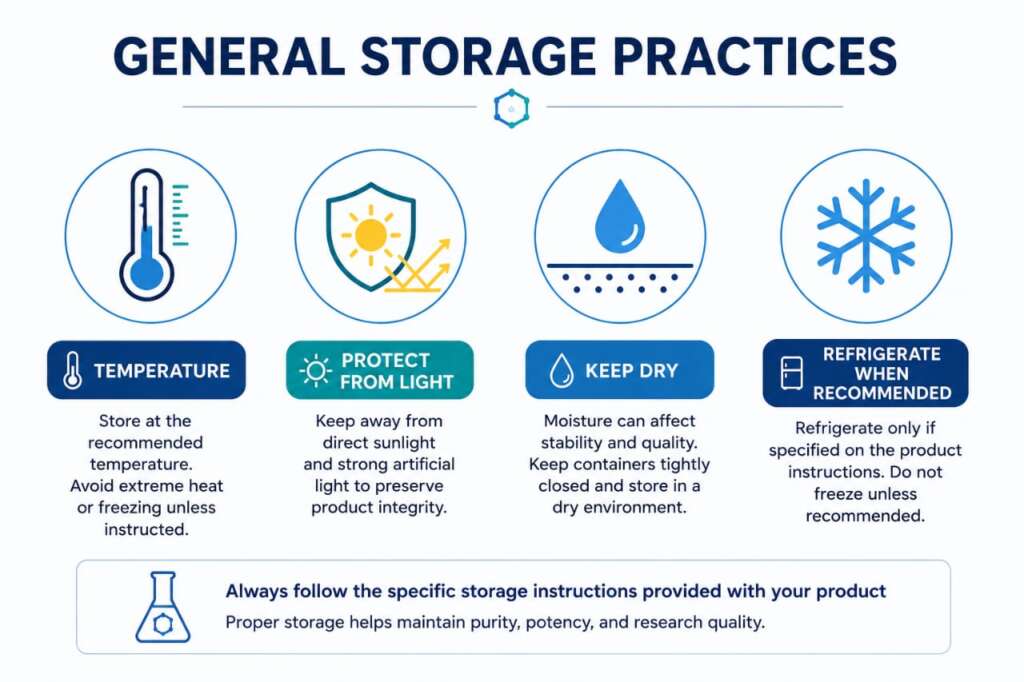
General Storage Best Practices
While individual products may have specific requirements, good practices include:
- Follow the manufacturer’s storage instructions.
- Protect peptides from direct sunlight.
- Keep products in a clean, dry environment.
- Avoid unnecessary temperature changes.
- Inspect shipments promptly after delivery.
- Place products into the recommended storage conditions as soon as possible.
Common Storage Mistakes
Over many years of serving researchers worldwide, we’ve seen several avoidable mistakes.
Leaving Deliveries Unattended
Some customers leave shipments sitting for days after delivery.
Research compounds should be inspected promptly and transferred to the recommended storage conditions.
Exposure to Heat
Leaving peptides in:
- Hot vehicles
- Direct sunlight
- Warm rooms
- Near heat sources
may negatively affect product stability.
Frequent Temperature Changes
Repeatedly moving compounds between storage environments is generally less desirable than maintaining stable conditions.
Consistent temperatures help support product integrity.
Refrigeration vs. Room Temperature
A common source of confusion is deciding whether peptides belong in the refrigerator.
The answer depends on:
- The specific peptide
- Whether it is lyophilized or reconstituted
- Manufacturer recommendations
- Expected storage duration
There is no single rule that applies to every peptide, which is why checking the product guidance is important.
Should Peptides Be Frozen?
Freezing is another area where misconceptions are common.
Some products may tolerate frozen storage under appropriate conditions, while others may be better suited to refrigeration. Repeated freeze-thaw cycles are generally discouraged because they may affect stability.
Always refer to the product-specific recommendations before freezing any peptide.
Protect Peptides from Light
Many peptides are packaged in amber vials because exposure to light may affect stability.
To help protect research materials:
- Store vials away from direct sunlight.
- Keep products in their original packaging until needed.
- Minimize unnecessary light exposure.
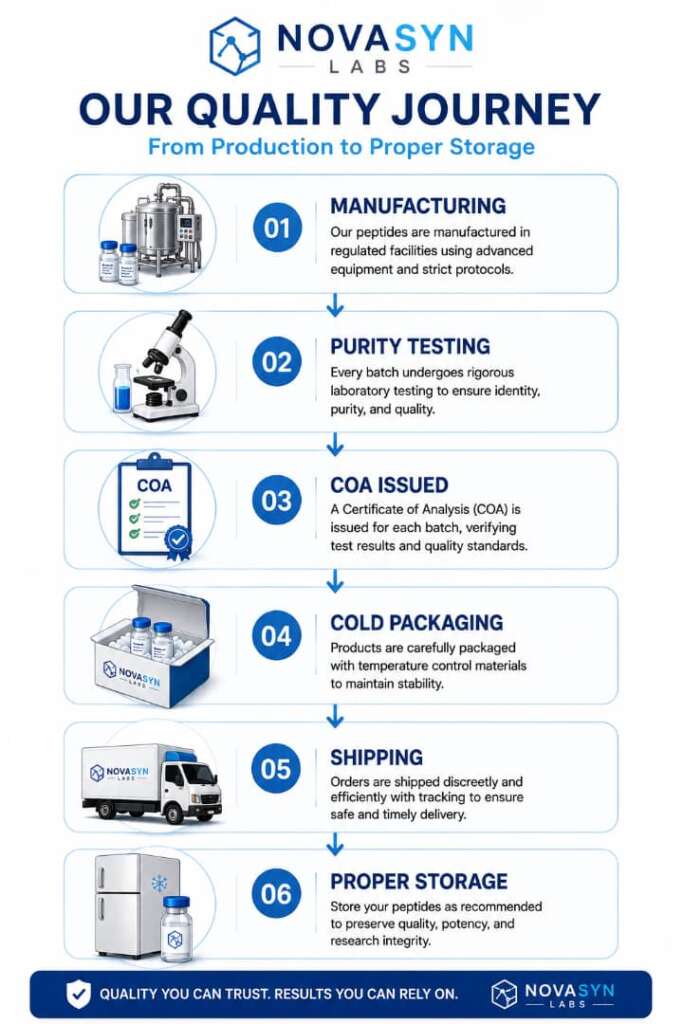
Shipping and Handling at NovaSyn Labs
At NovaSyn Labs, protecting product quality begins before your order leaves our facility.
Depending on the product, we use:
- Ice packs where appropriate
- Professional packaging
- Discreet shipping
- Careful packaging inspections
These measures help support product quality during transit.
Quality Starts Before Shipping
Proper storage is only one part of quality assurance.
Every order is backed by our commitment to:
- High-purity research peptides
- Manufacturing standards
- Packaging inspections
- Quality documentation
- Batch-specific Certificates of Analysis (COAs)
Real Customer Experiences
Maintaining Product Integrity
One Customer shared:
“After receiving our research compounds, we immediately transferred them to the recommended storage conditions and carefully followed handling guidelines. Product integrity remained consistent throughout our research timeline.”
Secure Shipping
Another customer commented:
“Our order arrived securely packaged and within the expected delivery window. Temperature-sensitive materials were well protected during transit”
Long-Term Research Planning
A laboratory conducting a multi-phase research project explained:
“We followed the recommended storage procedures immediately upon delivery. The compounds remained properly preserved, allowing us to maintain organized inventory management.”
These testimonials reflect customer experiences with product handling and shipping and should not be interpreted as evidence of research outcomes.
Common Myths About Peptide Storage
Myth: Peptides Never Need Refrigeration
Not all peptides have identical storage requirements. Many products benefit from refrigeration after reconstitution or during longer-term storage.
Myth: Room Temperature Storage is Always Fine
Environmental conditions such as heat, humidity, and storage duration all influence the appropriate storage method.
Frequently Asked Questions
How long can peptides stay at room temperature?
The answer depends on the specific product, formulation, and manufacturer recommendations. Review the instructions supplied with your peptide.
Can I freeze reconstituted peptides?
Some products may be suitable for frozen storage, while others may not. Avoid repeated freeze-thaw cycles unless specifically recommended.
What happens if my shipment arrives warm?
Inspect the shipment promptly. If you have concerns about product condition, contact the supplier before use. At NovaSyn Labs, our support team is available to help evaluate shipping-related questions.
Why is consistent temperature important?
Stable storage conditions may help preserve the quality of research materials by minimizing unnecessary environmental stress.
Does a Certificate of Analysis guarantee stability?
No. A COA provides information such as identity and purity testing but does not replace proper storage and handling.
Why Researchers Trust NovaSyn Labs
For more than 16 years, NovaSyn Labs has supported researchers with:
- High-purity laboratory -grade peptides
- Quality documentation
- Responsive customer support
- Educational resources
- Affordable pricing
- Fast worldwide shipping
- Professional packaging
- Careful quality control
We believe that providing accurate information is just as important as supplying quality research compounds.
Final Thoughts
Proper peptide storage and handling play a vital role in maintaining the integrity of research compounds. By following manufacturer recommendations, minimizing exposure to heat and light, avoiding unnecessary temperature fluctuations, and inspecting shipments promptly, researchers can help preserve product quality throughout their projects.
At NovaSyn Labs, our experience serving hundreds of thousands of customers worldwide over more than 16 years has shown that attention to storage and handling is one of the simplest-and most important-steps researchers can take to support consistent results. Combined with high-quality materials, clear documentation, and responsive customer support, good storage practices form the foundation of reliable peptide research.
Continue Your Research
If you’d like to learn more:
- Browse our peptide catalog to explore our laboratory-grade research compounds.
- Read our educational articles covering peptide categories, reconstitution, and quality standards.
- Contact the NovaSyn Labs support team if you have questions about storage guidance, shipping, or product documentation.
- Visit our homepage to discover why researchers worldwide have trusted NovaSyn Labs for over 16 years.
References


Comment
Peptide Injections For Weight Loss: Benefits, How They Work & What You Should Know (2026 Guide)
[…] Peptide Storage and Handling […]