


No products in the cart.
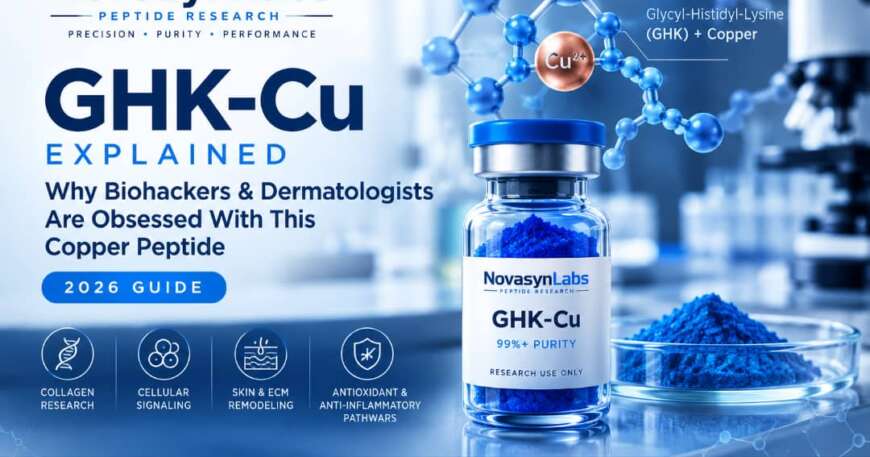
GHK-Cu Explained: Why Biohackers & Dermatologists Are Obsessed With This Copper Peptide (2026 Guide)

Table of Contents
Introduction
GHK-Cu has become one of the most discussed copper peptides in modern skin, longevity, regenerative biology, and peptide research. But behind the growing interest is a deceptively small molecule with a surprisingly broad research profile.
Known as GHK-Cu, copper tripeptide-1, or copper peptide, the compound consists of the naturally occurring tripeptide glycyl-L-histidyl-L-lysine (GHK) complexed with copper. Researchers have investigated GHK-Cu for decades, particularly in areas involving extracellular matrix remodeling, collagen biology, cellular signaling, wound-healing models, oxidative stress, and tissue repair.
In 2026, interest in GHK-Cu is increasingly moving beyond simple cosmetic marketing. Researchers and advanced skincare formulators are asking more sophisticated questions:
- How does GHK-Cu differ from uncomplexed GHK?
- Why does copper binding matter?
- What does GHK-Cu actually do at the cellular level?
- How important is purity?
- How should research-grade GHK-Cu be stored?
- What does a meaningful GHK-Cu COA look like?
- How does GHK-Cu compare with BPC-157, TB-500, Matrixyl, or AHK-Cu?
- Why can two apparently similar GHK-Cu batches produce different research outcomes?
This guide examines GHK-Cu peptide research from a research-material and biochemical perspective, while separating laboratory evidence from claims that have not been established clinically.
What Is GHK-Cu?
GHK-Cu is a copper-containing peptide complex formed from the tripeptide glycyl-L-histidyl-L-lysine (GHK) and a copper ion.
GHK itself is a small naturally occurring peptide. When complexed with copper, the resulting molecule is generally referred to as GHK-Cu or copper tripeptide-1.
The copper component is not simply an ingredient added to the vial. Copper is coordinated by the peptide, producing a distinct copper-peptide complex with different biochemical characteristics from free GHK.
For research purposes, this distinction is extremely important.
A researcher purchasing GHK-Cu should not think of the material as simply:
«GHK + copper = GHK-Cu»
The chemical state, purity, copper coordination, water content, degradation profile, and analytical identity of the final material all matter.
The commonly reported molecular mass of GHK-Cu is approximately 403.9 g/mol, although the exact reported value can vary slightly depending on how the complex and analytical measurement are represented.
GHK vs. GHK-Cu
| Characteristic | GHK | GHK-Cu |
| Basic structure | Gly-His-Lys tripeptide | GLY-His-Lys complexed with Cu²⁺ |
| Copper | Not complexed | Copper coordinated with peptide |
| Research interest | Peptide signaling | Copper-dependent peptide signaling |
| Molecular mass | ~340.38 g/mol | ~403.9 g/mol |
| Appearance | Depends on formulation | Often blue due to copper complex |
| Typical research focus | Peptide biology | ECM, collagen, signaling and tissue biology |
This difference becomes particularly important when calculating concentrations.
A researcher who uses the molecular weight of uncomplexed GHK when preparing a GHK-Cu solution can introduce a concentration error.

Why Is GHK-Cu Suddenly So Popular?
The renewed interest in GHK-Cu comes from several research areas converging at the same time.
First, modern researchers are increasingly interested in cellular signaling rather than single-target compounds. Second, longevity research has expanded interest in compounds associated with extracellular matrix maintenance, oxidative stress and cellular repair. Third, the cosmetic industry has continued investigating copper peptides for skin and collagen-related applications.
GHK-Cu therefore sits at the intersection of several research fields:
Copper peptide → cellular signaling → extracellular matrix → collagen biology → wound-healing research → skin research
This broad research footprint explains why GHK-Cu attracts both dermatology researchers and the biohacking community.
However, these groups often approach GHK-Cu from completely different perspectives.
GHK-Cu and Collagen Research
One of the most important areas of GHK-Cu research involves the extracellular matrix (ECM).
The extracellular matrix provides structural support around cells and contains proteins and molecules such as collagen, elastin, proteoglycans and glycosaminoglycans.
Collagen is particularly important because it provides much of the structural framework of skin and other connective tissues.
Research involving GHK-Cu has investigated changes in pathways associated with:
- Collagen synthesis
- Extracellular matrix remodeling
- Glycosaminoglycan production
- Fibroblast activity
- Elastin-related biology
- Decorin and matrix organization
- Metalloproteinase activity
This does not mean that GHK-Cu should be described as a guaranteed collagen-building treatment.
The more scientifically appropriate interpretation is that GHK-Cu has demonstrated biological activity relevant to extracellular matrix and connective-tissue research, making it an interesting experimental compound.
How GHK-Cu May Interact With Cells
GHK-Cu is particularly interesting because its activity is not limited to one simple biochemical pathway.
Researchers have investigated its effects on several interconnected processes.
1. Fibroblast Research
Fibroblasts are important extracellular-matrix-producing cells.
In experimental models, fibroblast activity is relevant to collagen production, matrix remodeling and wound repair.
GHK-Cu research has therefore frequently focused on whether the compound can influence fibroblast behavior and extracellular matrix-associated signaling.
2. Collagen and ECM Signaling
GHK-Cu has been studied in connection with collagen-related processes and matrix components.
This is one reason copper peptide research has become so prominent in dermatological and cosmetic science.
3. Cellular Migration
Cell migration is an important component of wound-healing models.
Experimental studies using scratch assays and related systems can measure how quickly cells migrate into an artificially created gap.
NovaSynLabs’ research observations have included increased migration signals in keratinocyte and fibroblast models involving high-quality GHK-Cu material.
These findings should be interpreted as laboratory observations, rather than evidence that GHK-Cu will produce the same outcome in humans.
4. Oxidative Stress and Inflammatory Signaling
Copper participates in numerous biological processes, while GHK-related biology has been investigated in oxidative-stress and inflammatory pathways.
Research has explored relationships between GHK-Cu and signaling molecules associated with inflammation, including TNF-α and IL-6.
Again, laboratory pathway modulation should not automatically be translated into a claim that GHK-Cu treats an inflammatory disease.
The Gene-Expression Question
One of the most fascinating aspects of GHK-Cu research is its proposed influence on gene expression.
Historical research associated with GHK and GHK-Cu has reported broad changes in gene-expression patterns. Some secondary sources frequently cite a figure of approximately 31% of genes being shifted toward a different expression state.
This claim requires careful interpretation.
It does not mean that GHK-Cu simply “turns on 31% of human genes,” nor does it mean that those genes are universally “reset” to a younger state.
Gene-expression experiments depend heavily on:
- Cell type
- Experimental conditions
- Concentration
- Exposure duration
- Measurement methodology
- Baseline gene-expression state
- Definition of a significant change
For a scientifically responsible 2026 GHK-Cu guide, the more useful conclusion is that GHK-related signaling has been investigated for broad gene-expression effects, which is one reason the peptide continues to attract interest in regenerative and aging-related research.
Why GHK-Cu Purity Matters More Than Most Buyers Realize
One of NovaSynLabs’ biggest lessons from more than five years of GHK-Cu supply and research is that material quality can dramatically affect how researchers interpret experimental results.
GHK-Cu is not a compound where a label saying “copper peptide” tells the entire story.
Important quality variables include:
- Peptide purity
- Correct molecular identity
- Copper complexation
- Water content
- Degradation products
- Residual solvents
- Heavy metals
- Endotoxin levels
- Storage conditions
- Batch traceability
NovaSynLabs targets ≥99.0% HPLC purity for its GHK-Cu research material.
Identity is additionally evaluated using mass spectrometry, while batch-specific COAs provide analytical documentation.
NovaSynLabs GHK-Cu QC Framework
| Test | Purpose |
| RP-HPLC | Measures chromatographic purity |
| LC-MS / ESI-MS | Confirms molecular identity/mass |
| Endotoxin testing | Evaluates endotoxin burden |
| ICP-MS | Screens for elemental contaminants/heavy metals |
| GC/GC-MS | Evaluates residual volatile compounds |
| Karl Fischer | Measures water content |
| Batch-specific COA | Provides lot traceability |
For researchers, this is much more useful than simply seeing a marketing statement such as “99% pure.”
The underlying question should always be:
99% pure according to which test, for which batch, and with what identity confirmation?
HPLC vs. Mass Spectrometry: Why You Want Both
HPLC and mass spectrometry answer different questions.
HPLC primarily helps answer:
«How chromatographically pure is this material?»
Mass spectrometry helps answer:
«Does the material have the expected molecular mass/identity?»
That distinction matters.
A sample can produce an attractive HPLC purity percentage while still requiring independent identity confirmation.
For research-grade GHK-Cu, combining chromatographic purity with mass-spectrometric identity creates a substantially stronger analytical picture than relying on either technique alone.
A Better GHK-Cu Verification Workflow
Manufacturing → Purification → HPLC → Mass Spectrometry → Additional QC → COA → Batch Traceability
Researchers should ideally be able to connect the analytical results to the exact lot they received.
NovaSynLabs’ GHK-Cu Manufacturing Approach
NovaSynLabs’ stated production workflow follows a controlled sequence:
Solid-Phase Peptide Synthesis (SPPS)
↓
Copper Complexation
↓
Preparative RP-HPLC Purification
↓
Sterile Filtration / Controlled Processing
↓
Aseptic Lyophilization
↓
Nitrogen-Flushed, Vacuum-Sealed Packaging
The copper is complexed with the GHK peptide rather than being supplied as two separate components that the researcher must combine.
The final material is supplied as research-grade lyophilized GHK-Cu.
NovaSynLabs uses ISO 9001/GMP-aligned processing environments and emphasizes lot-level documentation.
The Storage Problem: GHK-Cu Is Hygroscopic
One of the most practical lessons NovaSynLabs has observed is that GHK-Cu powder is sensitive to moisture exposure.
Opening a vial repeatedly in a humid environment can introduce water into the material and potentially affect long-term stability.
This is particularly relevant because researchers sometimes focus heavily on the nominal purity printed on a COA while overlooking what happens after the vial reaches the laboratory.
Good handling practices include:
- Minimize unnecessary exposure to ambient humidity.
- Keep the vial tightly sealed.
- Follow the supplier’s recommended storage conditions.
- Avoid repeated unnecessary opening.
- Use appropriate moisture protection.
- Keep reconstituted material under appropriate controlled conditions.
- Avoid repeated freeze-thaw cycles when they are not part of the experimental design.
A high-purity peptide can still become a poor experimental material if it is improperly stored.
GHK-Cu Powder vs. Finished Cosmetic Formulations
Another common source of confusion is the difference between research-grade GHK-Cu powder and a finished cosmetic product.
They are not interchangeable.
A research-grade lyophilized GHK-Cu vial is a raw research material intended for controlled laboratory use.
A finished cosmetic formulation may contain:
- Water
- Humectants
- Preservatives
- Stabilizers
- Emulsifiers
- Penetration modifiers
- Other active ingredients
- A specific delivery vehicle
Therefore, researchers should not compare “100 mg GHK-Cu powder” directly with a skincare serum simply by looking at the headline concentration.
The formulation, concentration, stability, delivery system and intended use are fundamentally different.
A NovaSynLabs Internal Research Case Study: Purity Matters
NovaSynLabs has reported an internal quality-control comparison involving two GHK-Cu lots in a human dermal fibroblast research model.
Lot A: ≥99% HPLC purity
Lot B: approximately 91% purity/degraded material
The reported experimental observation was a substantially stronger collagen-associated response in the higher-purity material.
The internal comparison was represented approximately as:
| Research Material | Reported Collagen Type I Response |
| Control | 100% baseline |
| Lot A ≥99% | ~245% of baseline |
| Lot B ~91% | ~170% of baseline |
The important lesson is not that a particular percentage increase should be expected in every fibroblast experiment.
It is that purity and degradation state can become experimental variables themselves.
Lower-quality material may contain peptide fragments, altered species or other impurities that complicate interpretation.
For researchers, this creates an important principle:
«If two laboratories are using “GHK-Cu” but one has poorly characterized material, the experimental results may not be directly comparable.»
This is precisely why batch-specific analytical documentation matters.
Why the Blue Color of GHK-Cu Matters—But Isn’t a Purity Test
GHK-Cu is commonly associated with a blue coloration because of the copper complex.
However, visual appearance should never be treated as a substitute for analytical testing.
A darker blue material is not automatically purer.
Likewise, a researcher should not conclude that every pale or unusually colored sample is necessarily contaminated without analytical evidence.
Color can be affected by:
- Concentration
- Formulation
- Lighting
- pH
- Solvent/vehicle
- Container
- Chemical environment
The correct approach is simple:
Use appearance as an observation—not as an analytical test.
HPLC and mass spectrometry provide substantially more meaningful evidence.
GHK-Cu vs. GHK: What’s the Difference?
The copper-bound form is the more widely discussed copper-peptide research material.
| Feature | GHK | GHK-Cu |
| Copper complex | No | Yes |
| Molecular mass | ~340.38 g/mol | ~403.9 g/mol |
| Copper-dependent biology | Limited | Central to compound |
| Research interest | Peptide signaling | Copper-peptide signaling |
| Common research area | Cellular biology | ECM, collagen, skin and repair research |
For concentration calculations, this difference is critical.
Using the molecular weight of GHK instead of GHK-Cu can produce an incorrect molar concentration.
GHK-Cu vs. BPC-157
GHK-Cu and BPC-157 are frequently grouped together in peptide discussions, but their research profiles are different.
| GHK-Cu | BPC-157 |
| Copper tripeptide | Peptide sequence derived from gastric protein research |
| Strong interest in ECM/skin biology | Frequently investigated in tissue-repair models |
| Collagen and matrix research | Cell migration and repair-related research |
| Copper-dependent chemistry | Different biological mechanism |
| Particularly relevant to dermatological research | Broader experimental tissue-repair interest |
They should not be treated as interchangeable compounds.
GHK-Cu vs. TB-500
TB-500-related research is often discussed in the context of thymosin-related biology, actin regulation and cellular migration.
GHK-Cu has a stronger identity around copper-peptide signaling, extracellular matrix remodeling and collagen-related research.
Therefore:
TB-500 research → migration/cytoskeletal biology
GHK-Cu research → ECM/collagen/copper-peptide biology
The comparison is useful, but the compounds operate within different research frameworks.
GHK-Cu vs. Matrixyl
Matrixyl is a brand-associated family of cosmetic signal peptides, while GHK-Cu is a naturally occurring peptide complexed with copper.
Both have attracted significant interest in cosmetic science.
However, they are not chemically identical.
Matrixyl products may use synthetic peptide sequences designed for cosmetic signaling, whereas GHK-Cu is based on the GHK tripeptide and copper complex.
For researchers, the distinction is important because sequence, molecular structure, copper coordination, concentration and formulation can all affect biological behavior.
GHK-Cu vs. AHK-Cu
AHK-Cu is another copper peptide that has attracted interest, particularly in hair and follicle-related research.
The simplest conceptual distinction is:
GHK-Cu → broader ECM, skin and tissue research
AHK-Cu → particular interest in hair follicle/scalp research
Neither should be described as a guaranteed treatment for hair loss or skin aging.
Their research applications and evidence bases should be evaluated independently.
Research Powder vs. Topical GHK-Cu
This distinction deserves its own section because it is one of the most common sources of misunderstanding.
| Research-grade powder | Finished topical formulation |
| Concentrated raw material | Diluted/formulated product |
| Controlled laboratory use | Designed for topical application |
| Requires appropriate laboratory handling | Ready-to-use vehicle |
| Batch-specific analytical documentation | Finished-product formulation testing |
| No assumption of cosmetic performance | Delivery vehicle affects performance |
A laboratory researcher should never assume that a research-grade powder is equivalent to a commercially formulated serum.
Is ≥99% GHK-Cu Better Than ≥98%?
A difference between 98% and 99% may appear small.
It represents a one-percentage-point difference in chromatographic purity, not necessarily a dramatic difference in biological activity.
However, when research requires highly characterized material, minimizing impurities can be valuable.
The bigger issue is not simply:
«98% vs. 99%»
It is:
«What constitutes the remaining percentage, and has the material’s identity been independently confirmed?»
This is why NovaSynLabs emphasizes HPLC together with mass spectrometry and additional analytical testing.

What Should a GHK-Cu COA Contain?
A meaningful GHK-Cu Certificate of Analysis should provide enough information for researchers to connect the document to their actual material.
Look for:
- Product name
- Batch/lot number
- Test date
- HPLC purity
- Chromatogram where available
- Molecular identity/mass data
- Testing laboratory or analytical method
- Water content
- Relevant contaminant testing
- Endotoxin results where applicable
- Release information
A QR code can be useful, but the QR code itself is not proof of quality.
The underlying analytical information matters.
COA Verification Checklist
- Match the lot number.
Does the COA correspond to the vial you received? - Check the HPLC result.
Is the stated purity supported by analytical data? - Review identity testing.
Is mass spectrometry or another appropriate identity method provided? - Check dates.
When was the batch tested? - Review additional QC.
Are water, endotoxin, heavy-metal and residual-solvent results available where relevant? - Confirm traceability.
Can the supplier connect the analytical report to the actual production lot?

What Makes GHK-Cu Interesting in 2026?
GHK-Cu remains relevant because it represents a different approach to peptide research.
Rather than focusing exclusively on one receptor or one physiological endpoint, researchers are investigating how this small copper peptide interacts with interconnected systems involving:
- Extracellular matrix biology
- Collagen
- Fibroblast behavior
- Cellular migration
- Oxidative stress
- Inflammatory signaling
- Gene-expression patterns
- Tissue remodeling
That breadth explains why GHK-Cu continues to attract attention from researchers, dermatology scientists, cosmetic formulators and the biohacking community.
But the strongest 2026 approach is not to ask whether GHK-Cu is a “miracle peptide.”
The better question is:
What does the experimental evidence actually show, under what conditions, and how well characterized was the material used?
Frequently Asked Questions About GHK-Cu
What is GHK-Cu?
GHK-Cu is a copper-containing peptide complex consisting of the tripeptide GHK associated with copper. It is widely studied in extracellular matrix, collagen, cellular signaling, skin and tissue-repair research.
What is GHK-Cu used for in research?
GHK-Cu is investigated in areas including collagen biology, fibroblast activity, extracellular matrix remodeling, cellular migration, oxidative stress and skin-related research.
What is the molecular weight of GHK-Cu?
The commonly reported molecular mass of GHK-Cu is approximately 403.9 g/mol. Researchers should use the molecular weight specified for their particular material and analytical documentation when making concentration calculations.
Why is GHK-Cu blue?
The blue coloration is associated with the copper complex. However, color alone cannot establish purity, concentration or molecular identity.
How pure should research-grade GHK-Cu be?
Higher-purity, well-characterized material is generally preferable for controlled research. NovaSynLabs targets ≥99% HPLC purity for its GHK-Cu research material and supplements purity testing with mass-spectrometric identity confirmation.
How should GHK-Cu powder be stored?
Research-grade GHK-Cu should be stored according to the supplier’s documented conditions, with particular attention to moisture exposure because lyophilized peptide material can be hygroscopic.
Is the GHK-Cu the same as Matrixyl?
No. GHK-Cu and Matrixyl are different peptide systems. They may overlap in cosmetic research discussions but have different chemical structures and formulation contexts.
Is GHK-Cu the same as BPC-157?
No. GHK-Cu and BPC-157 are different peptides with different structures and research profiles.
Why does a GHK-Cu COA matter?
A batch-specific COA helps researchers verify the identity, purity and analytical characteristics of the actual lot they received rather than relying solely on a product-page claim.
Final Takeaway: GHK-Cu Is More Interesting Than the Marketing
GHK-Cu deserves attention-but not because it is a magic anti-aging compound.
Its scientific interest comes from the combination of a small peptide structure, copper coordination and a research history spanning extracellular matrix biology, collagen-related processes, cellular migration, oxidative stress and gene-expression research.
For dermatology and cosmetic science, GHK-Cu is particularly interesting because of its relationship with skin and extracellular matrix biology.
For broader peptide researchers, its value lies in understanding how a copper-bound peptide can influence multiple interconnected cellular processes.
For biohackers and longevity enthusiasts, the growing interest is understandable-but laboratory observations should not be confused with proven clinical outcomes.
And for researchers purchasing GHK-Cu, perhaps the most important lesson is much simpler:
Don’t buy the label. Verify the material.
A credible GHK-Cu research supplier should be able to provide:
Defined material → documented synthesis → purification → HPLC → mass spectrometry → batch-specific COA → traceability → appropriate storage guidance
That is the difference between simply purchasing a blue powder and obtaining a properly characterized research material.
NovaSynLabs has supplied and researched GHK-Cu for more than five years, working with academic researchers, independent laboratories and research-focused customers. Its current GHK-Cu offering emphasizes high-purity material, batch traceability and analytical documentation, including ≥99% HPLC purity and mass-spectrometric identity confirmation.
For researchers evaluating GHK-Cu in 2026, the most important question isn’t simply “Does GHK-Cu work?”
It is:
Which GHK-Cu material was used, how was it characterized, how was it stored, and what does the evidence actually demonstrate?
That is where good peptide research begins.
External References

