


No products in the cart.

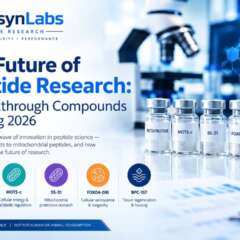
The Future of Peptide Research: 5 Breakthrough Research Compounds Shaping 2026

Table of Contents
The Future of Peptide Research Is Moving Beyond Single Targets
The future of peptide research is becoming increasingly complex.
For years, much of peptide research centered around compounds designed to influence a relatively specific biological pathway or receptor. That research remains important, but the direction of the field is changing.
Researchers are increasingly interested in compounds capable of influencing multiple biological pathways, mitochondrial function, cellular senescence, metabolic regulation, tissue-repair mechanisms, and targeted delivery systems.
This shift is visible in the types of research compounds attracting attention.
At Novasyn Labs, we have observed particularly strong interest in Retatrutide and MOTS-c, while compounds such as FOXO4-DRI generate more questions about analytical verification because of their complex sequence and synthesis considerations.
At the same time, researchers are becoming more sophisticated about quality.
A static Certificate of Analysis is no longer necessarily enough for laboratories conducting demanding analytical work. Increasingly, researchers want to examine batch-specific HPLC results, LC-MS spectra, molecular identity, storage conditions, and manufacturing information before beginning a study.
That is an important development.
The future of peptide research isn’t simply about discovering more peptides. It is also about better characterization, better reproducibility, better handling, and better understanding of what individual compounds actually do in experimental systems.
In this article, we’ll examine five compounds that illustrate where peptide research is heading in 2026:
- Retatrutide
- MOTS-c
- SS-31 (Elamipretide)
- FOXO4-DRI
- BPC-157
Research-use disclaimer: The compounds discussed in this article are presented in the context of laboratory and preclinical research. Research findings should not be interpreted as evidence of established clinical efficacy. Novasyn Labs products are intended strictly for qualified research use and are not for human or animal consumption.
5 Breakthrough Peptides Shaping Research in 2026
The five compounds represent five different directions within modern peptide science: multi-pathway metabolic signaling, mitochondrial biology, mitochondrial membrane research, cellular senescence, and tissue-repair models.

1. Retatrutide: The Multi-Pathway Metabolic Frontier
Retatrutide represents one of the clearest examples of the movement toward multi-target peptide research.
Rather than focusing on a single receptor, Retatrutide is a triple agonist involving GIP, GLP-1, and glucagon receptor signaling.
This makes it particularly interesting from a research perspective because it allows investigators to examine how simultaneous modulation of multiple metabolic pathways can influence experimental systems.
The significance goes beyond one compound.
Retatrutide illustrates a broader question at the center of the future of peptide research:
Can strategically designed multi-pathway compounds produce biological effects that cannot be adequately studied using single-target molecules?
That question is driving substantial interest in multi-agonist research.
Why researchers are watching Retatrutide
Research interest surrounding Retatrutide includes areas such as:
Metabolic signaling
Energy balance
Glucose regulation
Receptor pharmacology
Multi-agonist mechanisms
Obesity and metabolic disease research models
For peptide researchers, the compound also provides an important example of how modern peptide design is moving toward polypharmacology.
Novasyn Labs observation
Among the compounds discussed in this article, Retatrutide has generated some of the highest levels of research inquiries observed by Novasyn Labs.
That interest reflects a larger transition we’ve seen: researchers who previously focused primarily on single-pathway compounds are increasingly asking about dual- and triple-pathway candidates.
2. MOTS-c: Peptide Research Enters the Mitochondrial Era
If Retatrutide represents the multi-pathway metabolic frontier, MOTS-c represents another major direction: mitochondrial biology.
MOTS-c is a mitochondrial-derived peptide associated with research into cellular energy regulation and metabolic processes.
Its significance lies partly in where it originates.
Rather than being a conventional peptide designed solely around a classical extracellular receptor, MOTS-c belongs to an expanding area of research investigating mitochondria as sources of signaling molecules.
This has broadened the scope of peptide research.
Mitochondria were traditionally viewed primarily as cellular energy-producing organelles. Modern research increasingly examines them as dynamic signaling hubs involved in metabolism, cellular stress responses, and broader physiological regulation.
Why MOTS-c matters for the future of peptide research
MOTS-c research intersects with:
Cellular energy metabolism
Mitochondrial signaling
Metabolic regulation
Cellular stress responses
Exercise-related molecular research
Aging and longevity research models
MOTS-c is also one of the compounds generating particularly high interest among Novasyn Labs customers.
However, interest in a peptide creates another important responsibility: understanding its handling requirements.
MOTS-c and other sensitive peptides require careful attention to temperature, formulation, storage, and repeated handling.
The lesson is important:
The future of peptide research isn’t only about discovering biologically interesting molecules. It is about preserving their analytical integrity from synthesis through experimentation.
3. SS-31 (Elamipretide): Targeting the Mitochondrial Inner Membrane
SS-31, also known as Elamipretide, provides another example of the growing interest in mitochondrial research.
Unlike a general metabolic signaling approach, SS-31 has been investigated for its interactions with the inner mitochondrial membrane, including research involving mitochondrial structure, oxidative stress, and cardiolipin-associated mechanisms.
This makes SS-31 particularly interesting in experimental models focused on mitochondrial function.
Research areas associated with SS-31
Researchers have investigated SS-31 in contexts involving:
Mitochondrial membrane biology
Oxidative stress
Cellular energy systems
Mitochondrial dysfunction
Cardiovascular research models
Neurobiological research models
Its research profile demonstrates how peptide science is moving deeper into subcellular biology.
Instead of simply asking:
“Which receptor does this peptide activate?”
researchers increasingly ask:
“Where inside the cell does this molecule act, what molecular structure does it interact with, and how does that interaction affect cellular function?”
That represents a significant evolution in the future of peptide research.
4. FOXO4-DRI: Exploring Cellular Senescence
The fourth compound takes the field in another direction: cellular senescence.
FOXO4-DRI is a peptide research compound associated with experimental investigation of senescent cells and mechanisms involving FOXO4 and p53-related signaling.
It has attracted attention within the broader field of senolytic research, where scientists investigate strategies for selectively influencing or eliminating senescent cells.
Why senescence matters
Cellular senescence is a complex biological state.
Senescent cells stop proliferating but can remain metabolically active and release signaling molecules collectively associated with the senescence-associated secretory phenotype (SASP).
Understanding these cells is therefore relevant to research into:
Cellular aging
Senescence biology
Inflammation
Tissue remodeling
Aging-associated mechanisms
Senolytic strategies
FOXO4-DRI is particularly interesting because it demonstrates the expanding role of designed peptides in highly targeted cellular research.
Why analytical verification matters especially here
From our experience, FOXO4-DRI generates more questions about purity and analytical verification than many simpler peptide research compounds.
Complex peptide sequences can present additional synthesis and characterization challenges.
That is why simply seeing a high purity number on a product page shouldn’t be the end of the evaluation process.
Researchers should consider:
Does the analytical data support the stated identity?
This is where combining reverse-phase HPLC with LC-MS becomes particularly valuable.
5. BPC-157: A Widely Studied Tissue-Repair Research Model
BPC-157 represents another major branch of peptide research: tissue-repair and localized biological mechanisms.
BPC-157 has been extensively investigated in preclinical models involving tissue and gastrointestinal systems, among other research areas.
Its popularity also demonstrates an important feature of the peptide field.
Not every influential research peptide needs to be a newly discovered molecule.
Some compounds remain relevant because researchers continue investigating their mechanisms, biological interactions, and potential applications in experimental models.
Areas of research interest
BPC-157 has been investigated in preclinical contexts involving:
Tissue repair
Gastrointestinal research
Angiogenesis-related mechanisms
Inflammatory pathways
Wound-healing models
Musculoskeletal research
However, its extensive preclinical interest should not be confused with established clinical efficacy.
This distinction is essential when discussing the future of peptide research.
Promising laboratory observations are not equivalent to regulatory approval or proven therapeutic effectiveness.
5-Compound Peptide Research Matrix
The following table provides a high-level research comparison.
| Compound | Primary Research Focus | Major Research Pathways/Targets | Approx. Molecular Mass* | Research Direction |
| Retatrutide | Metabolic research | GIP / GLP-1 / glucagon receptors | ~4.8 kDa | Multi-agonist biology |
| MOTS-c | Mitochondrial & metabolic research | Mitochondrial-derived signaling | ~2.2 kDa | Cellular energy regulation |
| SS-31 | Mitochondrial research | Inner mitochondrial membrane/cardiolipin-associated mechanisms | ~0.64 kDa | Mitochondrial protection research |
| FOXO4-DRI | Senescence research | FOXO4-DRI/p53-related mechanisms | ~5 kDa | Senolytic research |
| BPC-157 | Tissue-repair research | Multiple preclinical signaling mechanisms | ~1.4 kDa | Regeneration/healing models |
*Molecular masses are approximate and can vary depending on molecular form, counterion, modification, and analytical convention. Researchers should use the batch-specific analytical documentation for definitive identity confirmation.
Key takeaway
The table reveals something important about the future of peptide research.
These compounds don’t all work through the same biological pathway.
Instead, they represent a diversification of peptide science.
Researchers are investigating molecules that interact with metabolic receptors, mitochondria, intracellular signaling networks, cellular senescence mechanisms, and tissue-repair pathways.
The Biggest Peptide Research Trends We Are Seeing in 2026
The five compounds are important individually, but the bigger story is the direction of peptide research as a whole.
At Novasyn Labs, several changes have become increasingly apparent between 2024 and 2026.
1. From Single Targets to Multi-Agonists
One of the strongest trends is movement away from exclusively single-target compounds.
Multi-agonists such as Retatrutide demonstrate the growing interest in simultaneously modulating multiple metabolic pathways.
This raises fascinating research questions around:
Synergistic signaling
Receptor cross-talk
Metabolic adaptation
Dose-response relationships
Multi-pathway pharmacology
This trend is likely to remain central to the future of peptide research.
2. Mitochondria Are Becoming a Major Research Frontier
MOTS-c and SS-31 illustrate another major shift.
Researchers are increasingly examining mitochondria not simply as energy-producing structures, but as important components of cellular signaling and stress responses.
This could expand the peptide research landscape substantially.
The next generation of mitochondrial peptides may investigate:
Energy metabolism
Oxidative stress
Mitochondrial membrane integrity
Cellular signaling
Metabolic adaptation
Aging-related cellular processes
3. Senescence Is Becoming a Major Experimental Target
The growing interest in FOXO4-DRI reflects a broader scientific fascination with senescent cells.
Rather than studying aging as one generalized process, researchers can investigate specific cellular mechanisms associated with senescence.
This opens opportunities for more targeted experimental models.
Research Quality Is Becoming Just as Important as Research Novelty
A breakthrough compound is only useful for rigorous laboratory research if researchers can confidently establish what is actually in the vial.
This is why analytical verification has become increasingly important.
At Novasyn Labs, our quality philosophy centers around a combination of:
Reverse-Phase HPLC
HPLC provides analytical information regarding peptide purity and chromatographic profile.
LC-MS
Mass spectrometry provides molecular-weight information that can support identity confirmation.
Researchers should understand the differences between HPLC and mass spectrometry for peptide testing before evaluating analytical documentation.
Batch-Level Documentation
Rather than treating a generic certificate as sufficient for every production batch, researchers increasingly want batch-specific documentation.
Lyophilization Verification
Low residual moisture and appropriate lyophilization parameters can be important for maintaining the quality of lyophilized research peptides.
Understanding why peptides are lyophilized and how freeze-drying affects stability is also important when evaluating peptide quality.
Cold-Chain Handling
Temperature-controlled packaging can help protect temperature-sensitive materials during transportation.
Inert-Gas/Vacuum Packaging
Appropriate packaging can reduce exposure to environmental factors that may affect sensitive materials.

Case Study 1: Why LC-MS Can Reveal What a Purity Number Cannot
A research laboratory encountered an unexpected chromatography peak in a batch purchased from another supplier.
At first glance, the material appeared to meet the supplier’s advertised purity specification.
However, the unexpected peak raised questions about the identity and composition of the material.
An independent LC-MS analysis was subsequently performed.
The analysis supported the presence of a sequence deletion, providing an explanation for the unexpected chromatographic behavior.
The laboratory subsequently moved to a 98%+ Novasyn Labs batch and observed restoration of baseline protocol reproducibility.
The lesson
This case demonstrates why researchers shouldn’t evaluate peptide quality using a single number.
A stated purity percentage can be useful, but purity and identity are different analytical questions.
HPLC can help answer:
“How clean does this sample appear chromatographically?”
LC-MS helps investigate:
“Does the measured molecular mass support the expected molecular identity?”
For demanding research, both pieces of information can matter.
Case Study 2: Freeze-Thaw Cycles and Peptide Stability
A research partner encountered precipitation in a reconstituted peptide preparation following repeated freeze-thaw cycles.
Rather than repeatedly freezing and thawing the same preparation, the laboratory changed its handling protocol.
The research team introduced single-use aliquots and maintained the material under controlled low-temperature storage.
The change resolved the observed stability issue.
The lesson
Researchers sometimes focus heavily on the quality of the original lyophilized powder while overlooking what happens after reconstitution.
Reconstituted peptides can have different stability characteristics from their lyophilized counterparts.
Repeated temperature cycling can therefore introduce avoidable variables into an experiment.
Good experimental practice should consider the entire lifecycle:
Synthesis → Testing → Lyophilization → Shipping → Storage → Reconstitution → Experimental handling
4 Common Mistakes That Can Undermine Peptide Research
Even high-quality research material can become problematic when handled incorrectly.
Mistake 1: Trusting the Purity Number Alone
A product advertised as “98% pure” isn’t necessarily enough information for rigorous research.
Researchers should also consider:
Batch-specific HPLC data
LC-MS identity data
COA availability
Batch number
Manufacturing documentation
Mistake 2: Repeated Freeze-Thaw Cycles
Repeated freezing and thawing can introduce unnecessary stress to reconstituted peptide preparations.
A carefully designed aliquoting strategy can reduce repeated temperature cycling.
Mistake 3: Using an Inappropriate Diluent
The choice of reconstitution medium should be determined by the specific research protocol and compound characteristics.
Researchers should avoid assuming that every peptide behaves identically.
Important considerations can include:
pH
formulation
sterility requirements
intended experimental duration
compatibility with the research system
Mistake 4: Improper Post-Reconstitution Storage
Leaving reconstituted research material at inappropriate temperatures or exposing sensitive compounds to direct light can potentially compromise experimental consistency.
Storage conditions should therefore be established as part of the experimental protocol rather than treated as an afterthought.
Researchers should also follow established principles for proper peptide storage and handling, particularly after reconstitution.
What Will the Future of Peptide Research Look Like From 2026 to 2030?
The five compounds discussed here may represent only the beginning.

Several emerging technologies could reshape peptide science over the next several years.
1. Peptide-Drug Conjugates
Peptide-drug conjugates (PDCs) could become an important area of targeted delivery research.
The underlying concept is to use peptide-based targeting mechanisms to influence where a molecular payload is delivered.
This could potentially provide researchers with more sophisticated tools for studying tissue- or cell-specific delivery.
2. Multi-Pathway Combinations
Another fascinating direction is the study of complementary biological mechanisms.
For example, researchers may increasingly investigate experimental combinations involving:
Senescence biology + mitochondrial biology
rather than studying each pathway independently.
This doesn’t mean that combinations are automatically better.
It means researchers can ask more sophisticated questions about pathway interaction and biological synergy.
3. Oral and Non-Invasive Peptide Delivery
One of the longstanding challenges in peptide science is delivery.
Many peptides face significant barriers involving:
- Stability
- Enzymatic degradation
- Absorption
- Bioavailability
- Formulation
Consequently, research into oral and other non-injectable delivery platforms remains highly significant.
4. Lipid Nanoparticle and Advanced Encapsulation Technologies
Advanced delivery technologies, including lipid-based nanoparticles and other encapsulation systems, could further expand how researchers investigate peptide delivery.
The future may therefore involve not simply:
“Which peptide should we study?”
but:
“Which peptide, delivery system, target and biological pathway should we study together?”
Why Analytical Rigor Will Define the Next Generation of Peptide Research
There is another trend that may be less exciting than discovering a new peptide—but arguably just as important.
Reproducibility.
As peptide research becomes more sophisticated, laboratories need greater confidence that experimental differences are actually caused by biological variables rather than inconsistencies in the research material.
This makes analytical characterization increasingly important.
A laboratory investigating a novel compound should be able to ask:
- Is the peptide actually the expected molecular species?
- Does the LC-MS result support the expected mass?
- Does the HPLC profile match expectations?
- Is the batch properly documented?
- How was the material lyophilized?
- How was it transported?
- How was it stored?
- What happened after reconstitution?
These questions represent the more mature side of the future of peptide research.
Novasyn Labs: Research Peptides Built Around Analytical Verification
At Novasyn Labs, our approach is centered around research-grade peptide synthesis and analytical verification.
Our quality framework emphasizes:
≥98% purity
combined with:
Reverse-phase HPLC + LC-MS analytical verification
and:
Batch-level documentation and COAs.
We also emphasize controlled lyophilization, protective packaging, and temperature-conscious shipping for research materials where handling requirements make this appropriate.
For laboratories working with emerging peptide compounds, the objective isn’t simply to provide a powder labeled with a compound name.
The objective is to provide researchers with better analytical information about the material they’re working with.
That distinction becomes increasingly important as peptide research moves into more complex biological territory.
The Future of Peptide Research Is Bigger Than the Next “Popular Peptide”
The peptide field is entering an interesting period.
Retatrutide demonstrates the movement toward multi-agonist metabolic research.
MOTS-c and SS-31 demonstrate the growing importance of mitochondrial biology.
FOXO4-DRI highlights the emerging significance of cellular senescence research.
BPC-157 demonstrates the continued importance of tissue-repair and regeneration models.
But the most important development may not be any single compound.
It is the convergence of several trends:
Multi-pathway signaling + mitochondrial biology + cellular senescence + targeted delivery + advanced analytical verification.
That combination could define the next phase of peptide science.
For researchers, however, enthusiasm needs to be matched by rigor.
Emerging peptides can be scientifically interesting without being clinically established. Preclinical observations are not equivalent to approved therapies. And an advertised purity number is not a substitute for appropriate analytical characterization.
The future of peptide research will therefore depend not only on discovering more sophisticated molecules, but also on developing better methods to identify, characterize, preserve, deliver, and reproducibly study them.
For laboratories entering this field in 2026, that may be the most important breakthrough of all.
Frequently Asked Questions
What is the future of peptide research in 2026?
The future of peptide research is increasingly focused on multi-agonists, mitochondrial peptides, cellular senescence, targeted delivery, advanced peptide engineering, and improved analytical characterization.
Which peptides are attracting research interest in 2026?
Retatrutide, MOTS-c, SS-31, FOXO4-DRI, and BPC-157 represent five distinct areas of peptide research attracting significant scientific interest. Research interest and clinical validation are separate issues, however.
Why is Retatrutide important to peptide research?
Retatrutide is a triple agonist involving GIP, GLP-1, and glucagon receptor signaling. It provides researchers with an important model for investigating multi-pathway metabolic signaling.
Why are mitochondrial peptides becoming important?
Mitochondrial peptides such as MOTS-c and SS-31 allow researchers to investigate biological processes involving mitochondrial signaling, energy metabolism, membrane biology, and cellular stress.
Why is LC-MS important for peptide research?
LC-MS can provide molecular-mass information that supports peptide identity assessment. When combined with HPLC, it provides complementary analytical information useful for evaluating research materials.
Are these peptides approved treatments?
The compounds discussed in this article should not be treated as established therapies simply because they are being investigated in research. Their scientific evidence, regulatory status, and clinical applicability vary considerably.
Are Novasyn Labs peptides for human use?
No. Novasyn Labs research peptides are supplied for Research Use Only (RUO) and are not intended for human or animal consumption.
External References

