



No products in the cart.
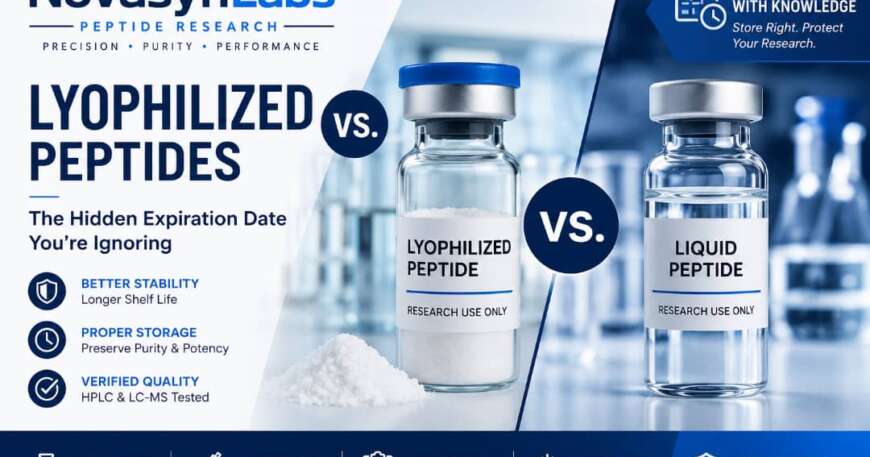
Lyophilized vs. Liquid Peptides: The Hidden Expiration Date You’re Ignoring

Table of Contents
Lyophilized vs. Liquid Peptides: The Hidden Expiration Date You’re Ignoring
Research Use Only (RUO): This article discusses peptide stability, storage, and analytical quality for laboratory research purposes only. Novasynlabs products are intended strictly for research use and are not intended for human or veterinary use.
Many researchers assume the expiration date printed on a peptide vial tells the entire story.
It doesn’t.
The biggest mistake we see isn’t buying an old batch—it’s treating a freshly reconstituted peptide as though it still has years of stability left.
After supplying high-purity research peptides for over 8 years, serving 50,000+ research customers and institutional orders worldwide, one pattern appears repeatedly: the real stability clock changes the moment a lyophilized peptide is exposed to moisture or reconstituted into solution.
That’s the hidden expiration date most researchers overlook.
In this guide, you’ll learn:
- The difference between lyophilized vs liquid peptides
- How long lyophilized peptides last
- Why reconstituted peptides degrade faster
- Proper peptide storage guidelines
- The seven storage mistakes that silently reduce stability
- Real Novasynlabs case studies showing how storage affects analytical purity
Lyophilized vs. Liquid Peptides: What’s Actually Different?
The biggest distinction isn’t simply powder versus liquid.
It’s water.
Lyophilized peptides undergo freeze-drying, where water is removed through sublimation under vacuum. Liquid peptides already contain water, creating an environment where degradation processes can occur much more readily.

Quick Comparison
| Feature | Lyophilized Peptides | Liquid Peptides |
|---|---|---|
| Physical Form | Freeze-dried powder | Peptide solution |
| Water Present | No | Yes |
| Long-Term Stability | Excellent | Limited |
| Contamination Risk | Low while sealed | Higher after opening |
| Shipping Stability | Strong | More temperature-sensitive |
| Moisture Sensitivity | High before opening | Less relevant after dissolution |
| Freeze/Thaw Sensitivity | Lower | Higher |
| Long-Term Storage | Deep freezer preferred | Generally not recommended |
For most research laboratories, lyophilized peptides offer significantly greater storage flexibility, while liquid peptides demand much stricter environmental control.
Why Lyophilization Improves Peptide Stability
Lyophilization isn’t simply drying.
It’s a carefully controlled preservation process designed to protect delicate molecular structures.

The Process
- Freezing – The peptide solution is frozen.
- Vacuum Application – Pressure is dramatically reduced.
- Sublimation – Ice converts directly into vapor.
- Secondary Drying – Residual moisture is minimized.
- Sealed Storage – The vial remains protected from environmental moisture.
Removing water helps suppress many degradation pathways that become more active in solution, including hydrolysis.
Why Water Matters
Water seems harmless.
For peptides, it’s one of the biggest variables affecting long-term stability.
Once moisture enters the system, several risks increase:
- Hydrolysis
- Oxidation
- Aggregation
- Contamination opportunities
- Reduced analytical purity over time
This is why unopened lyophilized peptides generally maintain their quality far longer than reconstituted solutions.
The Hidden Expiration Date: When the Clock Really Starts
Here’s the central idea.
The printed expiration date primarily applies to an unopened lyophilized vial stored under appropriate conditions.
A second timeline begins much earlier than many researchers realize.

The Hidden Stability Timeline
Manufacturing
↓
Quality Testing (HPLC & LC-MS)
↓
Lyophilization
↓
Sealed Storage
↓
Vial Opened
↓
Reconstitution
↓
Environmental Exposure
↓
Accelerated Stability Changes
Several events can start shortening practical stability:
- Breaking the vacuum seal
- Atmospheric moisture entering the vial
- Adding diluent
- Temperature fluctuations
- Light exposure
- Handling contamination
Think of the printed expiration date as the factory timeline.
The hidden expiration date becomes the handling timeline.
How Long Do Lyophilized Peptides Last?
One of the most common questions researchers ask is:
How long do lyophilized peptides last?
The answer depends primarily on storage conditions.
Novasynlabs Operational Storage Guidance
| Storage Condition | Expected Stability Guidance |
|---|---|
| -20°C to -80°C | Approximately 2–5 years |
| 2°C to 8°C | Around 12–24 months |
| 15°C to 25°C | Short handling/shipping periods |
These observations reflect properly manufactured, sealed, high-purity research peptides stored under controlled conditions.
Why Deep Freezing Matters
Deep freezing dramatically slows chemical activity.
More importantly, maintaining consistent temperatures matters as much as the temperature itself.
Repeated warming and cooling introduce additional stress that laboratories should minimize whenever possible.
How Long Do Liquid Peptides Last?
Liquid peptides exist in a completely different stability environment.
Once dissolved, degradation processes become much more active.
Refrigerated Liquid Stability
| Condition | Practical Guidance |
|---|---|
| Refrigerated (2–8°C) | Approximately 14–28 days |
| Room Temperature | Significantly shorter depending on peptide |
Certain peptides demonstrate greater sensitivity than others.
Examples include:
- Semaglutide
- Tirzepatide
- Retatrutide
- MOTS-c
- SS-31
These sequences deserve particularly careful handling once reconstituted.
Why Bacteriostatic Water Matters
For multi-dose laboratory handling, many researchers prefer bacteriostatic water because it contains 0.9% benzyl alcohol, which helps reduce microbial growth during repeated access.
Sterile Water for Injection (SWFI), by comparison, lacks this preservative and is generally treated differently in laboratory handling protocols.
The Ultimate Peptide Storage Matrix
Proper peptide storage isn’t complicated—but consistency matters.

| Storage Phase | Lyophilized | Reconstituted |
|---|---|---|
| Long-Term | -20°C to -80°C | Generally not preferred |
| Short-Term | 2°C to 8°C | 2°C to 8°C |
| Handling | Brief room-temperature acclimation | Minimize room-temperature exposure |
Four Essential Protection Rules
Always protect peptides from:
- Moisture
- UV light
- Temperature fluctuations
- Unnecessary freeze/thaw cycling
These four variables influence practical stability more than many researchers expect.
Seven Storage Mistakes That Can Shorten Peptide Shelf Life
Many peptide failures don’t begin in manufacturing.
They begin during routine handling.

1. Opening Cold Vials Immediately
Cold glass attracts condensation.
Allowing the vial to reach room temperature before opening helps reduce moisture entering the vial.
2. Reconstituting Everything at Once
Many researchers prepare multiple vials simultaneously.
Instead, reconstituting only what is needed reduces unnecessary exposure time.
3. Repeated Freeze/Thaw Cycling
Repeated freezing and thawing of liquid peptides can promote physical and chemical instability.
Avoid unnecessary cycling whenever possible.
4. Vigorous Shaking
Peptides aren’t cocktails.
Aggressive shaking can increase foaming and aggregation.
Gentle swirling is generally preferred.
5. Choosing the Wrong Diluent
Using inappropriate diluents for repeated laboratory handling can introduce unnecessary complications.
Follow validated laboratory protocols.
6. Using Frost-Free Freezers
Auto-defrost freezers periodically warm contents.
Those temperature cycles matter.
Manual-defrost freezers provide a more consistent environment.
7. Ignoring Light Exposure
Copper-binding peptides like GHK-Cu deserve extra attention because light exposure can affect stability.
Peptide-by-Peptide Storage Considerations
Not every peptide behaves the same.
BPC-157
- Strong long-term lyophilized stability
- Excellent candidate for proper frozen storage
TB-500
- Stable when stored correctly
- Avoid unnecessary environmental exposure after reconstitution
Semaglutide
- More sensitive after reconstitution
- Minimize repeated temperature excursions
Tirzepatide
- Refrigeration consistency matters
- Limit prolonged room-temperature exposure
Retatrutide
- Particularly important to maintain controlled handling conditions
GHK-Cu
- Light-sensitive
- Prefer amber or protected storage
MOTS-c
- Greater liquid sensitivity
- Avoid unnecessary handling delays
SS-31
- Benefits from careful refrigerated handling after reconstitution
CJC-1295 / Ipamorelin
- Follow strict cold-chain handling
Tesamorelin
- Consistent refrigerated storage helps maintain handling quality
Case Study: BPC-157 After 36 Months
One of the clearest examples of proper storage came from long-term monitoring of a sealed lyophilized batch.
Conditions
- Storage: -20°C
- Duration: 36 months
- Initial HPLC purity: 99.5%
Results
Retesting showed:
- HPLC purity: 99.2%
The decrease remained minimal.
Lesson
Proper deep-freeze storage can preserve analytical quality remarkably well when the cold chain remains intact.
Case Study: Semaglutide’s Hidden Expiration Clock
This second example illustrates why refrigeration alone isn’t enough.
Conditions
- Reconstituted with bacteriostatic water
- Stored at approximately 4°C
- Removed daily for extended room-temperature exposure
After 21 Days
Observed HPLC purity changed from:
- 99.1%
- to 84.3%
The repeated temperature excursions appeared far more significant than many researchers would expect.
The Lesson
Refrigeration cannot completely offset repeated environmental stress.
Consistency matters.
How Novasynlabs Verifies Peptide Quality
Before discussing storage, it’s important to understand how quality is established.
HPLC Purity Testing
High-Performance Liquid Chromatography verifies purity by separating molecular components.
This allows laboratories to detect impurities and monitor analytical quality.
LC-MS Identity Confirmation
Liquid Chromatography-Mass Spectrometry confirms molecular identity by verifying expected molecular mass.
Together, these methods create a much stronger quality verification process than visual inspection alone.
Every Batch Includes
- Third-party COAs
- Batch/Lot numbers
- HPLC purity verification
- LC-MS identity confirmation
- Minimum 98% purity benchmark
This analytical documentation helps researchers evaluate quality before storage even begins.
Visual vs. Analytical Signs of Degradation
Many researchers rely only on appearance.
Appearance helps—but laboratory analysis remains the definitive method.
Visual Red Flags
Lyophilized
- Collapsed cake
- Sticky texture
- Unexpected discoloration
Liquid
- Cloudiness
- Persistent particulates
- Surface film
- Color changes
Definitive Laboratory Indicators
Analytical confirmation may include:
- Additional HPLC peaks
- LC-MS molecular shifts
- Unexpected chromatographic changes
Visual inspection alone cannot confirm purity.
Proper Reconstitution Workflow
A consistent workflow reduces unnecessary exposure.
Recommended Laboratory Workflow
- Remove the lyophilized vial from cold storage.
- Allow it to reach room temperature before opening.
- Prepare a clean work surface.
- Use the appropriate validated laboratory diluent.
- Add the diluent slowly.
- Gently swirl.
- Refrigerate promptly.
- Minimize repeated room-temperature exposure.
This simple sequence helps reduce several common handling errors.
Pro Insight from the Novasynlabs QC Lab
After supporting 50,000+ research customers across North America, Europe, Australia, and the UK, one observation stands out:
The printed expiration date is only one part of the stability story. Once a lyophilized peptide is exposed to moisture or reconstituted into solution, researchers are working within an entirely different handling timeline.
This perspective has shaped our emphasis on:
- cold-chain consistency
- third-party analytical verification
- moisture protection
- proper storage education
Frequently Asked Questions
Are lyophilized peptides more stable than liquid peptides?
Generally, yes. Removing water typically improves long-term storage stability compared with reconstituted solutions.
How long do lyophilized peptides last?
Under properly maintained frozen conditions, many research peptides can remain stable for years, while refrigerated storage generally supports shorter storage windows.
Does reconstitution start a new expiration clock?
Practically speaking, yes. Reconstitution changes the peptide’s stability profile because the molecule is now in solution.
Can peptides stay at room temperature?
Brief handling periods are generally different from long-term storage. Researchers should minimize unnecessary room-temperature exposure.
Can light damage peptides?
Certain peptides—particularly copper-binding peptides like GHK-Cu—deserve extra protection from light exposure.
Why shouldn’t liquid peptides be repeatedly frozen and thawed?
Repeated freeze/thaw cycling can promote physical and chemical instability that researchers generally try to avoid.
How can researchers verify peptide quality?
Analytical methods such as HPLC and LC-MS provide much stronger confirmation than appearance alone.
The Real Takeaway: Don’t Ignore the Hidden Expiration Date
The biggest lesson from comparing lyophilized vs. liquid peptides isn’t simply that powder lasts longer.
It’s understanding when the stability clock changes.
A properly manufactured, unopened lyophilized peptide stored under appropriate conditions can maintain exceptional analytical quality for extended periods. Once moisture enters the vial, however, researchers should treat the material according to its new handling and storage profile rather than relying solely on the printed label date.
For laboratories that prioritize analytical quality, consistency matters more than shortcuts.
Why Researchers Choose Novasynlabs
For over 8 years, Novasynlabs has supplied high-purity research peptides to 50,000+ research customers and institutional orders worldwide, with distribution across the United States, Europe, Canada, Australia, and the UK.
Every batch is supported by:
- Third-party Certificates of Analysis
- HPLC purity verification
- LC-MS identity confirmation
- Matching Batch/Lot Numbers
- Minimum 98% analytical purity benchmark
If you’re evaluating research-grade peptides, explore the Novasynlabs batch-tested COA database and product pages to review analytical documentation before selecting your next research material.
External References

