





No products in the cart.

How Do I Track My Peptide Results and Progress?

Table of Contents
Introduction
Whether studying recovery peptides, longevity peptides, GLP-1 peptides, growth hormone secretagogues, mitochondrial peptides, or cosmetic peptides, one question consistently arises among researchers:
“How do I track my peptide results and progress?”
The answer extends far beyond simply observing the final outcome of an experiment. Reliable peptide research depends on systematic documentation, standardized laboratory procedures, careful record keeping, and objective data collection over time.
Researchers today are generating increasingly complex datasets involving biomarkers, cellular signaling pathways, mitochondrial function, metabolic activity, tissue repair mechanisms, and molecular interactions. Without a structured tracking system, even well-designed experiments can become difficult to reproduce or compare across studies.
At NovaSyn Labs, we have supplied laboratory-grade research peptides since 2000. Over the years, we’ve observed that laboratories producing the most reproducible data share several common practices:
- Standardized data collection
- Consistent peptide storage
- Careful documentation
- Batch traceability
- Routine review of analytical documentation
- Strict adherence to laboratory protocols
While peptide quality is only one component of successful research, maintaining complete experimental records helps scientists interpret results with greater confidence and identify variables that may influence outcomes.
This guide explains how researchers can build an effective peptide tracking workflow while highlighting the importance of quality assurance, proper storage, and standardized documentation.
Why Tracking Peptide Progress Is Essential
Every peptide experiment generates valuable information.
Researchers commonly monitor:
- Experimental conditions
- Biomarker changes
- Time-course observations
- Cellular responses
- Storage history
- Analytical verification
- Laboratory variables
- Sample integrity
Without organized documentation, important details can easily be overlooked, making it difficult to determine why two seemingly identical experiments produce different results.
Tracking enables researchers to:
- Compare experiments over time
- Improve reproducibility
- Identify procedural differences
- Maintain sample traceability
- Simplify troubleshooting
- Strengthen data interpretation
Rather than focusing only on final outcomes, experienced laboratories evaluate the entire experimental process from peptide receipt through data analysis.
Common Misconceptions About Tracking Peptide Results
Several misconceptions can reduce research quality.
Myth 1: Results Should Appear Immediately
Different peptides influence different biological pathways.
Some experiments evaluate:
- Acute cellular responses
- Long-term molecular adaptations
- Gene expression
- Protein synthesis
- Mitochondrial activity
- Tissue remodeling
Observation timelines depend entirely on study design and experimental objectives.
Myth 2: Every Peptide Produces Measurable Changes at the Same Rate
Recovery peptides, metabolic peptides, longevity peptides, and mitochondrial peptides all have distinct mechanisms under investigation.
Because these biological targets differ, researchers should avoid expecting identical timelines across peptide classes.
Myth 3: Only Final Results Matter
Experienced laboratories understand that every stage of an experiment contributes valuable information.
Intermediate observations may include:
- Cell viability
- Assay performance
- Biomarker trends
- Sample stability
- Instrument calibration
- Storage conditions
Monitoring these variables often provides insights that final measurements alone cannot.
Myth 4: Documentation Isn’t Necessary
Documentation is one of the foundations of reproducible science.
Accurate records help laboratories:
- Repeat experiments
- Compare datasets
- Identify unexpected variables
- Train new researchers
- Maintain regulatory compliance where applicable
Incomplete records can make troubleshooting significantly more difficult.
Myth 5: Storage Conditions Don’t Affect Reproducibility
Peptide stability depends on proper handling.
Researchers commonly document:
- Storage temperature
- Reconstitution date
- Freeze-thaw history
- Moisture exposure
- Light exposure
- Expiration date
These details can become important when interpreting experimental variability.
What Should Researchers Track?
A comprehensive tracking system often includes far more than experimental outcomes.
Researchers may record:
Peptide Information
- Product name
- Batch number
- Lot number
- Purity
- Certificate of Analysis
- HPLC results
- Mass Spectrometry verification
Storage Information
- Date received
- Storage temperature
- Reconstitution date
- Buffer used
- Aliquot preparation
- Freeze-thaw cycles
Experimental Information
- Study objective
- Cell line or model
- Incubation time
- Dose
- Experimental endpoint
- Instrument settings
- Laboratory technician
- Observation dates
Analytical Information
- Biomarker measurements
- Statistical analysis
- Chromatography results
- Microscopy observations
- Image analysis
- Raw data files
Keeping these details organized allows researchers to compare experiments with greater accuracy.
Table: Why Researchers Track Peptide Studies
| Tracking Element | Why It Matters |
| Batch Number | Identifies the specific peptide batch used in each experiment. |
| Certificate of Analysis | Confirms purity and analytical testing results. |
| HPLC Data | Verifies peptide purity. |
| Mass Spectrometry | Confirms molecular identity. |
| Storage Temperature | Helps maintain peptide stability. |
| Freeze-Thaw Cycles | Supports sample integrity by documenting handling history. |
| Experimental Conditions | Enables accurate replication of studies. |
| Biomarkers | Provides objective measurements of biological responses. |
| Time-Course Data | Shows how observations change throughout the study. |
| Laboratory Notes | Documents unexpected observations and procedural details. |
NovaSyn Labs Quality Practices That Support Reliable Research
Although no supplier can guarantee specific experimental outcomes, providing well-characterized research materials helps laboratories begin with greater confidence.
NovaSyn Labs supports researchers through:
- ≥98% peptide purity
- Batch-specific Certificates of Analysis
- High-Performance Liquid Chromatography (HPLC) testing
- Mass Spectrometry verification
- Cold-chain shipping where appropriate
- Proper storage recommendations
- Standardized quality documentation
These quality practices help researchers maintain traceability from peptide receipt through experimental analysis.
What You’ll Learn in This Guide
In the remaining sections, we’ll cover:
- Which laboratory variables should be documented
- How biomarkers help researchers evaluate progress
- Objective vs subjective measurements
- Time-course studies
- Dose-response relationships
- Laboratory record-keeping systems
- Two real-world anonymous case studies
- Best practices for improving reproducibility
- Common tracking mistakes to avoid
- Practical documentation checklists
- Frequently asked questions
- Scientific references and downloadable infographic ideas
By the end of this guide, you’ll have a structured framework for tracking peptide research in a way that supports consistency, transparency, and reproducibility.
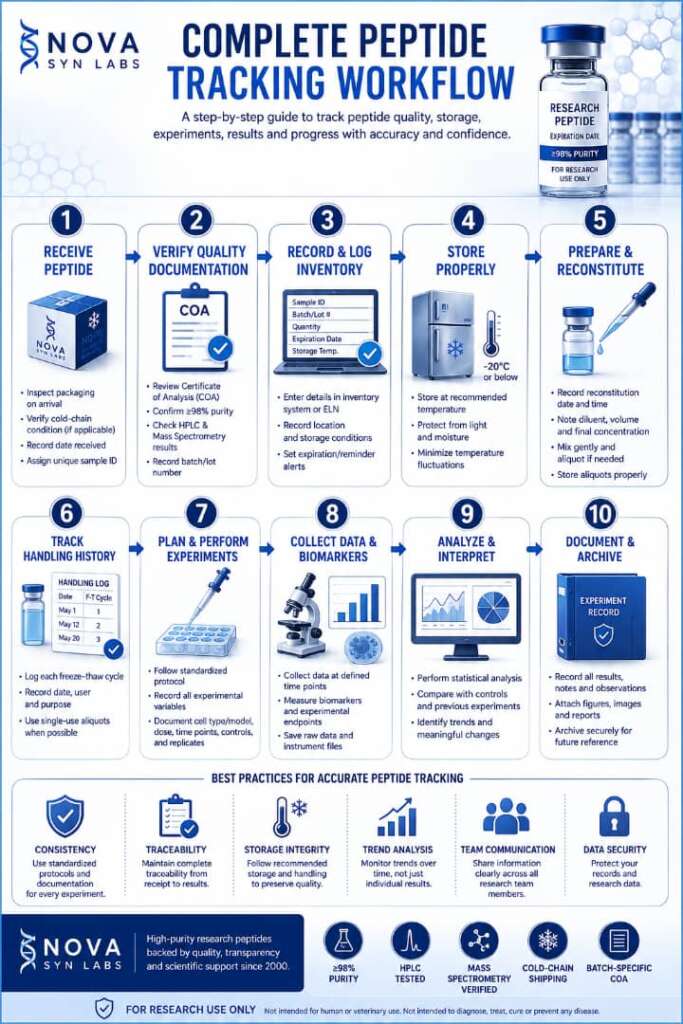
Start with Complete Peptide Identification
Every experiment should begin with accurate identification of the research peptide being used.
Even when laboratories purchase from the same supplier, different production batches may have unique lot numbers and accompanying analytical documentation. Recording this information allows researchers to trace experimental materials if questions arise later.
Researchers commonly record:
- Peptide name
- Peptide category
- Manufacturer or supplier
- Batch number
- Lot number
- Date received
- Expiration or recommended use date
- Storage recommendations
Keeping these identifiers organized makes long-term studies significantly easier to review.
Review the Certificate of Analysis (COA)
A Certificate of Analysis (COA) provides important quality information for each peptide batch.
Researchers should review the COA before beginning experiments rather than assuming every batch is identical.
Typical information includes:
- Batch number
- Purity
- Molecular weight
- Analytical methods
- HPLC chromatogram
- Mass Spectrometry verification
- Manufacturing date
At NovaSyn Labs, every batch is accompanied by a batch-specific Certificate of Analysis, helping laboratories verify the identity and analytical characteristics of the peptide they receive.
Record Peptide Purity
Peptide purity is one variable that may influence research consistency.
Rather than simply recording the peptide name, laboratories often document:
| Record | Example |
| Peptide | SS-31 |
| Purity | ≥98% |
| Analytical Method | HPLC |
| Identity Confirmation | Mass Spectrometry |
| COA Reviewed | Yes |
on Mass Spectrometry
Recording purity allows researchers to compare experiments performed with different peptide batches.
Document Storage Conditions
Storage history should accompany every peptide sample.
Researchers frequently document:
- Storage temperature
- Refrigerator or freezer location
- Date stored
- Date removed
- Exposure to room temperature
- Moisture exposure
- Light exposure (where applicable)
Storage documentation becomes particularly valuable during long-term projects involving multiple investigators.
Monitor Freeze-Thaw Cycles
Repeated freeze-thaw cycles may influence peptide stability over time.
Many laboratories maintain a simple tracking log.
Examplee
| Date | Researcher | Freeze-Thaw Cycle |
| May 3 | Researcher A | 1 |
| May 10 | Researcher B | 2 |
| May 17 | Researcher C | 3 |
Preparing single-use aliquots can help minimize unnecessary handling and preserve sample integrity.
Record Reconstitution Details
For lyophilized peptides, documentation should include preparation information.
Researchers often record:
- Reconstitution date
- Diluent used
- Buffer composition
- Final concentration
- Mixing procedure
- Storage after preparation
Consistent preparation methods help reduce avoidable variability between experiments.
Biomarkers: Measuring Objective Changes
Biomarkers provide measurable indicators of biological activity and allow researchers to compare results objectively over time.
The biomarkers monitored depend on the study objective and peptide under investigation.
Examples by Research Area
| Research Area | Common Biomarkers |
| Cellular metabolism | ATP production, glucose utilization |
| Oxidative stress | Reactive oxygen species (ROS), antioxidant enzyme activity |
| Mitochondrial research | Membrane potential, oxygen consumption rate |
| Inflammation research | Cytokine profiles, inflammatory mediators |
| Tissue repair | Growth factor expression, collagen synthesis |
| Healthy aging | Senescence-associated markers, DNA damage indicators |
Objective biomarker data often provides stronger evidence than subjective observations alone.
Experimental Endpoints
Every study should define its primary endpoints before experiments begin.
Examples include:
- Cell viability
- Protein expression
- Gene expression
- Enzyme activity
- Mitochondrial function
- Cellular proliferation
- Histological analysis
- Microscopy findings
Clearly defined endpoints improve consistency across repeat experiments.
Time-Course Studies
Many peptide studies involve monitoring biological responses over multiple time points rather than relying on a single observation.
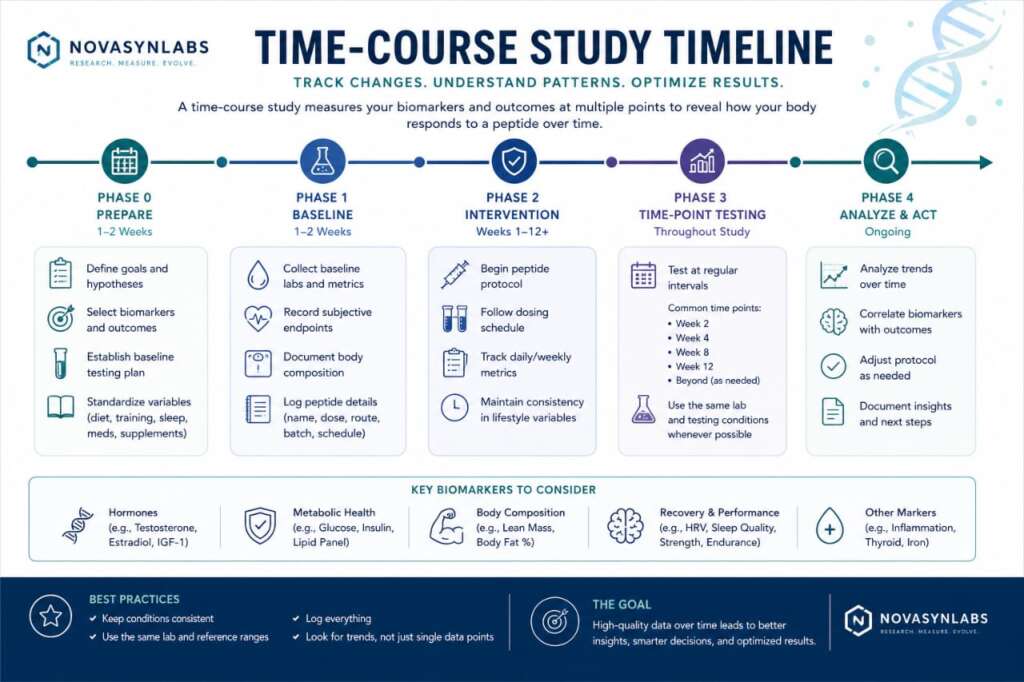
For example:
| Time Point | Measurements |
| Baseline | Biomarkers, controls |
| 24 Hours | Initial response |
| 72 Hours | Intermediate observations |
| 1 Week | Trend analysis |
| 2 Weeks | Long-term comparison |
Time-course studies help researchers identify patterns that isolated measurements may miss.
Dose-Response Relationships
One objective of many peptide studies is understanding how biological responses vary under different experimental conditions.
Researchers commonly compare:
- Different experimental concentrations
- Multiple observation periods
- Biological replicates
- Independent experiments
Carefully documenting these variables helps support accurate interpretation of dose-response trends.
Objective vs Subjective Measurements
Objective measurements generally provide quantifiable data, while subjective observations may offer useful context.
| Objective Measurements | Subjective Observation |
| Biomarker concentrations | Visual appearance |
| ATP production | General observations |
| Gene expression | Behavioral notes (where applicable) |
| Protein analysis | Researcher comments |
| Microscopy measurements | Descriptive laboratory notes |
Both forms of documentation can be valuable when interpreted appropriately.
Qualitative vs Quantitative Data
Researchers benefit from recording both descriptive observations and numerical measurements.
| Qualitative Data | Quantitative Data |
| Cell morphology | Cell counts |
| Microscopy images | Protein concentration |
| Sample appearance | Fluorescence intensity |
| Histological observations | Enzyme activity |
| Laboratory notes | Statistical measurements |
Combining qualitative and quantitative data provides a more comprehensive understanding of experimental outcomes.
Different Peptide Categories and Commonly Monitored Outcomes
Different peptide classes are studied for different research objectives.
| Peptide Category | Commonly Monitored Outcomes |
| GLP-1 peptides | Glucose metabolism, insulin signaling, metabolic biomarkers |
| Recovery peptides | Tissue regeneration markers, inflammation-related biomarkers |
| Mitochondrial peptides | ATP production, Oxidative phosphorylation, mitochondrial membrane potential |
| Longevity peptides | Cellular senescence markers, DNA damage responses, autophagy-related pathways |
| Cosmetic peptides | Collagen synthesis, extracellular matrix proteins, skin-related biomarkers |
| Growth hormone secretagogues | Growth hormone signaling, IGF-related biomarkers, protein synthesis |
Monitoring outcomes should always align with the specific research objectives of the study.
Key Takeaways
Reliable peptide tracking involves far more than recording the final experimental result. Comprehensive documentation—including peptide identity, batch information, COAs, storage conditions, reconstitution methods, biomarkers, experimental endpoints, and time-course observations—provides the foundation for reproducible laboratory research.
By systematically collecting these data throughout a study, researchers can better compare experiments, identify sources of variability, and strengthen confidence in their findings.
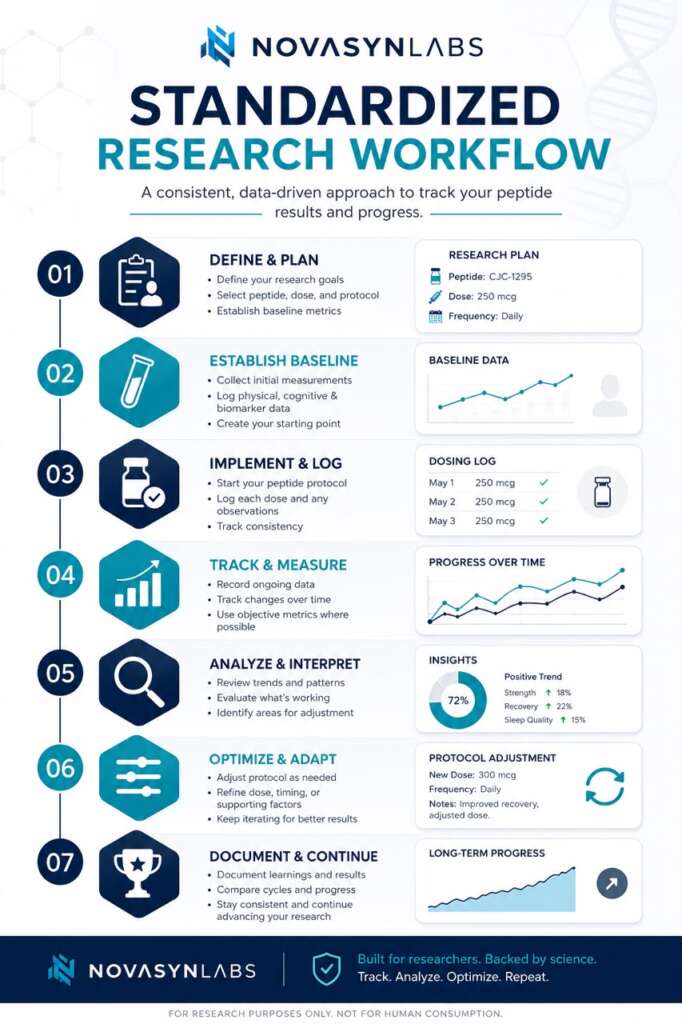
Develop a Standardized Documentation System
One of the defining characteristics of highly reproducible laboratories is consistency in documentation.
Rather than allowing each researcher to develop their own recording method, many laboratories use standardized templates that ensure the same information is captured for every experiment.
A standardized record may include:
- Experiment identification number
- Research objective
- Peptide name
- Batch number
- Certificate of Analysis reference
- Storage conditions
- Reconstitution details
- Experimental protocol
- Instrument settings
- Observation schedule
- Biomarker measurements
- Statistical analysis
- Final conclusions
Using the same format across projects makes it much easier to compare experiments conducted months—or even years—apart.
Record Every Variable That Could Influence Results
Researchers often focus on the peptide itself while overlooking procedural variables that may influence experimental outcomes.
Examples include:
- Storage temperature
- Laboratory humidity (where relevant)
- Buffer composition
- Incubation time
- Cell passage number
- Instrument calibration
- Sample preparation methods
- Timing of observations
Documenting these variables helps identify subtle procedural differences when experiments produce unexpected results.
Avoid Changing Multiple Variables Simultaneously
Changing several experimental conditions at once can make it difficult to determine which factor influenced the outcome.
For example, altering the:
- peptide concentration,
- incubation period,
- storage method,
- and assay protocol
within the same experiment makes interpretation considerably more challenging.
Instead, researchers often adjust one variable at a time while keeping all other conditions as consistent as possible.
Use Digital Laboratory Records
While traditional laboratory notebooks remain valuable, many research groups now supplement them with electronic laboratory notebooks (ELNs) or digital databases.
Digital systems make it easier to:
- Search historical experiments
- Compare datasets
- Attach chromatography reports
- Store microscopy images
- Record instrument settings
- Track peptide inventory
- Maintain version history
- Share data among research teams
The goal is not simply convenience, but improved traceability and collaboration.
Analyze Trends Instead of Individual Results
A single experiment rarely provides a complete picture.
Researchers gain greater insight by examining trends across multiple experiments.
Examples include:
- Biomarker changes over time
- Consistency between biological replicates
- Batch-to-batch comparisons
- Time-course observations
- Dose-response relationships
Trend analysis helps distinguish meaningful patterns from normal experimental variability.
Table: Isolated Results vs Trend Analysis
| Single Observation | Trend Analysis |
| One experiment | Multiple independent experiments |
| Limited context | Greater statistical confidence |
| Difficult to interpret | Reveals long-term patterns |
| May reflect random variability | Supports reproducibility assessments |
| Useful starting point | Stronger basis for scientific conclusions |
Apply Appropriate Statistical Analysis
Reliable research depends not only on data collection but also on appropriate interpretation.
Depending on study design, researchers may evaluate:
- Mean values
- Standard deviation
- Confidence intervals
- Biological replicates
- Technical replicates
- Statistical significance
Statistical methods help determine whether observed differences are likely to reflect genuine biological effects rather than normal variation.
Anonymous Case Study 1
Improved Reproducibility Through Standardized Peptide Tracking
A university research laboratory conducting peptide-based cell signaling experiments experienced inconsistent results between different researchers. Although the peptides originated from the same supplier, the team discovered that aliquots were labeled differently, storage histories were incomplete, and freeze-thaw cycles were not consistently documented.
To address these issues, the laboratory introduced a standardized peptide tracking system. Every peptide vial received a unique identification code, while researchers recorded lot numbers, preparation dates, storage temperatures, freeze-thaw cycles, and expiration dates in a shared electronic log.
Within several months, the laboratory observed noticeably improved reproducibility between independent experiments. Researchers spent less time investigating discrepancies because sample histories were readily available, and experimental conditions could be replicated more accurately across projects. The standardized documentation also simplified internal quality reviews and improved confidence in long-term studies.
Key Takeaway
Consistent peptide tracking and documentation can strengthen experimental reproducibility by ensuring complete traceability throughout the research workflow.
Anonymous Case Study 2
Reducing Experimental Variability Through Comprehensive Record Keeping
A multidisciplinary biomedical research group relied on synthetic peptides for multiple in vitro assays performed by different team members. Despite using validated protocols, small variations in experimental outcomes occasionally delayed data analysis.
Following an internal process review, the team implemented a standardized documentation protocol. Researchers began consistently recording:
- Storage temperatures
- Peptide reconstitution methods
- Buffer compositions
- Assay incubation times
- Analytical instrument settings
- Chromatography results
for every experiment.
Over the following research cycle, the group reported improved consistency between repeat experiments and greater confidence when comparing datasets generated by different researchers. The comprehensive records also made it easier to identify procedural differences during troubleshooting, reducing time spent investigating unexpected results.
Key Takeaway
Recording storage conditions, assay parameters, and analytical observations in a consistent format supports reproducibility, improves troubleshooting efficiency, and enhances overall research quality.
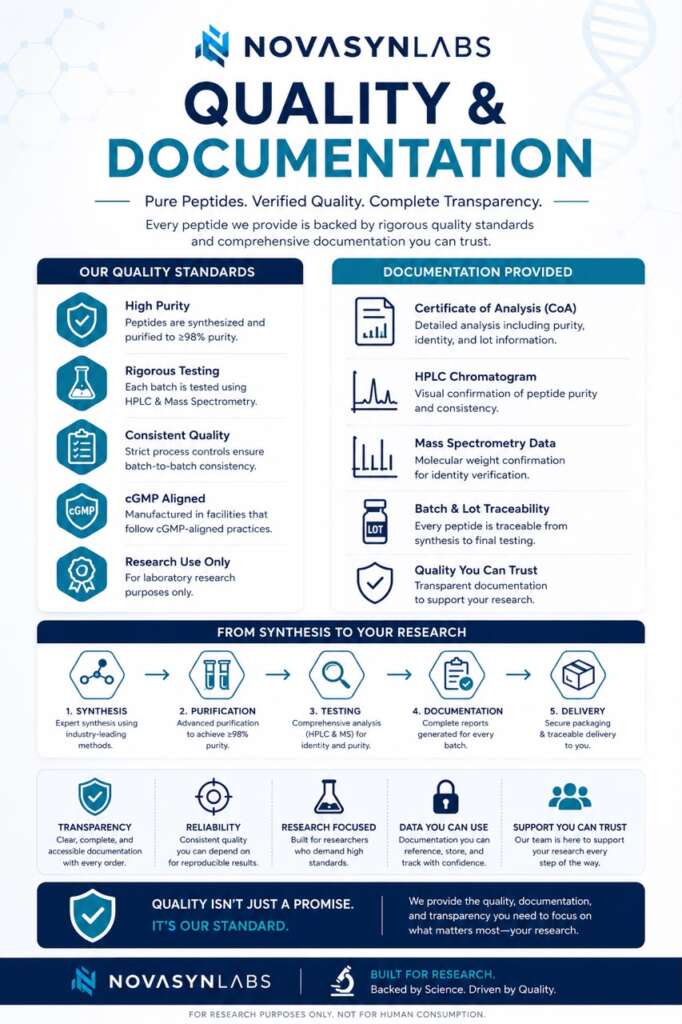
Why Quality Documentation Starts Before the Experiment
Tracking progress begins long before the first assay.
Researchers should evaluate peptide quality upon receipt.
NovaSyn Labs supports laboratories by providing:
- ≥98% purity
- Batch-specific Certificates of Analysis
- High-Performance Liquid Chromatography (HPLC) testing
- Mass Spectrometry verification
- Cold-chain shipping where appropriate
- Proper storage recommendations
- Standardized quality documentation
Beginning with well-characterized research materials helps reduce one potential source of experimental variability.
Common Tracking Mistakes to Avoid
Even experienced laboratories can encounter avoidable documentation issues.
| Common Mistake | Better Practice |
| Recording only final results | Document every stage of the experiment |
| Ignoring storage history | Record temperatures and handling conditions |
| Mixing multiple peptide batches | Track each batch independently |
| Failing to review the COA | Verify analytical documentation before experiments |
| Changing several variables simultaneously | Modify one variable while keeping others constant |
| Inconsistent naming conventions | Use standardized identifiers across projects |
| Missing observation dates | Record every collection time point |
| Incomplete laboratory notes | Document unexpected observations immediately |
Practical Checklist for Researchers
Before beginning an experiment, ask:
☐ Have I reviewed the Certificate of Analysis?
☐ Is the peptide batch number documented?
☐ Has storage history been recorded?
☐ Are reconstitution details complete?
☐ Have freeze-thaw cycles been tracked?
☐ Are biomarkers clearly defined?
☐ Are experimental endpoints established?
☐ Is the observation schedule documented?
☐ Will statistical analysis be performed?
☐ Are all researchers using the same documentation format?
Completing this checklist before every study promotes consistency and reduces avoidable variability.
Key Takeaways
Reliable peptide tracking is built on careful planning, standardized documentation, and attention to detail. By recording quality data from the moment a peptide is received through every stage of an experiment, researchers create a stronger foundation for reproducible science.
Comprehensive documentation also improves collaboration, simplifies troubleshooting, and allows meaningful comparisons between studies—making it an essential part of any high-quality peptide research program.
Frequently Asked Questions (FAQ)
1. How do researchers track peptide results and progress?
Researchers typically use a standardized documentation system that records peptide identity, batch numbers, Certificates of Analysis (COAs), storage conditions, reconstitution details, experimental protocols, biomarkers, observation schedules, and statistical analyses. Consistent documentation supports reproducibility and makes it easier to compare results across experiments.
2. What measurements should be recorded during peptide research?
The specific measurements depend on the research objective, but laboratories commonly record:
- Biomarker levels
- Cell viability
- Gene expression
- Protein expression
- Enzyme activity
- Mitochondrial function
- Experimental endpoints
- Time-course observations
- Environmental and storage conditions
Recording these variables provides context for interpreting results and identifying sources of variability.
3. How often should peptide progress be reviewed?
Rather than relying on a single measurement, researchers often review progress at predefined intervals established in the study protocol. Time-course studies may include baseline measurements followed by multiple observation points to identify trends over time.
4. Why are biomarkers important?
Biomarkers provide objective, measurable indicators of biological activity. They allow researchers to evaluate experimental outcomes using quantitative data instead of relying solely on subjective observations.
5. Why should researchers review Certificates of Analysis?
A Certificate of Analysis verifies important analytical information, including peptide purity, molecular identity, and testing methods such as HPLC and Mass Spectrometry. Reviewing batch-specific COAs helps ensure traceability throughout the research process.
6. How do storage conditions affect peptide research?
Improper storage may contribute to peptide degradation over time. Recording storage temperatures, reconstitution dates, and freeze-thaw history helps laboratories maintain sample integrity and better understand experimental variability.
7. Should laboratories document every experiment?
Yes. Consistent documentation—including successful experiments and unexpected outcomes—supports troubleshooting, trend analysis, and long-term reproducibility.
8. Why is statistical analysis important?
Statistical analysis helps determine whether observed differences are likely due to meaningful biological changes or normal experimental variation. Appropriate statistical methods strengthen confidence in research findings.
Best Practices for Tracking Peptide Research
Researchers can improve experimental consistency by following these practical recommendations:
- Develop a standardized documentation system.
- Review the Certificate of Analysis before beginning experiments.
- Record batch numbers, storage conditions, and reconstitution details.
- Monitor freeze-thaw cycles and prepare single-use aliquots when appropriate.
- Define experimental endpoints before data collection begins.
- Use objective biomarkers whenever possible.
- Maintain identical laboratory protocols across repeat experiments.
- Analyze trends across multiple experiments rather than isolated observations.
- Record all procedural changes during the study.
- Store documentation securely for future reference.
These practices help create reliable datasets that are easier to interpret and reproduce.
Summary Table: Best Practices for Tracking Peptide Research
| Best Practice | Why It Matters |
| Record batch numbers | Supports traceability between experiments |
| Review COAs | Confirms analytical characteristics of the peptide |
| Document storage conditions | Helps maintain sample integrity |
| Track freeze-thaw cycles | Reduces one potential source of variability |
| Record biomarkers | Provides objective experimental measurements |
| Use standardized protocols | Improves reproducibility across studies |
| Analyze trends over time | Strengthens data interpretation |
| Perform statistical analysis | Supports evidence-based conclusions |
| Archive laboratory records | Enables future comparison and troubleshooting |
| Select high-quality peptides | Reduces variability related to research materials |
Final Thoughts
Tracking peptide results is not simply about recording the final outcome of an experiment. High-quality research depends on complete documentation from the moment a peptide arrives in the laboratory through every stage of sample preparation, storage, experimental execution, and data analysis.
At NovaSyn Labs, we understand that reproducible science begins with well-characterized research materials and continues through disciplined laboratory practices. Since 2000, we have supported researchers by providing laboratory-grade peptides with ≥98% purity, batch-specific Certificates of Analysis, HPLC testing, Mass Spectrometry verification, cold-chain shipping where appropriate, and clear storage guidance.
While no supplier can eliminate every source of experimental variability, combining high-quality research materials with standardized documentation and careful data collection helps laboratories improve consistency and confidence in their research workflows.
Related Articles
- How Is Peptide Purity Maintained During Storage?
- How Do Peptides Influence Cellular Aging Pathways?
- What Role Do Peptides Play in Mitochondrial Research?
- What Are the Side Effects of Using Peptides?
- How Should Research Peptides Be Stored?
Scientific References
- ICH Guideline Q1A(R2): Stability Testing of New Drug Substances and Products
- National Center for Biotechnology Information (NCBI)
- PubMed
- Nature Reviews Molecular Cell Biology
- Cell Press
- Journal of Biological Chemistry
Conclusion
Careful peptide tracking is a cornerstone of reliable laboratory research. By combining standardized documentation, objective measurements, validated analytical data, and consistent laboratory protocols, researchers can improve reproducibility, simplify troubleshooting, and generate higher-quality datasets.
Whether monitoring biomarkers, documenting storage conditions, or reviewing batch-specific COAs, each step contributes to a more transparent and dependable research process. As peptide research continues to evolve, disciplined record keeping will remain one of the most valuable tools for producing meaningful and reproducible scientific results.

