




No products in the cart.
Complete Guide to BPC-157 Research (2026): Origins, Quality, Storage & Experimental Applications
Table of Contents
Complete Guide to BPC-157 Research
BPC-157 has become one of the most discussed research peptides in recent years. Interest has grown among laboratories, universities, and biotechnology organizations investigating tissue biology, cellular signaling, and peptide science. At the same time, online information about BPC-157 often ranges from outdated summaries to overly promotional claims that fail to distinguish experimental findings from established clinical evidence.
This guide was created to provide researchers with a balanced, evidence-based overview of BPC-157. It explains where the peptide originated, why it has attracted scientific interest, how high-quality BPC-157 is manufactured and tested, and what factors researchers should consider when selecting a laboratory supplier.
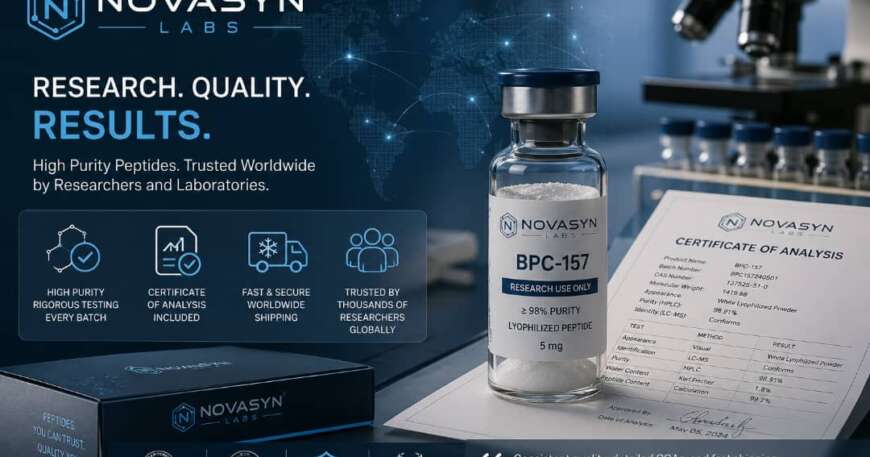
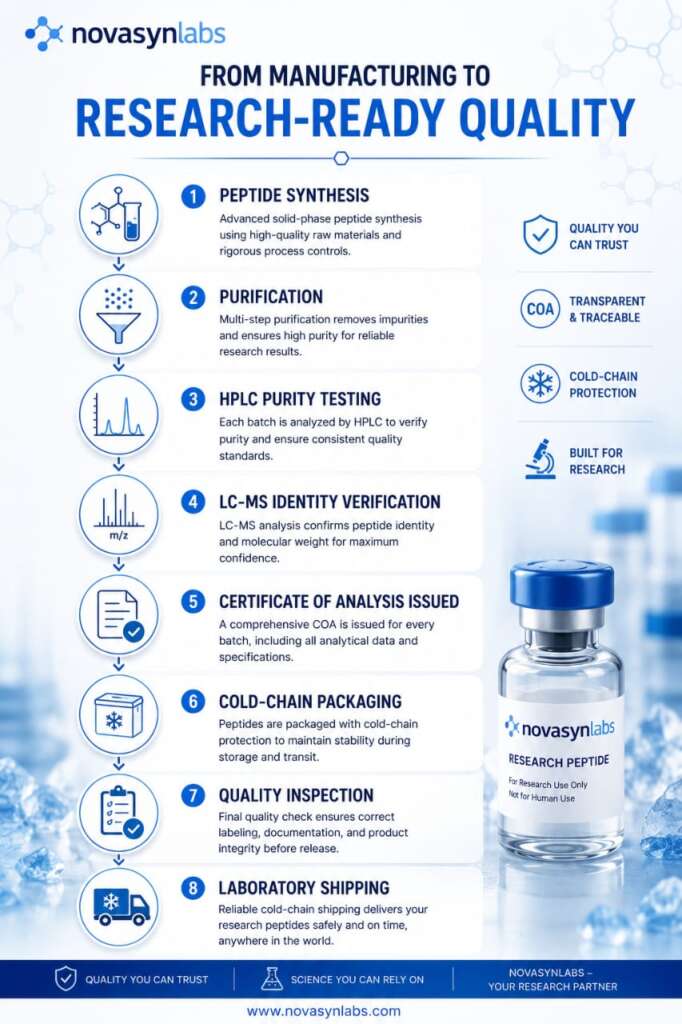
At NovaSyn Labs, we have supplied laboratory-grade BPC-157 for more than nine years, serving over 700 research customers worldwide. Throughout that time, we have observed that reproducible research depends not only on experimental design but also on consistent peptide quality, batch documentation, and proper storage practices. Every production batch is accompanied by analytical documentation, including High-Performance Liquid Chromatography (HPLC) purity testing, Liquid Chromatography–Mass Spectrometry (LC-MS) identity verification, and a Certificate of Analysis (COA) to support laboratory quality assurance.
This article is intended for educational and scientific purposes. It discusses BPC-157 within the context of laboratory research and does not present it as an approved treatment or make claims regarding clinical efficacy.
What Is BPC-157?
BPC-157 is a synthetic peptide consisting of 15 amino acids. Its name is derived from Body Protection Compound, reflecting its relationship to peptide sequences identified in gastric protein research. Scientists have investigated the compound in experimental models to better understand cellular responses associated with tissue biology and repair processes.
Unlike many peptides that function primarily as hormones or signaling molecules within a single biological pathway, BPC-157 has been explored across several research areas, including:
- Tissue repair biology
- Tendon and ligament research
- Gastrointestinal research
- Angiogenesis (blood vessel formation) research
- Cellular signaling
- Neurobiology research
Most of the published literature involves cellular and animal studies. While these studies have generated scientific interest, the current body of evidence does not establish therapeutic effects in humans. Larger, well-controlled human clinical trials would be needed to determine safety and effectiveness in clinical settings.
For this reason, reputable suppliers describe BPC-157 as a research peptide intended for laboratory investigation.
Table 1. Basic Characteristics of BPC-157
| Characteristics | Details |
| Peptide Name | BPC-157 |
| Amino Acids | 15 |
| Classification | Synthetic research peptide |
| Research Focus | Tissue biology, gastrointestinal research cellular signaling, angiogenesis research |
| Typical Quality Documentation | HPLC, LC-MS, COA |
| Intended Context | Laboratory research |
Discovery and Origin of BPC-157
The scientific story of BPC-157 begins with investigations into naturally occurring proteins associated with the stomach. Researchers studying gastric protective mechanisms identified peptide fragments that could be synthesized for experimental use. From this work, BPC-157 emerged as a stable synthetic peptide suitable for laboratory investigation.
Over the past two decades, researchers have explored BPC-157 in a variety of experimental models to better understand how peptide signaling may influence cellular behavior. Published studies indexed by resources such as PubMed, NCBI, and journals focused on orthopaedic and gastrointestinal research have contributed to a growing body of preclinical literature.
Although this research has expanded scientific understanding, it is important to distinguish preclinical findings from clinical conclusions. Results observed in laboratory or animal models do not automatically translate to human outcomes. Responsible scientific communication requires acknowledging this distinction.
As interest in peptide science continues to grow, many laboratories now emphasize standardized manufacturing, rigorous analytical testing, and transparent documentation to support reproducibility across experiments.
Why Researchers Study BPC-157
One reason BPC-157 continues to attract attention is the diversity of biological processes examined in experimental research. Rather than focusing on a single application, investigators have explored the peptide across several interconnected areas of tissue biology.
Tissue Repair Research
A significant portion of published BPC-157 literature investigates tissue repair mechanisms in preclinical models. Researchers have examined cellular responses involved in connective tissues, skeletal muscle, and other biological systems to better understand how peptide signaling may interact with normal repair processes.
These findings have generated hypotheses for future investigation, but they should not be interpreted as demonstrating established clinical benefits in humans.
Tendon and Ligament Research
Experimental studies have also evaluated BPC-157 in models involving tendons and ligaments. Researchers are interested in understanding cellular organization, extracellular matrix interactions, and tissue remodeling processes under controlled laboratory conditions.
Because tendon and ligament injuries are challenging to study, these experimental findings have encouraged additional research while highlighting the need for robust human clinical trials.
Gastrointestinal Research
The peptide’s origin in gastric protein research has naturally led to continued investigation within gastrointestinal biology. Experimental studies have examined how peptide signaling may interact with the gastrointestinal environment, contributing to a broader understanding of digestive tissue biology.
Again, these findings are part of ongoing research and should not be interpreted as evidence of approved clinical use.
Cellular Signaling
Scientists have also explored BPC-157 within the context of cellular communication. Cells rely on complex signaling networks to regulate growth, organization, and adaptation. Understanding these pathways is an active area of peptide research and may inform future scientific investigations.
Table 2. Current Experimental Research Areas
| Research Area | Current Evidence Status |
| Tissue biology | Primarily preclinical |
| Tendon research | Primarily preclinical |
| Ligament research | Primarily preclinical |
| Gastrointestinal biology | Experimental |
| Cellular signaling | Experimental |
| Angiogenesis research | Experimental |
Experimental Mechanisms Under Investigation
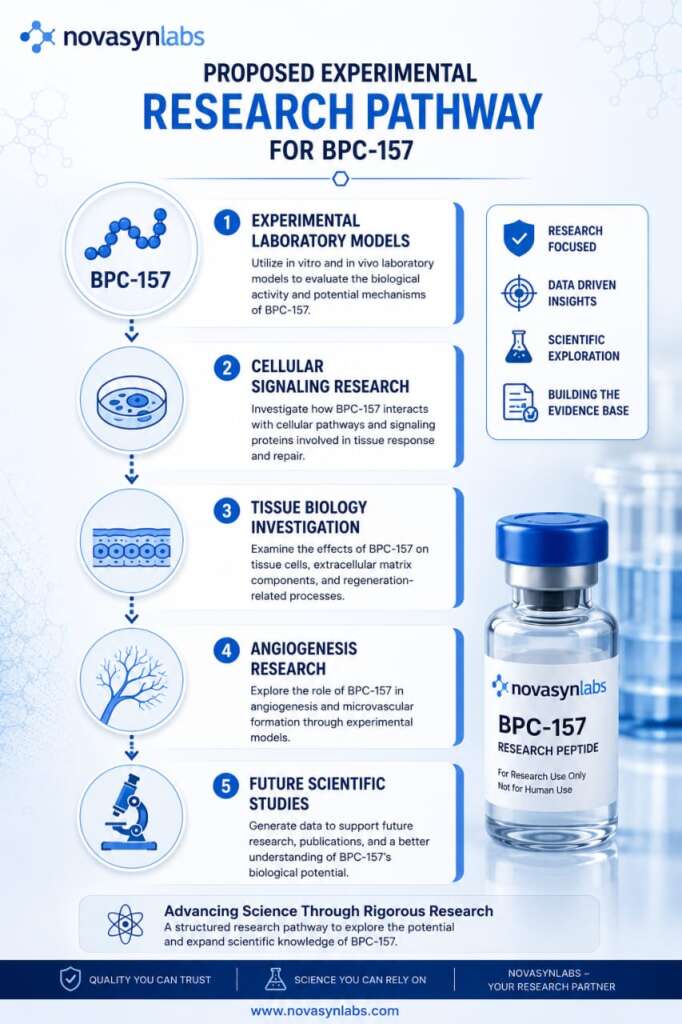
Scientists continue to investigate several proposed mechanisms through which BPC-157 may influence biological processes in experimental settings. These mechanisms remain subjects of ongoing research rather than established facts.
Areas under investigation include:
- Cellular signaling pathways
- Tissue remodeling processes
- Angiogenesis-related signaling
- Extracellular matrix interactions
- Cellular migration and organization
Because biological systems are highly complex, no single mechanism fully explains the observations reported across different studies. Future research, particularly well-designed human clinical trials, will be necessary to clarify these interactions and determine their clinical relevance.
Current Scientific Evidence and Research Limitations
As interest in BPC-157 has increased, so has the volume of scientific literature discussing its potential role in experimental research. However, one of the most important aspects of evaluating this peptide is understanding the difference between preclinical research and clinical evidence.
Many articles online present early laboratory findings as if they were proven human outcomes. This oversimplifies the current state of research and can create unrealistic expectations.
What Does the Current Evidence Show?
Most published studies involving BPC-157 have been conducted using:
- Cell culture models (in vitro)
- Animal models (in vivo)
- Experimental tissue biology research
These studies have explored how BPC-157 interacts with biological systems under controlled laboratory conditions. Researchers have investigated its relationship with tissue remodeling, cellular signaling, angiogenesis, and gastrointestinal biology.
While these studies provide valuable scientific insights, they do not establish that the same findings occur in humans.
Human physiology is significantly more complex than experimental laboratory models. Before any scientific compound can be considered safe and effective for clinical use, it typically requires multiple phases of well-designed human clinical trials that evaluate dosage, safety, efficacy, long-term outcomes, and reproducibility.
At present, BPC-157 has not completed this level of clinical validation.
Why More Research Is Needed
Scientific discovery follows a gradual process.
Researchers first identify promising biological observations in laboratory settings. Those findings are then evaluated through increasingly rigorous research before any clinical conclusions can be drawn.
Future research involving BPC-157 may focus on:
- Larger human clinical studies
- Long-term safety evaluations
- Standardized dosing protocols for research
- Better understanding of molecular mechanisms
- Comparative studies with other peptides
- Expanded tissue biology investigations
Until additional evidence becomes available, responsible scientific communication requires acknowledging the limitations of current research.
Table 3. Preclinical Research vs Clinical Evidence
| Aspect | Current Status |
| Laboratory Studies | Extensive |
| Animal Research | Extensive |
| Human Clinical Evidence | Limited |
| FDA Approval | No |
| Ongoing Scientific Interest | High |
| Need for Additional Research | Significant |
Common Misconceptions About BPC-157
As BPC-157 has become more widely discussed, several misconceptions have spread online. Understanding the current evidence helps researchers separate established facts from unsupported claims.
Myth 1: BPC-157 Is FDA Approved
Current Evidence
No.
BPC-157 is not approved by the U.S. Food and Drug Administration (FDA) as a therapeutic drug. Researchers should avoid assuming regulatory approval based on online marketing claims.
Myth 2: BPC-157 Is a Miracle Compound
Scientific research rarely supports the idea of a “miracle” molecule.
Although experimental findings have generated interest, biology is complex, and no peptide should be viewed as a universal solution.
Responsible researchers evaluate evidence critically rather than relying on exaggerated marketing language.
Myth 3: Human Benefits Have Already Been Proven
Current evidence does not support this conclusion.
While preclinical studies continue to expand scientific understanding, additional human clinical research is necessary before drawing conclusions regarding clinical efficacy.
Myth 4: Every Supplier Provides the Same Quality
One of the largest sources of variability in peptide research can be differences in manufacturing quality.
Factors that vary between suppliers include:
- Manufacturing standards
- Purification methods
- Batch consistency
- Analytical testing
- Documentation quality
- Shipping conditions
Choosing a supplier based solely on price may introduce unnecessary variability into research projects.
Table 4. Myth vs Current Scientific Evidence
| Myth | Current Scientific Evidence |
| BPC-157 is FDA approved | No |
| Human effectiveness is fully established | Evidence remains limited |
| All peptide suppliers are equivalent | Manufacturing quality varies |
| COAs are unnecessary | Analytical documentation supports quality assurance |
| Higher purity doesn’t matter | Purity is an important quality parameter for research |
Why Peptide Quality Matters
Regardless of the research project, reproducibility depends on minimizing variables wherever possible.
One potential source of variability is peptide quality.
Even carefully designed experiments may produce inconsistent results if peptide identity, purity, or batch consistency cannot be verified.
For this reason, experienced laboratories typically request comprehensive analytical documentation before introducing a peptide into their research workflow.
At NovaSyn Labs, our quality assurance process emphasizes transparency and consistency. Every production batch undergoes analytical testing and is supplied with a Certificate of Analysis so researchers can review key quality metrics before beginning experiments.
After supplying laboratory-grade peptides for more than nine years to over 700 research customers, we have consistently found that researchers value complete documentation just as much as peptide purity itself.
Understanding HPLC Purity Testing
One of the most widely used analytical techniques in peptide manufacturing is High-Performance Liquid Chromatography (HPLC).
HPLC separates compounds based on their chemical properties, allowing laboratories to estimate the proportion of the desired peptide relative to impurities.
The resulting chromatogram provides researchers with a visual representation of purity.
Higher purity generally indicates that fewer unwanted compounds are present in the sample, although researchers should evaluate purity alongside other quality metrics.
Why HPLC Matters
Researchers commonly review HPLC data to:
- Assess peptide purity
- Compare production batches
- Support internal quality assurance
- Document experimental materials
- Verify manufacturing consistency
HPLC has become one of the standard analytical methods used throughout the peptide industry.
LC-MS Identity Verification
While HPLC evaluates purity, Liquid Chromatography–Mass Spectrometry (LC-MS) helps confirm that the peptide being supplied matches the expected molecular identity.
Mass spectrometry measures molecular mass with high precision, allowing laboratories to verify that the synthesized peptide corresponds to its intended structure.
Because purity alone cannot confirm identity, many laboratories review both HPLC and LC-MS data together.
This complementary approach provides stronger analytical confidence before research begins.
Table 5. Comparing Analytical Testing Methods
| Analytical Method | Primary Purpose | Information Provided |
| HPLC | Purity assessment | Percentage purity and chromatogram |
| LC-MS | Identity verification | Molecular mass confirmation |
| Certificate of Analysis | Batch documentation | Analytical summary for the production lot |
Why Certificates of Analysis (COAs) Matter
A Certificate of Analysis (COA) is one of the most important quality documents supplied with laboratory-grade peptides.
Rather than relying solely on marketing claims, researchers can review batch-specific analytical information before incorporating a peptide into experimental protocols.
A comprehensive COA may include:
- Product name
- Batch or lot number
- Manufacturing date
- Purity results
- HPLC chromatogram
- LC-MS identity confirmation
- Storage recommendations
- Appearance
- Analytical methods used
Maintaining this documentation also supports laboratory record-keeping and internal quality reviews.
NovaSyn Labs’ Commitment to Research Quality
Selecting a research peptide supplier involves more than comparing prices or product availability. For laboratories conducting reproducible scientific work, quality assurance, batch consistency, and transparent analytical documentation are essential considerations.
For more than nine years, NovaSyn Labs has supplied laboratory-grade BPC-157 and other research peptides to over 700 research customers, including independent laboratories, universities, and biotechnology organizations.
Our quality-focused approach includes:
- High-purity peptide manufacturing
- Batch-specific HPLC purity testing
- LC-MS identity verification
- Certificate of Analysis (COA) with every batch
- Cold-chain shipping where appropriate
- Secure packaging designed to help maintain product integrity during transit
- Responsive technical support for researchers
Rather than relying on marketing claims, we encourage researchers to review the analytical documentation accompanying every batch so they can make informed decisions based on objective quality data.
Proper Storage and Handling of BPC-157
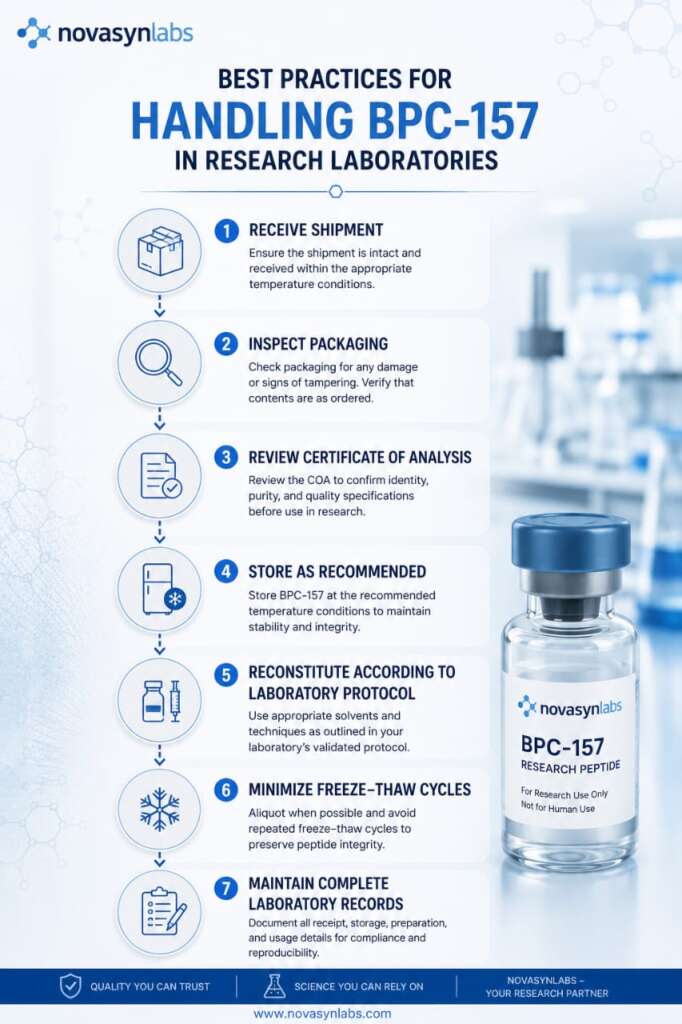
Even a high-quality peptide can be compromised if it is not stored correctly after shipment. Appropriate storage practices help preserve peptide integrity and reduce unnecessary experimental variability.
Researchers should always follow the storage recommendations provided with their specific batch and maintain consistent laboratory handling procedures.
Before Reconstitution
For lyophilized (freeze-dried) BPC-157:
- Store under the temperature conditions recommended on the Certificate of Analysis or product documentation.
- Protect the vial from prolonged exposure to heat and direct sunlight.
- Keep the vial sealed until it is ready for use in accordance with laboratory protocols.
After Reconstitution
Once reconstituted:
- Store under recommended refrigerated conditions.
- Minimize repeated freeze–thaw cycles whenever possible, as they may affect peptide stability.
- Label the preparation clearly with the reconstitution date and batch information.
- Follow your laboratory’s standard operating procedures for handling and documentation.
Consistent storage practices contribute to better experimental reproducibility by reducing avoidable handling-related variables.
Table 6. Recommended Storage Practices
| Stage | Recommended Practice |
| Upon Delivery | Inspect packaging and verify shipment condition |
| Documentation | Inspect packaging and verify shipment condition |
| Before Reconstitution | Store according to product guidance and protect from excessive heat and light |
| After Reconstitution | Refrigerate according to product recommendations |
| Handling | Minimize repeated freeze–thaw cycles |
| Laboratory Records | Record lot number, storage conditions, and preparation date |
Case Study 1: Improving Experimental Reproducibility
One independent research laboratory experienced inconsistent assay performance while studying peptide signaling pathways over several months. Although multiple variables were reviewed, the team identified peptide quality and batch variability from a previous supplier as one potential contributing factor.
The laboratory transitioned to a supplier that provided:
- High-purity BPC-157
- Batch-specific HPLC chromatograms
- LC-MS identity verification
- A comprehensive Certificate of Analysis for every lot
Following the change, the research team reported more consistent assay performance and improved reproducibility across repeated experiments. They also found that the analytical documentation simplified internal quality reviews and supported more efficient experiment planning.
Key takeaway: Standardized peptide quality and complete analytical documentation can help reduce one potential source of experimental variability.
Case Study 2: Maintaining Batch-to-Batch Consistency in a Long-Term University Project
A university research group conducting a year-long peptide investigation required multiple production batches throughout the study. Maintaining consistency between batches was important because experimental data collected months apart needed to remain comparable.
The researchers selected a supplier that followed standardized manufacturing procedures and provided a Certificate of Analysis with every production lot.
Before introducing each new batch into their workflow, the team reviewed:
- HPLC purity results
- LC-MS identity confirmation
- Batch documentation
- Manufacturing records
By verifying analytical consistency before each phase of the project, the researchers were able to maintain a standardized quality review process throughout the duration of the study.
Key takeaway: Batch-to-batch consistency and documented quality assurance support long-term research projects by helping laboratories evaluate experimental materials using objective analytical data.
Choosing a Reliable BPC-157 Supplier
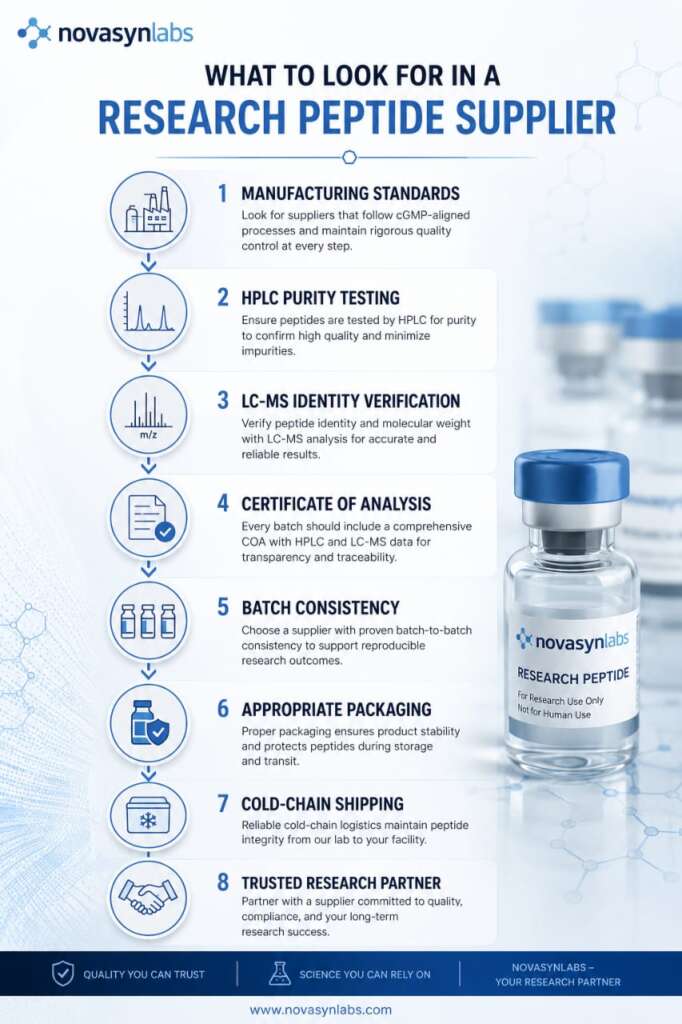
Not all research peptide suppliers follow the same manufacturing or quality assurance practices. Selecting a supplier with transparent analytical documentation can help laboratories make informed purchasing decisions.
When evaluating a supplier, consider whether they provide:
- Batch-specific Certificates of Analysis
- HPLC chromatograms showing purity
- LC-MS identity verification
- Clearly documented manufacturing standards
- Appropriate packaging and shipping procedures
- Responsive customer support
- Transparent product documentation
- Consistent batch quality
While cost is one consideration, quality assurance and documentation are often equally important for laboratories that prioritize reproducible research.
Table 7. Supplier Evaluation Checklist
| Quality Indicator | Why It Matters |
| Certificate of Analysis | Documents analytical results for each batch |
| HPLC Testing | Provides purity information |
| LC-MS Verification | Confirms peptide identity |
| Batch Consistency | Supports reproducible research |
| Cold-Chain Shipping | Helps preserve product quality during transit where appropriate |
| Transparent Documentation | Supports laboratory quality assurance |
| Technical Support | Assists researchers with product information |
Comparing BPC-157 with Other Recovery Peptides
Different research peptides are investigated for different biological questions. Rather than viewing one peptide as universally superior, researchers often select compounds based on the objectives of a particular study.
Table 8. Research Peptide Comparison
| Peptide | Common Area of Research | Documentation Available from NovaSyn Labs |
| BPC-157 | Tissue biology, gastrointestinal research, cellular signaling | HPLC, LC-MS, COA |
| TB-500 | Tissue biology and cell migration research | HPLC, LC-MS, COA |
| GHK-Cu | Skin biology and cosmetic peptide research | HPLC, LC-MS, COA |
| KPV | Inflammation-related laboratory research | HPLC, LC-MS, COA |
| ARA-290 | Experimental neurobiology research | HPLC, LC-MS, COA |
Each peptide has a distinct research focus, and published findings should be interpreted within the context of the available evidence for that specific compound.
Related Articles
- How Peptide Purity Is Maintained During Storage
- Peptide Storage and Handling Guide
- GLP-1 vs Other Peptides Comparison
References
- National Center for Biotechnology Information (NCBI)
- PubMed
- National Institute of Health (NIH)
- International Union of Pure and Applied Chemistry (IUPAC)
Conclusion
BPC-157 continues to be an active area of scientific investigation, particularly in studies exploring tissue biology, cellular signaling, and gastrointestinal research. Although the current body of literature is largely preclinical, it has provided a foundation for ongoing research and future clinical investigation.
For laboratories, universities, and biotechnology organizations, obtaining well-characterized research materials is an important part of maintaining high scientific standards. Batch-specific analytical documentation, HPLC purity testing, LC-MS identity verification, and appropriate storage practices all contribute to quality assurance and experimental consistency.
At NovaSyn Labs, our focus is on supplying laboratory-grade research peptides supported by transparent quality documentation. With more than nine years of experience and over 700 research customers, we remain committed to helping researchers access consistent, high-quality peptide materials for laboratory investigations.
If you’re looking for laboratory-grade BPC-157, or would like to explore our broader collection of recovery peptides including TB-500, GHK-Cu, KPV, and ARA-290, browse our catalog or contact the NovaSyn Labs team for additional product information and technical support.
Scientific Disclaimer
This article is provided for educational and informational purposes only. BPC-157 discussed in this guide is presented in the context of laboratory and scientific research. Statements in this article are based on available scientific literature and should not be interpreted as evidence of approved medical uses, therapeutic efficacy, or safety in humans. Researchers should evaluate current scientific publications and applicable regulations when conducting their work.

