



No products in the cart.

Next-Gen Peptides for Obesity: Beyond Ozempic and the Future of Multi-Pathway Weight-Loss Research

Table of Contents
Introduction: The Obesity-Peptide Revolution Is Moving Beyond Ozempic
Ozempic changed the conversation around obesity and metabolic research.
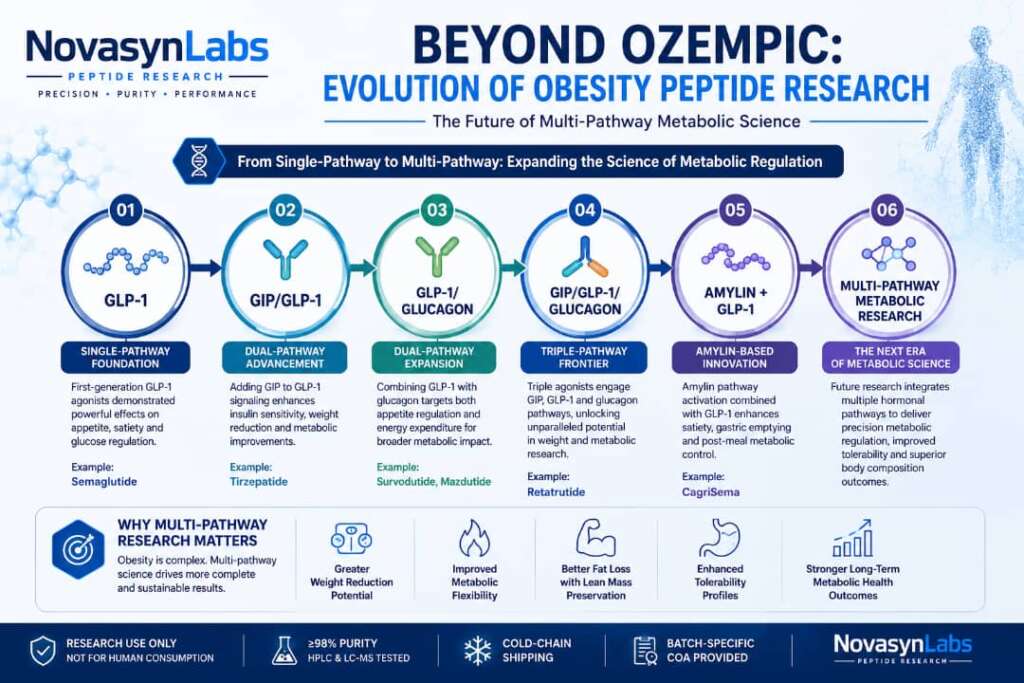
Semaglutide, a GLP-1 receptor agonist, helped demonstrate just how powerful manipulation of appetite, glucose regulation and energy balance could be. But the rapid evolution of obesity research has made one thing increasingly clear:
The future of obesity treatment and metabolic research may not be about finding a stronger version of a single-pathway GLP-1 drug. It may be about targeting multiple metabolic pathways simultaneously.
That is where Next-Gen Peptides for Obesity enter the discussion.
Researchers are now investigating compounds that influence two or even three biological pathways, including combinations involving GLP-1, GIP, glucagon and amylin-related mechanisms.
Among the compounds attracting significant research interest are:
- Tirzepatide
- Retatrutide
- Cagrilintide
- CagriSema
- Survodutide
- Mazdutide
These compounds do not all work in the same way, and they are not all at the same stage of development or regulatory approval. Some are established medicines in certain markets, while others remain investigational.
For researchers, however, the broader scientific question is fascinating:
«Can multi-pathway metabolic signaling produce greater and more sustainable changes in body weight, fat metabolism and metabolic health than traditional single-pathway approaches?»
At NovaSyn Labs, our perspective on this evolution comes from more than 20 years of serving research customers, including thousands of researchers across Europe and the United States.
Over that period, we have seen the research-peptide market move from relatively simple single-target compounds toward increasingly sophisticated metabolic research.
The current shift toward multi-pathway obesity research may be one of the most important developments yet.
What Are Next-Gen Peptides for Obesity?
The term Next-Gen Peptides for Obesity generally describes emerging peptide-based compounds being investigated for their ability to influence multiple aspects of energy balance, appetite regulation, glucose metabolism and body composition.
The first major wave of modern obesity peptides focused heavily on GLP-1 receptor signaling.
GLP-1 activation can influence:
- Appetite
- Food intake
- Glucose-dependent insulin secretion
- Gastric emptying
- Satiety signaling
- Overall energy intake
The next generation is more complicated.
Instead of activating one receptor pathway, researchers are investigating dual and triple agonists capable of interacting with several metabolic pathways.
The progression looks roughly like this:
| Research Generation | Example | Main Pathway Concept |
| First-generation | Semaglutide | GLP-1 |
| Dual-pathway | Tirzepatide | GIP + GLP-1 |
| Amylin-focused/combinational | Cagrilintide | Amylin pathway |
| Combination | CagriSema | Cagrilintide + semaglutide |
| Triple-pathway | Retatrutide | GIP + GLP-1 + glucagon |
| Multi-pathway investigational | Survodutide | GLP-1 + glucagon |
| Multi-pathway investigational | Mazdutide | GLP-1 + glucagon |
This progression is important because obesity is not controlled by a single biological switch.
Appetite, insulin sensitivity, hepatic metabolism, energy expenditure, fat storage and gastrointestinal signaling are interconnected systems.
That is why multi-pathway metabolic research has become such a major area of interest.
Why Researchers Are Looking Beyond Ozempic
The “Ozempic era” demonstrated the potential of GLP-1 biology.
But it also exposed several important research questions.
1. Is one pathway enough?
GLP-1 agonism can produce substantial effects, but researchers are investigating whether simultaneous modulation of other pathways can produce additional metabolic effects.
2. Can greater fat loss be achieved?
As obesity research develops, researchers are increasingly interested in more than total body weight.
Questions about:
- Fat mass
- Lean mass
- Muscle preservation
- Energy expenditure
- Visceral adiposity
are becoming increasingly important.
3. Can tolerability be improved?
Gastrointestinal effects remain a major consideration in incretin-based research.
Nausea, vomiting, appetite suppression and delayed gastric emptying can influence experimental adherence and study completion.
Consequently, “stronger” is not automatically equivalent to “better.”
4. Can multiple pathways create a different metabolic profile?
This is perhaps the most interesting question.
Instead of simply increasing GLP-1 activity, researchers are exploring whether combining pathways can alter the balance between:
appetite suppression + glucose regulation + lipid metabolism + energy expenditure.
That is the fundamental scientific idea behind many of the Next-Gen Peptides for Obesity now being investigated.
Tirzepatide: The Dual-Pathway Benchmark
Tirzepatide represents an important transition from single-pathway GLP-1 therapy toward multi-receptor metabolic signaling.
Unlike semaglutide, tirzepatide activates both:
- GLP-1 receptors
- GIP receptors
This makes it a dual agonist.
GIP has historically received less public attention than GLP-1, but metabolic research has increasingly demonstrated that GIP signaling may have important interactions with insulin secretion, nutrient metabolism and adipose tissue biology.
The research significance of tirzepatide therefore goes beyond simply asking:
«“Is tirzepatide stronger than semaglutide?”»
A better research question is:
«What happens when two complementary metabolic pathways are activated simultaneously?»
That question helped establish the foundation for the next wave of obesity-peptide research.
Retatrutide: The Triple-Agonist Frontier
If tirzepatide represents the move from one pathway to two, retatrutide represents the move toward three.
Retatrutide is an investigational triple agonist targeting:
- GLP-1
- GIP
- Glucagon
This combination is particularly interesting because glucagon introduces another dimension to metabolic research.
While GLP-1 and GIP are strongly associated with incretin biology, glucagon is involved in energy mobilization and metabolic regulation.
Researchers are therefore investigating whether simultaneous GLP-1/GIP/glucagon signaling can produce a different balance between:
appetite regulation + glucose control + energy expenditure + lipid metabolism.
Clinical research has generated considerable interest because high levels of weight reduction have been observed in trials.
However, researchers should avoid interpreting trial percentages as guarantees for individual outcomes.
Study population, dose, duration, baseline characteristics, adherence and tolerability all influence results.
Why retatrutide has become so important
From our experience serving research customers, interest in triple-agonist research has increased dramatically.
This is what we call the “Retatrutide Effect.”
The research conversation has shifted from:
«“How can we reproduce GLP-1 effects?”»
to:
«“Can multiple metabolic pathways be coordinated to produce a fundamentally different obesity-research profile?”»
That is a much more sophisticated question.
Cagrilintide and the Amylin Pathway
Cagrilintide represents another important direction in obesity research.
Rather than simply extending the GLP-1 pathway, cagrilintide works through amylin-related signaling.
Amylin is a peptide hormone involved in:
- Satiety
- Food intake
- Gastric emptying
- Post-meal metabolic regulation
This makes the amylin pathway particularly interesting when researchers are investigating appetite regulation through mechanisms that differ from traditional GLP-1 signaling.
The broader lesson is important:
The next generation of obesity research may not depend on one dominant peptide pathway.
It may involve combinations of complementary pathways.
CagriSema: Combining Different Biological Signals
CagriSema is particularly interesting because it combines:
Cagrilintide + semaglutide
The scientific concept is straightforward: combine amylin-related signaling with GLP-1 signaling.
This illustrates an increasingly important trend in obesity research:
«Rather than asking which single molecule is best, researchers are investigating whether strategically combining mechanisms can produce a broader metabolic effect.»
This does not mean every combination will be superior.
Combination therapies introduce additional questions involving:
- Tolerability
- Pharmacokinetics
- Dosing complexity
- Adherence
- Side-effect profiles
- Cost
- Long-term sustainability
Those questions will require continued clinical research.
Survodutide: GLP-1 + Glucagon
Survodutide is another investigational compound attracting interest because it targets:
GLP-1 + glucagon receptors.
This combination is scientifically significant because it attempts to combine appetite and glucose-related GLP-1 signaling with glucagon-mediated metabolic effects.
Research interest extends beyond body weight into areas such as:
- Liver metabolism
- Fat accumulation
- Metabolic dysfunction
- Energy balance
This illustrates another important characteristic of the next generation:
Obesity research is increasingly connected to broader metabolic disease research.
Mazdutide and the Expanding Multi-Pathway Pipeline
Mazdutide is another investigational multi-pathway peptide being studied in obesity and metabolic research.
Its GLP-1/glucagon activity places it within the same broad scientific movement toward combining incretin signaling with glucagon biology.
The existence of multiple compounds exploring similar but not identical mechanisms is important.
It allows researchers to investigate whether differences in:
- Receptor activity
- Molecular structure
- Pharmacokinetics
- Exposure
- Tolerability
- Patient populations
produce meaningful differences in outcomes.
This is precisely why the emerging obesity-peptide landscape should not be reduced to a simple “which peptide is strongest?” ranking.
Next-Gen Peptides for Obesity: Comparison Table
| Compound | Primary Research Mechanism | Development/Use Context | Key Research Question |
| Semaglutide | GLP-1 | Established medicine | What can GLP-1 agonism achieve? |
| Tirzepatide | GIP + GLP-1 | Established medicine in relevant indications | Does dual signaling improve metabolic outcomes? |
| Retatrutide | GIP + GLP-1 + glucagon | Investigational | Can triple agonism produce greater metabolic effects? |
| Cagrilintide | Amylin pathway | Investigational | Can amylin signaling complement incretin biology? |
| CagriSema | Cagrilintide + semaglutide | Investigational | Can amylin + GLP-1 improve outcomes? |
| Survodutide | GLP-1 + glucagon | Investigational | Can dual GLP-1/glucagon signaling broaden metabolic effects? |
| Mazdutide | GLP-1 + glucagon | Investigational | How does dual-pathway activity affect obesity/metabolic research? |

Important: Regulatory status and approved indications can change. Investigational compounds should not be represented as approved obesity treatments.
The Biggest Market Shift: From “Weight Loss” to Body Composition
One of the most interesting changes we have observed among research customers is the evolution of the questions being asked.
Earlier conversations often focused almost exclusively on:
«“How much weight does this compound produce?”»
Today, researchers increasingly ask:
«“What happens to fat mass versus lean mass?”»
That is a much more sophisticated question.
Total body weight does not tell the whole story.
A hypothetical 10 kg reduction could involve different proportions of:
- Fat mass
- Lean tissue
- Water
- Glycogen
Therefore, obesity research increasingly incorporates tools such as:
- DEXA
- MRI
- CT
- Indirect calorimetry
- Body-composition analysis
- Metabolic biomarkers
Exercise enters the picture here
Exercise should not be viewed simply as a way to “burn more calories.”
Resistance training, for example, can be relevant to research questions surrounding muscle preservation and functional capacity.
Aerobic exercise can contribute to cardiovascular fitness and energy expenditure.
For research protocols involving animal models, exercise paradigms may include:
- Treadmill protocols
- Voluntary wheel activity
- Resistance-related models
- Indirect calorimetry
- Activity monitoring
The exact exercise protocol should be selected according to the study model and validated methodology rather than copied from a human weight-loss program.
For human readers, exercise recommendations should likewise come from qualified healthcare and fitness professionals, particularly when obesity, medication or underlying disease is involved.
Tolerability May Become More Important Than Maximum Potency
The obesity-peptide field has discovered something important:
Maximum biological activity does not automatically equal maximum practical value.
Gastrointestinal tolerability remains one of the major considerations surrounding incretin-based research.
Potential problems can include:
- Nausea
- Vomiting
- Reduced food intake
- Delayed gastric emptying
- Gastrointestinal discomfort
- Reduced fluid intake
This creates a difficult research balance.
A compound may demonstrate impressive efficacy, but if tolerability problems interfere with adherence or experimental completion, the practical value of that protocol may be reduced.
This is why future research is likely to focus increasingly on:
efficacy + tolerability + body composition + sustainability
rather than efficacy alone.
Case Study 1: Mitigating Gastrointestinal Effects in a High-Efficacy Research Model
Research setting
An academic metabolic laboratory was conducting non-human animal-model research involving triple-agonist pathways.
The researchers were comparing retatrutide with tirzepatide.
The problem
Aggressive initial exposure resulted in substantial gastrointestinal distress and reduced fluid intake among experimental subjects.
This created a serious risk of early subject drop-off.
The research discussion
The laboratory reviewed published clinical-trial titration principles and redesigned its experimental escalation protocol.
Rather than immediately targeting a higher maintenance exposure, the study moved toward a gradual four-step escalation approach.
The laboratory reported a substantial reduction in gastrointestinal side-effect markers and ultimately achieved approximately 95% subject retention, allowing the research team to reach its week-24 body-mass evaluation milestone.
Key lesson
This case illustrates a critical principle:
«In obesity research, protocol design can be as important as compound selection.»
The lesson should not be interpreted as a universal dosing recommendation. Exposure schedules must be established according to the relevant experimental model, compound, study protocol and applicable ethical requirements.
Case Study 2: When Purity Isn’t the Whole Story
A private biotechnology company was evaluating lipolytic peptides in localized fat-reduction models.
The compounds included:
- AOD-9604
- Fragment 176-191
The laboratory encountered a major problem.
One batch generated expected activity.
A later batch produced essentially no comparable metabolic response.
The immediate assumption was that the experimental model had failed.
Instead, the investigation shifted toward analytical quality.
The research team implemented stricter third-party:
- HPLC
- Mass spectrometry
- COA verification
- Batch-level documentation
The investigation ultimately identified evidence of aggregation associated with inappropriate handling/transport conditions.
The company subsequently changed its supply-chain storage requirements.
The key lesson
A peptide labeled “98% pure” should not automatically be treated as analytically equivalent to every other 98% batch.
Researchers should consider:
identity + purity + aggregation + storage + transport + batch documentation.
That distinction is critical.
Case Study 3: Dual-Pathway Versus Single-Pathway Research
A clinical research organization was designing an early-stage comparative research program involving obesity models.
The team was evaluating:
Semaglutide vs. Tirzepatide
The main question was whether the additional complexity and cost associated with dual-pathway research justified its inclusion.
The research team reviewed comparative evidence surrounding GLP-1 monotherapy and GIP/GLP-1 dual agonism.
The resulting evidence package helped the CRO justify allocation toward the dual-pathway arm and ultimately select tirzepatide as its primary research cohort.
The broader lesson
The decision was not simply about buying the “strongest” peptide.
It involved:
- Mechanism
- Research objective
- Budget
- Expected effect size
- Study design
- Scientific rationale
That is how sophisticated peptide research decisions should be made.
The Purity Crisis: Why Peptide Quality Matters More Than Ever
The rapid growth of the obesity-peptide market has created another problem:
trust.
The popularity of GLP-1-related compounds has attracted numerous suppliers, resellers and grey-market products.
Researchers therefore need to distinguish between:
«A product that has a peptide name printed on a vial»
and
«A properly documented research material with verifiable analytical evidence.»
At NovaSyn Labs, our quality-control approach focuses on batch-specific analytical documentation.
HPLC: Measuring Peptide Purity
Reversed-phase HPLC can separate the target peptide from manufacturing-related impurities.
These may include:
- Truncated sequences
- Degradation products
- Synthesis-related impurities
- Other chromatographic components
For research-grade materials, our stated specification is ≥98% HPLC purity, where applicable.
However, HPLC purity is not the same thing as proving molecular identity.
That is why another analytical technique is important.
Mass Spectrometry: Confirming Identity
Mass spectrometry helps determine whether the observed molecular mass corresponds to the expected compound.
In simple terms:
HPLC asks: “How much of the sample corresponds to the target peak?”
Mass spectrometry asks: “Is this actually the expected molecule?”
Using both techniques provides substantially more useful information than relying on a purity number alone.
Why Batch-Specific COAs Matter
A Certificate of Analysis should correspond to the actual lot being supplied.
A generic PDF reused across multiple batches should raise questions.
A useful batch-specific COA can contain:
- Lot number
- Sample identification
- Test date
- HPLC results
- Chromatogram
- Mass-spectrometry results
- Analytical laboratory information
- Relevant specifications
Where available, direct verification of analytical information provides another layer of confidence.
A useful rule for researchers:
No batch-specific evidence = no easy assumption of batch equivalence.
Cold-Chain Storage and Peptide Stability
Quality control does not end when analytical testing is complete.
Peptide materials can be affected by:
- Temperature
- Moisture
- Light
- Repeated temperature fluctuations
- Improper reconstitution
- Extended storage
- Transportation conditions
For appropriately specified lyophilized research peptides, controlled low-temperature storage may be used according to the manufacturer’s documented storage requirements.
Cold-chain packaging can also help reduce temperature exposure during transportation.
Researchers should always follow the specific storage instructions accompanying the material rather than assuming that every peptide has identical stability characteristics.
What “98% Purity” Does—and Doesn’t—Mean
One of the most common mistakes in peptide marketing is treating a purity percentage as an absolute guarantee of quality.
It isn’t.
A scientifically responsible statement is:
≥98% HPLC purity according to the applicable analytical specification.
It should not become:
“100% pure.”
No credible analytical discussion should casually claim that a research peptide contains zero impurities.
Likewise, research peptides should not automatically be described as:
- Pharmaceutical grade
- Human grade
- FDA approved
- Safe for human consumption
unless the relevant regulatory and manufacturing requirements actually support those claims.
What Researchers Should Look for When Evaluating a Peptide Supplier
Research Peptide Quality-Control Checklist
| Question | Why It Matters |
| Is the batch clearly identified? | Links the material to its documentation |
| Is there a lot-specific COA? | Helps verify the actual batch |
| Is HPLC data available? | Provides purity information |
| Is identity confirmed by MS? | Helps confirm molecular identity |
| Is the analytical laboratory identified? | Improves transparency |
| Is third-party testing available? | Adds independent verification |
| Are storage requirements documented? | Helps protect material integrity |
| Is transportation appropriately controlled? | Reduces avoidable degradation risk |
| Are claims limited to research use? | Helps maintain regulatory accuracy |
| Can analytical documentation be verified? | Reduces reliance on generic paperwork |
What Comes After Ozempic?
The most important question may not be:
“What replaces Ozempic?”
The better question is:
“What comes after single-pathway obesity biology?”
The answer may involve an entire ecosystem of complementary mechanisms.
The emerging research map
GLP-1
↓
GIP + GLP-1
↓
GLP-1 + glucagon
↓
GIP + GLP-1 + glucagon
↓
GLP-1 + amylin combinations
↓
Next-generation combinations targeting multiple aspects of metabolism
This does not mean every new compound will succeed.
Some will fail because of:
- Insufficient efficacy
- Poor tolerability
- Safety concerns
- Manufacturing challenges
- Pharmacokinetic limitations
- Regulatory hurdles
- Commercial constraints
That is normal for pharmaceutical research.
The important point is that the scientific direction has changed.
The Future: Precision Metabolic Research
The next stage of obesity research may ultimately become less about “weight-loss drugs” and more about precision metabolic intervention.
Researchers could increasingly investigate combinations according to specific biological characteristics.
For example:
Research phenotype A
High appetite + insulin resistance
Potential research question:
Which combination of appetite and glucose-regulatory pathways produces the most appropriate response?
Research phenotype B
High visceral adiposity + metabolic dysfunction
Potential research question:
Can compounds affecting glucagon and incretin signaling produce additional metabolic effects?
Research phenotype C
High weight loss + concern about lean mass
Potential research question:
How do pharmacological interventions interact with nutrition and resistance exercise to influence body composition?
This is a much more sophisticated research framework than simply ranking compounds by percentage of weight reduction.

The Future May Be About Combination Biology
The obesity field is moving toward a fascinating concept:
metabolic orchestration.
Instead of asking one receptor to do everything, researchers are investigating whether multiple biological signals can be coordinated.
Tirzepatide demonstrated the importance of dual agonism.
Retatrutide pushed the concept toward triple agonism.
Cagrilintide and CagriSema demonstrate the potential importance of amylin-related combinations.
Survodutide and mazdutide add further exploration of GLP-1/glucagon biology.
Together, these compounds represent different experiments in the same larger scientific question:
Can multiple metabolic signals work together to produce a more comprehensive approach to obesity biology?
The answer is still being investigated.
Frequently Asked Questions About Next-Gen Peptides for Obesity
What are the next-generation peptides for obesity?
Next-generation obesity peptides include compounds and combinations designed to influence multiple metabolic pathways. Examples being researched include tirzepatide, retatrutide, cagrilintide, CagriSema, survodutide and mazdutide.
Is retatrutide stronger than Ozempic?
Retatrutide and semaglutide have different mechanisms, and retatrutide is an investigational triple agonist whereas semaglutide is an established GLP-1-based medicine. Clinical-trial results cannot be translated into a guarantee that one compound will produce a particular result for an individual.
What makes tirzepatide different from semaglutide?
Semaglutide primarily targets GLP-1 signaling, while tirzepatide targets both GIP and GLP-1 receptors. This makes tirzepatide an example of dual-pathway metabolic signaling.
What is CagriSema?
CagriSema is an investigational combination involving cagrilintide and semaglutide. It represents research into combining amylin-related and GLP-1 pathways.
Why are researchers interested in triple agonists?
Triple agonists such as retatrutide are designed to influence GLP-1, GIP and glucagon pathways. Researchers are investigating whether this broader receptor activity can produce different effects on appetite, metabolism, energy balance and body composition.
Does higher purity automatically mean better research results?
No. Purity is important, but research outcomes can also be affected by molecular identity, aggregation, degradation, storage, handling, experimental design and other variables.
What should researchers look for on a peptide COA?
Researchers should look for a batch-specific document containing relevant analytical information such as HPLC results, molecular identity testing, lot identification and laboratory information.
Are next-generation obesity peptides approved for human use?
Not all of them. Regulatory status varies substantially between compounds and jurisdictions. Investigational peptides should not be represented as approved medicines.
Conclusion: Beyond Ozempic Is About More Than a Stronger Peptide
The Ozempic era proved that peptide-based metabolic therapies could fundamentally change obesity research.
But the next chapter may be even more significant.
Next-Gen Peptides for Obesity are moving the scientific conversation from single-receptor activation toward multi-pathway metabolic regulation.
Tirzepatide introduced an important dual-pathway model.
Retatrutide is pushing research toward triple agonism.
Cagrilintide and CagriSema are exploring amylin-based combinations.
Survodutide and mazdutide are investigating GLP-1/glucagon biology.
The ultimate winner may not be the compound that simply produces the largest number on a scale.
Future obesity research is likely to consider a much broader equation:
Efficacy + tolerability + body composition + metabolic health + sustainability + quality control
That is the real meaning of moving beyond Ozempic.
For researchers, the opportunity is not simply to follow the latest peptide trend.
It is to understand the biology behind each compound, design appropriate experiments, maintain rigorous analytical standards and interpret results within the limitations of the available evidence.
With more than 20 years of experience serving research customers across Europe and the United States, NovaSyn Labs believes that the future of peptide research will depend not only on discovering increasingly sophisticated molecules, but also on maintaining the analytical transparency and quality standards required to study them properly.
The next generation of obesity research has already begun. The question is how far multi-pathway metabolic science can ultimately go.
Research-Use Disclaimer
The compounds discussed in this article are presented for scientific and research-education purposes. Investigational compounds are not necessarily approved for human use, and regulatory status varies by jurisdiction. Research peptides supplied for laboratory investigation should be used only in accordance with applicable laws, institutional requirements, manufacturer documentation and appropriate research protocols. Nothing in this article should be interpreted as medical advice, a human dosing recommendation, or a claim that any research peptide is safe or effective for treating obesity.
Continue Your Reading
- Mounjaro & Wegovy Online Pharmacy Europe: How to Buy Safely in 2026
- Retatrutide vs Tirzepatide
- Peptide Travel Planning Guide 2026
- GHK-Cu Raw Powder
External References

