



No products in the cart.
Why Are Peptides Lyophilized? The Science Behind Freeze-Drying Research Compounds (2026 Guide)
Table of Contents
Why Are Peptides Lyophilized? The Science Behind Freeze-Drying Research Compounds
If you’ve ever purchased a research peptide, you’ve probably noticed it arrives as a white, dry powder rather than a liquid solution. Whether it’s BPC-157, TB-500, CJC-1295, Ipamorelin, Tesamorelin, MOTS-c, SS-31, GHK-Cu, Semaglutide, Tirzepatide, or Retatrutide, the overwhelming majority of research peptides are supplied in lyophilized (freeze-dried) form.
But why are peptides lyophilized, and what makes freeze-drying the preferred method for preserving these delicate research compounds?
The answer lies in peptide chemistry. Peptides are complex chains of amino acids that can gradually degrade when exposed to water, heat, oxygen, light, or repeated temperature fluctuations. Lyophilization removes nearly all water from the finished peptide under carefully controlled conditions, creating a stable powder that is generally easier to store, transport, and handle before reconstitution.
At NovaSynLabs, we have supplied research peptides for over 20 years, serving thousands of research customers across the United States and Europe. Throughout that time, we’ve seen how proper manufacturing, rigorous quality testing, careful lyophilization, and appropriate storage practices contribute to consistent research materials for laboratory use.
In this guide, you’ll learn:
- What lyophilization means
- Why peptides are freeze-dried
- How the freeze-drying process works
- Why different peptides are supplied in lyophilized form
- How lyophilization helps improve stability during storage and shipping
- Common myths about lyophilized peptides
- Best practices for storing freeze-dried peptides
- How NovaSynLabs helps maintain quality through testing and documentation
«Research Use Only: The products discussed in this article are intended for laboratory research purposes only and are not approved for human or veterinary use unless specifically stated by applicable regulatory authorities.»
What Does Lyophilized Mean?
The word lyophilized refers to a specialized preservation process commonly known as freeze-drying. Instead of allowing water to evaporate through heat, the process removes frozen water directly from the solid state into vapor under a controlled vacuum. This transition is called sublimation.
Because peptides are sensitive molecules, excessive heat or prolonged exposure to moisture can affect their stability. Freeze-drying allows manufacturers to remove water while minimizing stress on the peptide structure.
The result is the familiar white or off-white powder found inside research peptide vials.
Unlike a liquid peptide solution, a lyophilized peptide contains very little residual moisture, which generally helps reduce degradation before reconstitution when stored appropriately.
Why Freeze-Drying Is Preferred Over Liquid Storage
If peptides remained dissolved in water from the moment they left the manufacturing facility, they would generally be more vulnerable to several factors, including:
- Hydrolysis (chemical breakdown in the presence of water)
- Microbial contamination if improperly handled
- Faster degradation over time
- Greater sensitivity to shipping temperatures
- Shorter storage life before use
By removing moisture through lyophilization, manufacturers help improve the stability of many peptide formulations during transportation and storage before reconstitution.
This is one reason freeze-drying has become a widely used preservation method for research compounds, biologics, pharmaceuticals, and certain vaccines.
Why Are Peptides Lyophilized?
Understanding why peptides are lyophilized begins with recognizing how delicate peptide molecules can be.
Peptides consist of amino acid chains linked together by peptide bonds. Although these structures are highly valuable for scientific research, they may gradually break down when exposed to unfavorable environmental conditions.
Lyophilization helps address many of these challenges by removing moisture while preserving the peptide in a dry state until researchers are ready to reconstitute it using appropriate laboratory procedures.
The key advantages include the following.
1. Improved Stability
One of the biggest reasons peptides are lyophilized is to improve stability before reconstitution.
Water can participate in chemical reactions that contribute to peptide degradation over time. By removing most of the water from the finished product, freeze-drying helps slow many of these processes.
Although no preservation method completely stops natural degradation indefinitely, reducing moisture is an important step in maintaining product quality during recommended storage periods.
2. Longer Shelf Life
Compared with many liquid peptide preparations, lyophilized peptides generally offer a longer storage window before reconstitution when kept under recommended conditions.
Researchers who purchase peptides for future experiments often appreciate the flexibility provided by freeze-dried formulations.
For long-term storage, unopened lyophilized peptides are commonly stored at -20°C, with -80°C used in some laboratories when extended storage is required.
3. Better Shipping Performance
Research peptides are frequently transported across countries and continents.
NovaSynLabs regularly ships throughout the European Union and the United States, using insulated protective packaging designed to help maintain product stability during transit.
A dry, lyophilized peptide is generally more suitable for shipping than a peptide already dissolved in solution because there is significantly less water available to promote degradation during transportation.
While shipping conditions remain important, freeze-drying provides an additional layer of protection for many peptide formulations before reconstitution.
4. Reduced Moisture-Related Degradation
Moisture is one of the primary environmental factors that can affect peptide stability.
Even small amounts of water may contribute to gradual chemical changes over time if products are improperly stored.
Lyophilization dramatically reduces the amount of water remaining inside the vial, helping create an environment that better supports long-term storage when combined with appropriate temperature control and sealed packaging.
5. Easier Laboratory Handling
Many laboratories prefer receiving peptides in lyophilized form because researchers can decide when to prepare the solution.
Instead of receiving a peptide that has already begun its life in solution, laboratories can:
- Store the unopened vial appropriately.
- Reconstitute only when needed.
- Prepare fresh solutions according to laboratory protocols.
- Minimize unnecessary handling before experiments begin.
This added flexibility can simplify inventory management for long-term research projects.
6. Greater Storage Flexibility
Another reason peptides are lyophilized is storage convenience.
Before reconstitution, many lyophilized peptides can be stored:
- Refrigerated for shorter periods when appropriate.
- Frozen for extended storage.
- Protected from light and moisture inside sealed vials.
By contrast, peptides already dissolved in solution generally require more careful temperature management throughout their usable lifespan.
7. Supports Consistent Research Practices
Consistency is essential in laboratory research.
While many factors influence experimental outcomes, beginning with a properly manufactured, quality-tested, and appropriately stored peptide can help researchers maintain reliable laboratory practices.
For this reason, reputable suppliers typically combine lyophilization with analytical testing and quality documentation before products are released.
At NovaSynLabs, this process includes analytical techniques such as HPLC, LC-MS, mass spectrometry, peptide identity testing, purity assessment, batch consistency evaluation, and a Certificate of Analysis (COA) for qualifying products.
The Science Behind Freeze-Drying
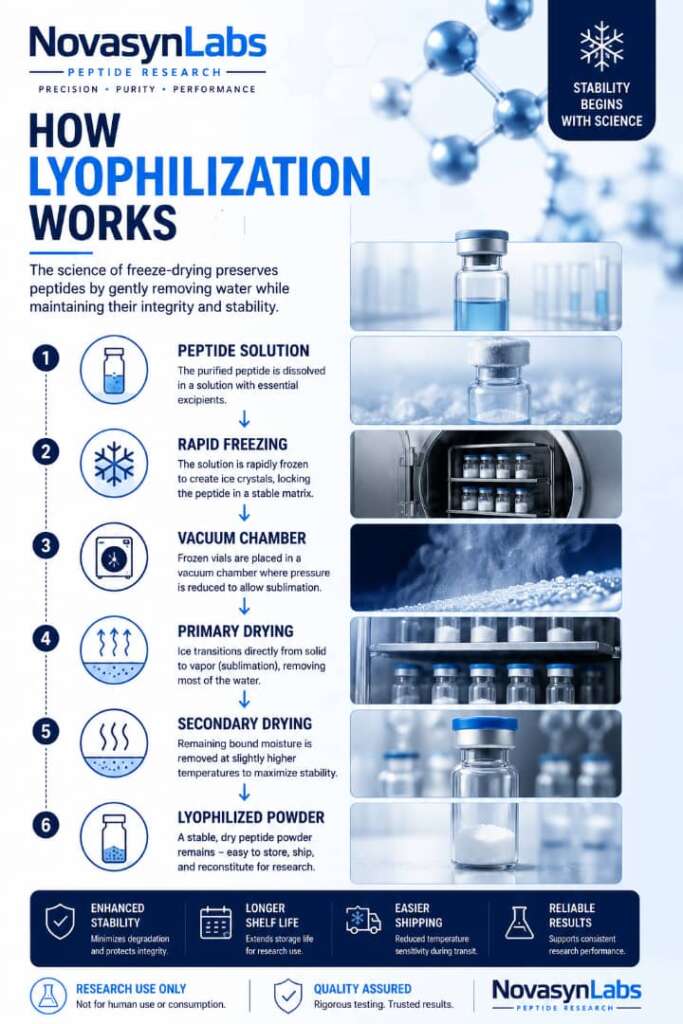
Although the finished peptide appears to be a simple white powder, the science behind lyophilization is highly controlled and involves several carefully managed stages.
Instead of drying the peptide using heat, manufacturers remove water through changes in temperature and pressure.
The process typically follows these steps:
| Stage | What Happens |
| Freezing | The purified peptide solution is rapidly frozen so the water forms ice crystals. |
| Vacuum Application | Pressure inside the chamber is reduced to create conditions for sublimation. |
| Primary Drying | Frozen ice transitions directly into water vapor without passing through the liquid phase. |
| Secondary Drying | Remaining traces of moisture are removed to further improve stability. |
| Sealing | The finished lyophilized peptide is sealed inside sterile vials to help protect against moisture and contamination. |
Because liquid water is largely removed, the peptide remains as a dry cake or powder that can later be reconstituted using appropriate laboratory procedures.
How Lyophilization Protects Different Research Peptides
While the freeze-drying process follows the same scientific principles, the benefits of lyophilization become especially important for peptides that are sensitive to moisture and prolonged storage in solution. By removing water after purification and quality testing, manufacturers can better preserve the integrity of many research peptides until they are reconstituted under appropriate laboratory conditions.
At NovaSynLabs, the peptides below are supplied in lyophilized form to help support quality, stability, and convenient storage for research applications.
| Research Peptide | Why It Is Lyophilized | Primary Benefit |
| BPC-157 | Reduces moisture exposure before reconstitution | Improved storage stability |
| TB-500 | Helps preserve peptide integrity | Longer shelf life |
| CJC-1295 | Minimizes degradation during storage | Better long-term preservation |
| Ipamorelin | Allows flexible laboratory storage | Improved handling |
| Tesamorelin | Reduces moisture-related changes | Stable storage before use |
| MOTS-c | Protects peptide during transport | Better shipping stability |
| SS-31 | Supports long-term preservation | Reduced degradation risk |
| GHK-Cu | Helps maintain peptide quality | Easier storage and transport |
| Semaglutide | Preserves product before reconstitution | Longer storage life |
| Tirzepatide | Improves shipping convenience | Greater stability |
| Retatrutide | Maintains peptide integrity before use | Reliable laboratory handling |
Although each peptide has unique chemical characteristics, the objective remains the same: preserving the material in a dry, stable state until researchers are ready to prepare it for laboratory experiments.
How NovaSynLabs Maintains Peptide Quality
Lyophilization is only one stage of peptide manufacturing. High-quality research peptides begin with careful production, extensive analytical testing, and strict quality control before the freeze-drying process even begins.
With more than 20 years of experience supplying research peptides to thousands of research customers across the United States and Europe, NovaSynLabs follows a quality-focused workflow designed to support consistency from production through shipping.
Our manufacturing and quality assurance process includes:
1. HPLC Purification
Each peptide undergoes purification using High-Performance Liquid Chromatography (HPLC) to separate the target peptide from synthesis-related impurities.
This purification step helps improve peptide purity before additional analytical testing.
2. Mass Spectrometry
Mass spectrometry confirms that the molecular weight of the peptide matches the expected structure.
This provides another layer of verification before the peptide proceeds through manufacturing.
3. LC-MS Analysis
Liquid Chromatography-Mass Spectrometry (LC-MS) combines chromatographic separation with mass analysis to further evaluate peptide identity and composition.
4. Peptide Identity Testing
Identity testing verifies that researchers receive the intended peptide sequence rather than an incorrect or substituted compound.
5. Purity Testing
Purity testing evaluates the percentage of the desired peptide compared with impurities generated during synthesis.
6. Sterility Testing
Where applicable, sterility testing helps evaluate manufacturing cleanliness and supports laboratory-quality handling procedures.
7. Batch Consistency
Every manufacturing batch should demonstrate consistent analytical characteristics.
Batch-to-batch consistency helps researchers obtain reliable materials for ongoing laboratory work.
8. Lyophilization
Only after analytical verification is complete does the peptide proceed through the freeze-drying process.
Removing water at this stage helps improve storage stability before packaging.
9. Certificate of Analysis (COA)
Qualifying products include a Certificate of Analysis, providing researchers with documented analytical information regarding the tested batch.
10. Protective Packaging & Shipping
Finally, peptides are packaged in insulated protective materials designed to help maintain product quality during transportation.
NovaSynLabs ships quickly throughout the European Union and the United States, using protective packaging intended to help preserve peptide stability during transit.
Because freeze-dried peptides appear as a white powder, researchers who are new to peptide science sometimes misunderstand what lyophilization actually means.
Let’s examine some of the most common misconceptions.
| Myth | Reality |
| A powder means the peptide is low quality. | In reality, freeze-dried powder is the standard presentation for many research peptides because it generally offers better stability before reconstitution. |
| Lyophilized peptides do not need refrigeration. | Proper storage remains important. Long-term storage is commonly recommended at -20°C, with -80°C used in some laboratories for extended preservation. |
| Lyophilized peptides never expire. | Freeze-drying improves stability but does not stop natural degradation indefinitely. Storage conditions and time remain important. |
| Reconstituted peptides last just just as long as dry powder. | Once water is added, peptides generally become more susceptible to degradation than when stored in their lyophilized state. |
| All peptide suppliers use the same manufacturing standards. | Manufacturing quality, analytical testing, documentation, and supplier quality systems can vary considerably between companies. |
Proper Storage Guide for Lyophilized Peptides
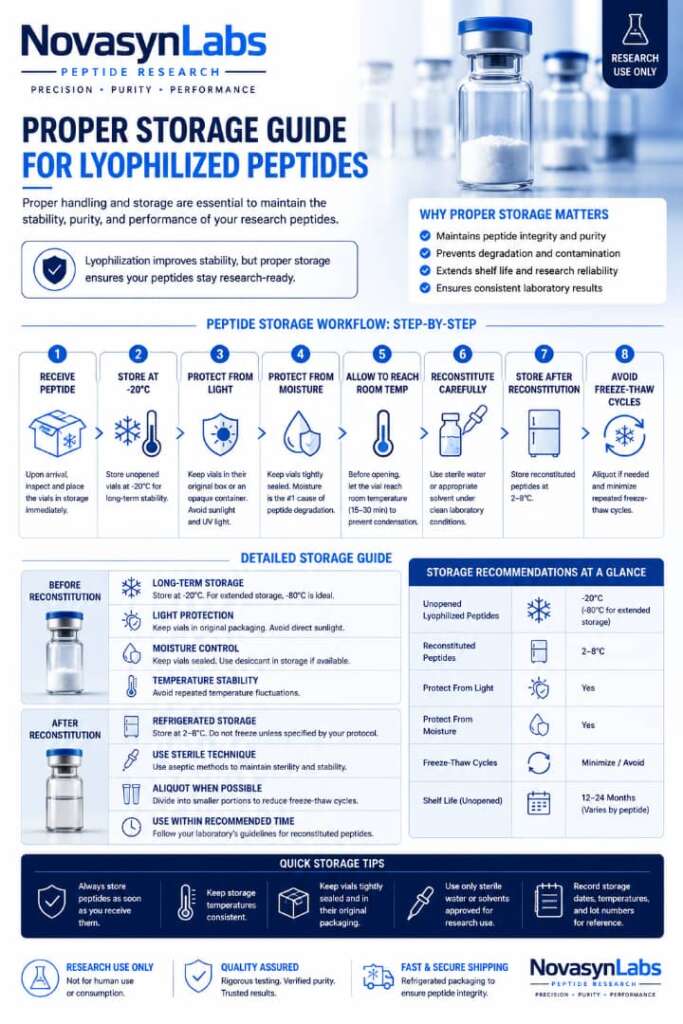
Even the highest-quality lyophilized peptide depends on appropriate storage to help preserve its condition before and after reconstitution.
Before Reconstitution
Store unopened lyophilized peptides in a cool, dry location away from direct sunlight and humidity.
For longer-term storage, freezing at -20°C is generally recommended.
Laboratories requiring extended preservation often use -80°C storage when available.
Protect from Light
Ultraviolet light may contribute to degradation of sensitive laboratory materials over time.
Whenever possible:
- Store vials in their original packaging.
- Use amber containers if appropriate.
- Avoid prolonged exposure to direct sunlight.
Prevent Moisture Exposure
Moisture is one of the primary reasons peptides are freeze-dried in the first place.
To minimize condensation:
- Keep vials tightly sealed.
- Allow frozen vials to reach room temperature before opening.
- Avoid exposing open vials to humid environments.
Shipping Conditions
NovaSynLabs ships research peptides in insulated protective packaging designed to help support product stability during transportation across Europe and the United States.
Long-Term Storage
For maximum stability:
- Keep unopened lyophilized peptides frozen.
- Avoid repeated warming and cooling.
- Minimize unnecessary handling.
After Reconstitution
Once the peptide has been reconstituted:
- Store at 2–8°C.
- Use sterile laboratory handling techniques.
- Avoid unnecessary temperature fluctuations.
- Consider preparing aliquots to reduce repeated freeze–thaw cycles.
Storage Recommendations at a Glance
| Stage | Recommended Practice |
| Before reconstitution | Cool, dry place |
| Long-term storage | -20°C |
| Extended storage | -80°C (when available) |
| After reconstitution | 2–8°C |
| Light exposure | Protect from sunlight and UV |
| Moisture | Keep vial tightly sealed |
| Shipping | Use insulated protective packaging |
| Handling | Minimize repeated freeze-thaw cycles |
Case Study 1: Long-Term Storage Success with Lyophilized Peptides
Proper storage is one of the biggest factors influencing the stability of lyophilized research peptides. The following example demonstrates how appropriate handling can help preserve peptide quality over an extended period.
Background
A European research laboratory purchased several lyophilized peptide vials from NovaSynLabs for a long-term experimental project. Because the study was not scheduled to begin immediately, the researchers followed recommended storage procedures upon receiving the shipment.
The unopened peptide vials were:
- Stored immediately at -20°C
- Protected from direct light
- Kept away from moisture
- Left unopened until needed
Approximately six months later, the laboratory prepared to begin the study.
Before opening the vials, they allowed them to gradually reach room temperature to reduce the risk of condensation forming inside the container. The peptides were then reconstituted using sterile laboratory techniques and stored at 2–8°C during active use.
Outcome
Throughout the study, the laboratory reported consistent experimental performance from the peptide samples.
Although many factors influence laboratory results, this case highlights how appropriate storage, careful handling, and proper reconstitution practices can help preserve sample integrity before use.
Key Takeaways
✔ Store unopened lyophilized peptides frozen whenever possible.
✔ Protect vials from moisture and direct light.
✔ Allow frozen vials to reach room temperature before opening.
✔ Use sterile laboratory procedures during reconstitution.
Case Study 2: Reduced Stability from Improper Handling
Freeze-drying significantly improves peptide stability before reconstitution, but improper handling afterward may increase the risk of degradation.
Background
A research group reconstituted a peptide for an ongoing laboratory project.
Instead of preparing smaller aliquots, the same vial was repeatedly removed from freezer storage over several weeks.
The peptide experienced numerous:
- Freeze–thaw cycles
- Temperature fluctuations
- Extended handling periods
Each thaw exposed the peptide solution to conditions that can contribute to gradual degradation over time.
Outcome
As the project progressed, the research team became concerned about maintaining sample integrity.
Rather than continue using the repeatedly thawed peptide, they chose to discontinue use of that vial and prepare a fresh aliquot for subsequent experiments.
Although this decision was precautionary, the experience reinforced an important lesson for future studies.
Lessons Learned
- Prepare aliquots whenever practical.
- Avoid repeated freeze–thaw cycles.
- Store reconstituted peptides consistently at 2–8°C unless laboratory protocols specify otherwise.
- Minimize unnecessary handling.
Why Quality Testing Matters Before Lyophilization
Many researchers focus primarily on freeze-drying, but quality begins long before lyophilization.
A peptide that has not undergone appropriate analytical testing cannot be improved simply by removing water.
This is why reputable manufacturers combine rigorous quality control with freeze-drying.
At NovaSynLabs, quality assurance includes multiple analytical techniques designed to evaluate identity, purity, and consistency before peptides are released for research use.
High-Performance Liquid Chromatography (HPLC)
HPLC is one of the most widely used analytical techniques in peptide manufacturing.
It separates peptide components and helps evaluate purity by identifying impurities that may remain after synthesis.
LC-MS
Liquid Chromatography-Mass Spectrometry combines chromatographic separation with molecular analysis.
This technique provides additional confidence regarding peptide composition and analytical consistency.
Mass Spectrometry
Mass spectrometry confirms that the molecular weight corresponds with the intended peptide.
This helps verify peptide identity before freeze-drying.
Peptide Identity Testing
Identity testing confirms that researchers receive the correct peptide sequence ordered for their laboratory work.
Purity Testing
Purity testing measures the proportion of the desired peptide compared with synthesis-related impurities.
Sterility Testing
Where applicable, sterility testing supports clean manufacturing practices and laboratory-quality handling.
Batch Consistency
Researchers conducting ongoing projects often rely on consistent material from one manufacturing batch to another.
Batch consistency testing helps verify that analytical characteristics remain consistent across production lots.
Certificate of Analysis (COA)
Following analytical testing, qualifying products are supplied with a Certificate of Analysis (COA) documenting key quality-control results.
This documentation provides researchers with greater transparency regarding the tested batch.
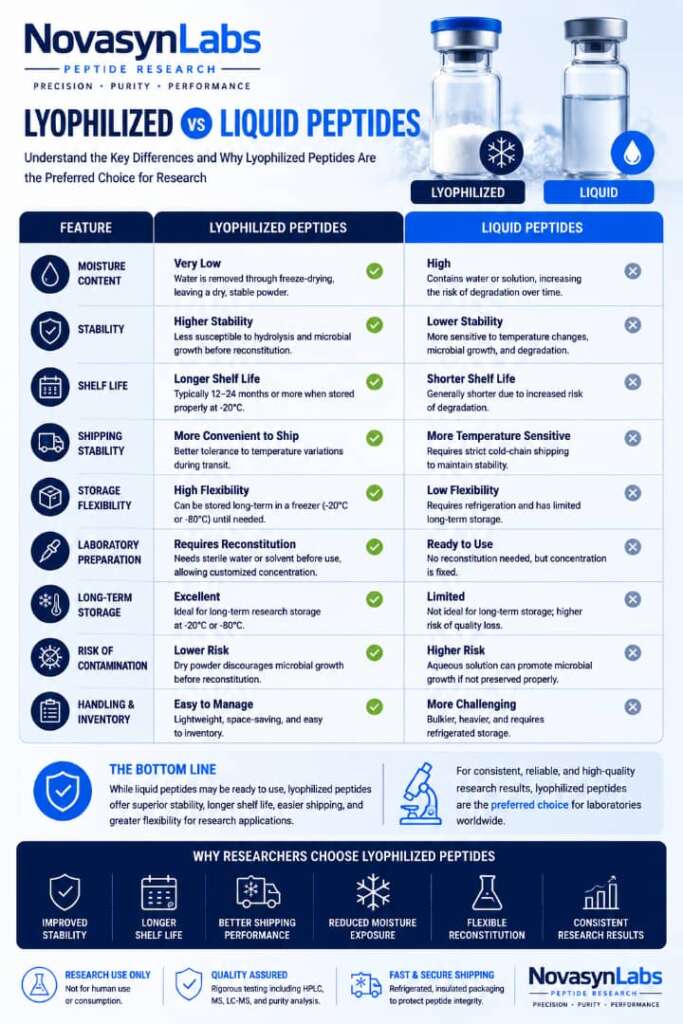
Lyophilized Peptides vs. Liquid Peptides
Although both forms may be suitable for specific research applications, lyophilized peptides are generally preferred for storage and transportation before reconstitution.
| Feature | Lyophilized Peptides | Liquid Peptides |
| Moisture Content | Very low | High |
| Storage Stability | Generally higher before reconstitution | More sensitive over time |
| Shelf Life | Typically longer under recommended storage | Often shorter |
| Shipping | More convenient | Greater temperature sensitivity |
| Laboratory Preparation | Requires reconstitution | Ready for use |
| Long-Term Storage | Well suited for frozen storage | Requires careful cold-chain management |
| Risk of Moisture-Related Degradation | Reduced | Higher |
Why Researchers Continue to Choose Lyophilized Peptides
Freeze-drying has become the preferred preservation method for many research peptides because it provides practical advantages throughout the product lifecycle.
Researchers value lyophilized peptides because they help support:
- Improved stability before reconstitution
- Longer storage potential
- Convenient laboratory inventory management
- Better shipping performance
- Reduced moisture exposure
- Flexible reconstitution timing
- Reliable handling during long-term research projects
When combined with analytical testing, proper packaging, and appropriate storage, lyophilization plays an important role in maintaining peptide quality from manufacturing through laboratory use.
Frequently Asked Questions
Why are peptides lyophilized?
Peptides are lyophilized to remove water while helping preserve stability before reconstitution. Freeze-drying can reduce moisture-related degradation, improve storage potential, and make transportation more practical.
What does lyophilized mean?
Lyophilized means a product has been freeze-dried through a controlled process that removes frozen water by sublimation under vacuum, leaving a dry powder.
Are all research peptides lyophilized?
Many research peptides—including BPC-157, TB-500, CJC-1295, Ipamorelin, Tesamorelin, MOTS-c, SS-31, GHK-Cu, Semaglutide, Tirzepatide, and Retatrutide—are commonly supplied in lyophilized form because of the storage and stability advantages before reconstitution.
Does freeze-drying affect peptide purity?
Lyophilization itself is intended to preserve the peptide rather than increase its purity. Purity is established earlier through manufacturing and analytical testing such as HPLC and mass spectrometry.
How should lyophilized peptides be stored?
For long-term storage, unopened lyophilized peptides are commonly stored at -20°C, with -80°C used in some laboratories for extended preservation. They should also be protected from moisture, light, and repeated temperature changes.
How should reconstituted peptides be stored?
After reconstitution, peptides are typically stored at 2–8°C using sterile laboratory handling techniques. Repeated freeze–thaw cycles should be minimized.
Why is a Certificate of Analysis important?
A Certificate of Analysis (COA) provides documentation of analytical testing, helping researchers review information such as identity, purity, and other quality-control results for the tested batch.
Why do researchers prefer lyophilized peptides for shipping?
Because they contain very little moisture, lyophilized peptides are generally easier to transport and store before reconstitution than comparable liquid preparations.
Conclusion
Understanding why peptides are lyophilized helps researchers appreciate why freeze-drying has become the industry standard for preserving many research compounds. By removing water through a carefully controlled process, lyophilization supports improved stability, longer storage potential, and greater convenience during transportation and laboratory handling.
However, freeze-drying is only one part of a comprehensive quality system. Analytical testing, including HPLC, LC-MS, mass spectrometry, peptide identity testing, purity assessment, sterility testing, and batch consistency verification, remains essential before a peptide is released for research.
With over 20 years of experience, NovaSynLabs has supplied thousands of research customers across the United States and Europe, combining rigorous quality control, protective packaging, and responsive customer support to help laboratories obtain dependable research materials.
Whether you’re working with BPC-157, TB-500, CJC-1295, Ipamorelin, Tesamorelin, MOTS-c, SS-31, GHK-Cu, Semaglutide, Tirzepatide, or Retatrutide, understanding the science behind lyophilization can help you make informed decisions about storage, handling, and laboratory best practices.
Research Use Only: All peptides supplied by NovaSynLabs are intended for laboratory research purposes only. They are not approved for human consumption, therapeutic use, or veterinary use unless expressly indicated by applicable regulatory authorities.
Continue Your Reading
External References

