



No products in the cart.

What Is the Best Weight Loss Peptide? The New Contenders in Europe (2026 Research Guide)
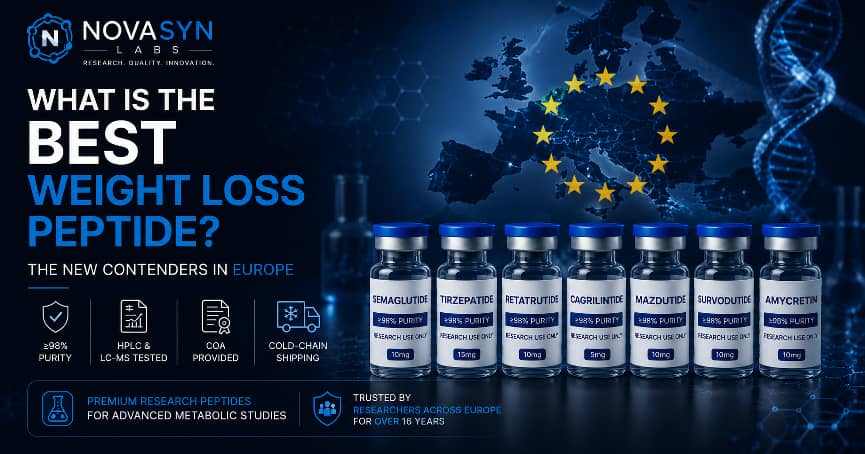
Table of Contents
What Is the Best Weight Loss Peptide?
The search for the best weight loss peptide has accelerated rapidly over the past few years, particularly across Europe, where researchers continue to evaluate a growing number of next-generation metabolic peptides. While semaglutide remains one of the most extensively studied GLP-1 receptor agonists, newer compounds—including tirzepatide, retatrutide, amycretin, survodutide, cagrilintide, and mazdutide—are expanding the landscape of peptide research.
Each peptide has distinct receptor targets, pharmacological characteristics, and areas of scientific interest. Rather than asking which peptide is universally “best,” researchers increasingly ask a more meaningful question:
Which peptide is best suited for a specific research objective?
Some compounds primarily activate the GLP-1 receptor, while others simultaneously target GIP receptors, glucagon receptors, or amylin pathways. These differences influence why researchers choose one peptide over another and explain why no single compound is appropriate for every experimental design.
At NovaSyn Labs, we have supplied research peptides for more than 16 years, serving over 6,000–7,000 research customers throughout Europe. During this time, we have observed significant growth in demand for semaglutide, tirzepatide, and more recently retatrutide, reflecting broader research trends across metabolic science.
Every batch supplied by NovaSyn Labs undergoes rigorous quality verification, including:
- ≥98% purity
- Third-party HPLC testing
- LC-MS verification
- Certificate of Analysis (COA)
- Cold-chain shipping
- Quality-controlled packaging
- Manufacturing standards designed to support research consistency
This guide compares today’s leading weight loss peptides from a research perspective, explains why receptor targets matter, highlights emerging European research trends, and discusses why peptide quality, storage, and analytical testing remain essential for reproducible laboratory studies.
Important: This article is intended for educational and laboratory research purposes only. It does not provide medical advice or recommend the use of any peptide outside approved research or clinical settings.
Quick Answer
What Is the Best Weight Loss Peptide?
There is no single “best” weight loss peptide for every research application.
Instead, the most appropriate peptide depends on the biological pathway being investigated and the objectives of the study.
For example:
| Research Objective | Frequently Studied Peptide |
| Established GLP-1 receptor research | Semaglutide |
| Dual incretin receptor studies | Tirzepatide |
| Triple receptor metabolic research | Retatrutide |
| GLP-1 and amylin combination research | Cagrilintide |
| Next-generation amylin research | Amycretin |
| GLP-1/glucagon co-agonist research | Survodutide |
| Emerging metabolic peptide research | Mazdutide |
Why Europe Is Becoming a Global Hub for Weight Loss Peptide Research
Europe has become one of the world’s leading regions for metabolic peptide research. Academic institutions, biotechnology companies, and pharmaceutical organizations continue to investigate innovative receptor-targeting compounds aimed at improving our understanding of obesity, metabolism, and related biological pathways.
Several factors contribute to this growing interest:
- Expansion of GLP-1 receptor research
- Development of dual- and triple-receptor agonists
- Increased collaboration between universities and biotechnology companies
- Growing publication of peer-reviewed metabolic studies
- Advances in peptide manufacturing and analytical testing
The result is an increasingly diverse pipeline of peptides with different receptor profiles and potential research applications.
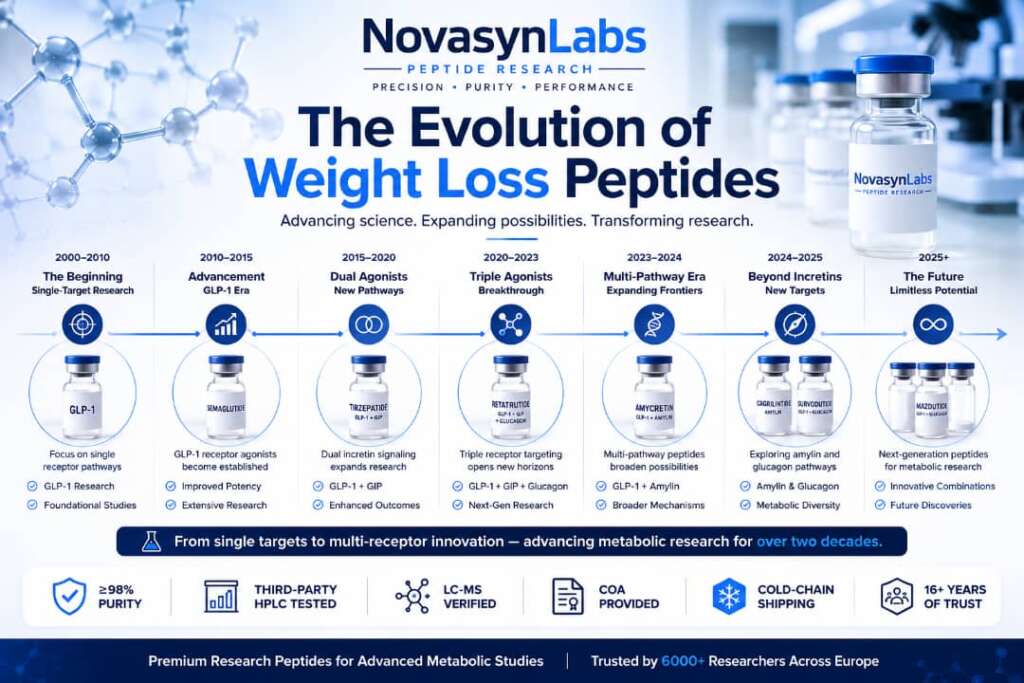
The Evolution of Weight Loss Peptides
The field has progressed well beyond traditional GLP-1 receptor agonists.
Today’s researchers are investigating compounds that activate multiple signaling pathways simultaneously.
Evolution Timeline
GLP-1 Agonists
(Semaglutide)
↓Dual Agonists
(GLP-1 + GIP)
(Tirzepatide)
↓Triple Agonists
(GLP-1 + GIP + Glucagon)
(Retatrutide)
↓GLP-1 + Amylin
(Cagrilintide / Amycretin)
↓Next-Generation Multi-Target Peptides
(Survodutide • Mazdutide)
Why Receptor Targets Matter
One of the biggest misconceptions is that all weight loss peptides work through the same biological mechanisms.
In reality, receptor targets are one of the primary reasons researchers choose one peptide over another.
Each receptor activates different signaling pathways that may influence metabolism, appetite regulation, energy expenditure, or other physiological processes.
Understanding these receptor interactions helps researchers design studies that align with their scientific objectives.
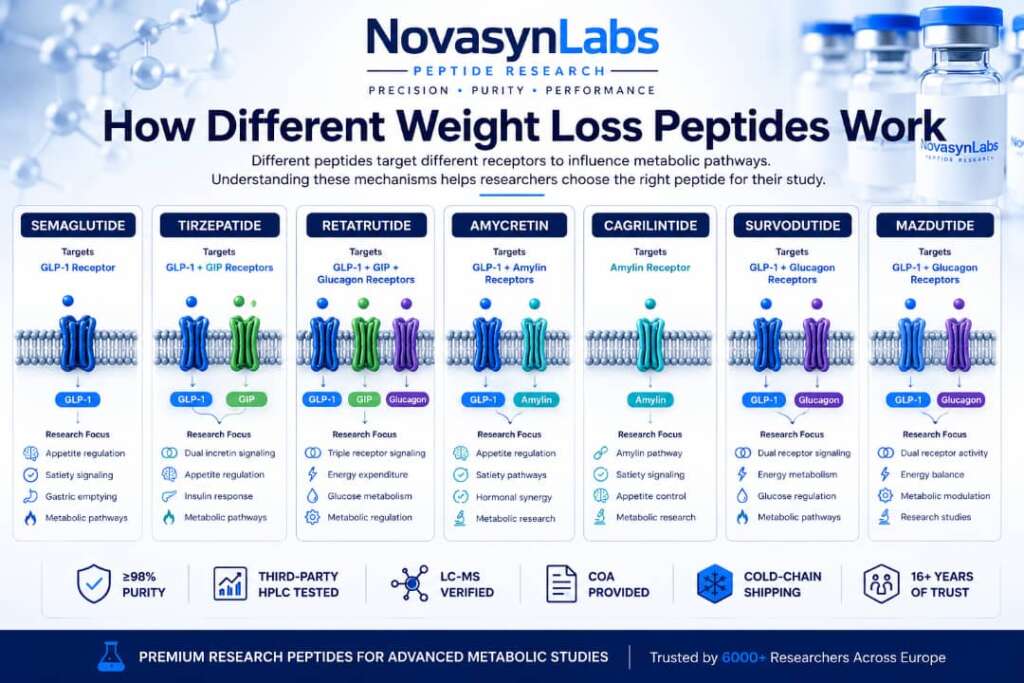
The Major Receptor Targets
GLP-1 Receptor
The glucagon-like peptide-1 (GLP-1) receptor is one of the most extensively studied metabolic receptors.
Researchers investigate GLP-1 signaling because it plays an important role in:
- Appetite regulation
- Glucose metabolism
- Gastric emptying
- Satiety signaling
Example peptide:
Semaglutide
GIP Receptor
Glucose-dependent insulinotropic polypeptide (GIP) receptors are increasingly being investigated alongside GLP-1 receptors.
Researchers study GIP signaling to better understand metabolic regulation and how multiple incretin pathways interact.
Example peptide:
Tirzepatide
Glucagon Receptor
Glucagon receptor activation is an active area of metabolic research.
Combining glucagon receptor activity with GLP-1 and GIP signaling has generated significant scientific interest because researchers continue investigating how multiple receptor pathways interact.
Example peptide:
Retatrutide
Amylin Pathway
Amylin analogues represent another growing area of peptide research.
Researchers continue exploring how amylin-related mechanisms may complement GLP-1 receptor activation within experimental models.
Examples
Amycretin
Cagrilintide
Table: Which Receptors Do These Peptides Target?
| Peptide | GLP-1 | GIP | Glucagon | Amylin |
| Semaglutide | ✓ | — | — | — |
| Tirzepatide | ✓ | ✓ | — | — |
| Retatrutide | ✓ | ✓ | ✓ | — |
| Amycretin | ✓ | — | — | ✓ |
| Cagrilintide | —* | — | — | ✓ |
| Survodutide | ✓ | — | ✓ | — |
| Mazdutide | ✓ | — | ✓ | — |
*Note: Cagrilintide is an amylin analogue rather than a GLP-1 receptor agonist, though it has been investigated alongside GLP-1-based approaches in research.
Why Researchers Are Looking Beyond Semaglutide
Semaglutide remains one of the most widely studied metabolic peptides worldwide.
However, newer compounds are expanding the field by targeting multiple biological pathways simultaneously.
Researchers are increasingly interested in questions such as:
- Can activating multiple receptors produce different biological responses?
- How do dual agonists compare with traditional GLP-1 receptor agonists?
- What role might triple agonists play in future metabolic research?
- Can amylin-based compounds complement GLP-1 receptor activation?
These questions continue to drive innovation throughout Europe and have contributed to growing interest in peptides such as tirzepatide, retatrutide, amycretin, survodutide, and mazdutide.
Expert Insight from NovaSyn Labs
Over the past 16+ years, NovaSyn Labs has supplied research peptides to more than 6,000–7,000 research customers across Europe.
One trend has become increasingly clear: researchers are no longer evaluating peptides based solely on popularity. Instead, they focus on selecting compounds that best match their specific experimental objectives while ensuring analytical quality and reproducibility.
As demand has evolved, Semaglutide, Tirzepatide, and Retatrutide have become the three most frequently requested metabolic research peptides from our European customer base.
Every batch supplied by NovaSyn Labs is supported by:
- ≥98% purity
- Third-party HPLC testing
- LC-MS verification
- Certificate of Analysis (COA)
- Cold-chain shipping
- Quality-controlled packaging
- Manufacturing standards designed to support reliable laboratory research
These quality-control measures help researchers begin their work with well-characterized materials backed by documented analytical testing.
Comparing Europe’s Leading Weight Loss Peptides
As metabolic peptide research advances, scientists are evaluating a growing range of compounds with different receptor targets and mechanisms of action. While all of the peptides discussed in this guide are associated with metabolic research, they are not interchangeable.
Some primarily activate the GLP-1 receptor, while others stimulate multiple receptors simultaneously or combine GLP-1 activity with additional pathways such as GIP, glucagon, or amylin signaling.
Understanding these differences helps researchers choose the most appropriate peptide for their specific experimental objectives.
Weight Loss Peptide Comparison Table
| Peptide | Primary Target(s) | Research Focus | Research Maturity |
| Semaglutide | GLP-1 | Appetite regulation, metabolic pathways | Extensive |
| Tirzepatide | GLP-1 + GIP | Dual incretin signaling | Extensive |
| Retatrutide | GLP-1 + GIP + Glucagon | Triple receptor metabolic research | Growing rapidly |
| Amycretin | GLP-1 + Amylin | Multi-pathway metabolic research | Emerging |
| Cagrilintide | Amylin | Satiety pathway research | Growing |
| Survodutide | GLP-1 + Glucagon | Energy metabolism research | Emerging |
| Mazdutide | GLP-1 + Glucagon | Next-generation metabolic research | Emerging |
Semaglutide
Semaglutide remains one of the most extensively researched GLP-1 receptor agonists worldwide and serves as a benchmark compound in metabolic research.
Researchers frequently select semaglutide because of its extensive scientific literature, well-characterized pharmacology, and reproducible laboratory protocols.
Primary Receptor
✔ GLP-1
Common Research Areas
- Appetite regulation
- Satiety signaling
- Gastric emptying
- Metabolic pathway research
- GLP-1 receptor biology
Why Researchers Continue Choosing Semaglutide
- Extensive peer-reviewed literature
- Well-established laboratory protocols
- Excellent comparison compound
- Widely referenced in published research
- Suitable for long-term metabolic studies
NovaSyn Labs currently supplies:
- 5 mg
- 10 mg
- 15 mg
- 20 mg
- 30 mg
Tirzepatide
Tirzepatide introduced an important advancement by activating both the GLP-1 and GIP receptors.
Rather than targeting a single receptor, tirzepatide allows researchers to investigate interactions between two incretin pathways.
Its growing body of published literature has made it one of Europe’s fastest-growing research peptides.
Primary Receptors
✔ GLP-1
✔ GIP
Common Research Areas
- Dual incretin biology
- Metabolic regulation
- Appetite signaling
- Comparative receptor studies
- Hormonal pathway research
Available at NovaSyn Labs
- 5 mg
- 10 mg
- 15 mg
- 20 mg
- 30 mg
- 40 mg
- 45 mg
- 50 mg
- 60 mg
Retatrutide
Retatrutide represents one of the newest developments in metabolic peptide research.
Unlike semaglutide and tirzepatide, retatrutide activates three receptors simultaneously:
- GLP-1
- GIP
- Glucagon
Because of this triple-agonist profile, researchers continue investigating its broader metabolic signaling characteristics.
Primary Receptors
✔ GLP-1
✔ GIP
✔ Glucagon
Current Research Interest
- Triple receptor activation
- Energy metabolism
- Multi-pathway signaling
- Comparative metabolic studies
- Next-generation obesity research
Available at NovaSyn Labs
- 5 mg
- 10 mg
- 15 mg
- 20 mg
- 30 mg
- 40 mg
- 50 mg
Amycretin
Amycretin is an emerging peptide being studied for its combined GLP-1 and amylin receptor activity.
Researchers are interested in understanding how these complementary pathways may interact within metabolic research models.
Primary Targets
✔ GLP-1
✔ Amylin
Research Focus
- Appetite pathway research
- Hormonal interaction studies
- Multi-target peptide biology
- Next-generation metabolic research
Although still relatively new compared with semaglutide, amycretin has generated considerable scientific interest because of its dual-mechanism approach.
Cagrilintide
Cagrilintide differs from traditional GLP-1 receptor agonists because it is primarily an amylin analogue.
Rather than directly activating GLP-1 receptors, researchers investigate cagrilintide for its effects on amylin signaling and its role in appetite-related research.
Primary Target
✔ Amylin
Research Areas
- Satiety pathways
- Amylin receptor biology
- Combination peptide research
- Appetite regulation studies
NovaSyn Labs currently supplies:
- 5 mg
- 10 mg
Survodutide
Survodutide combines GLP-1 receptor activity with glucagon receptor activation.
Researchers are increasingly investigating how these dual mechanisms may contribute to metabolic regulation within experimental models.
Primary Targets
✔ GLP-1
✔ Glucagon
Research Areas
- Dual receptor biology
- Energy metabolism
- Experimental metabolic pathways
- Emerging obesity research
NovaSyn Labs currently supplies:
- 10 mg
Mazdutide
Mazdutide is another emerging peptide attracting attention within European research communities.
Like survodutide, it combines GLP-1 and glucagon receptor activity while being investigated across a variety of metabolic research applications.
Primary Targets
✔ GLP-1
✔ Glucagon
Research Areas
- Energy balance research
- Metabolic signaling
- Receptor interaction studies
- Experimental obesity research
NovaSyn Labs currently supplies:
- 10 mg
Comparison Table: Which Peptide Fits Which Research Objective?
| Research Objective | Frequently Selected Peptide |
| Established GLP-1 receptor studies | Semaglutide |
| Dual incretin pathway research | Tirzepatide |
| Triple receptor signaling | Retatrutide |
| GLP-1 + amylin investigations | Amyeretin |
| Amylin pathway research | Cagrilintide |
| GLP-1 + glucagon studies | Survodutide |
| Emerging metabolic pathway research | Mazdutide |
Note: Selection should always be based on the scientific objectives of the study, not on the assumption that one peptide is universally “better” than another.
GLP-1 vs Dual Agonists vs Triple Agonists
One of the biggest shifts in metabolic peptide research has been the move from single-receptor agonists to compounds that activate multiple receptors.
| Category | Example | Receptor Targets | Research Focus |
| Single Agonist | Semaglutide | GLP-1 | Established GLP-1 biology |
| Dual Agonist | Tirzepatide | GLP-1 + GIP | Dual incretin signaling |
| Dual Agonist | Survodutide | GLP-1 + Glucagon | Energy metabolism |
| Triple Agonist | Retatrutide | GLP-1 + GIP + Glucagon | Multi-receptor research |
As research evolves, these newer compounds are expanding opportunities to investigate how multiple signaling pathways interact in metabolic studies.
Current Weight Loss Peptide Research Trends in Europe
European research institutions continue to expand investigations into next-generation metabolic peptides. While Semaglutide remains a cornerstone of GLP-1 receptor research, newer compounds are broadening the scope of metabolic studies.
Several trends are shaping current research:
- Increased interest in multi-receptor agonists.
- More comparative studies between established and emerging peptides.
- Greater emphasis on standardized laboratory workflows.
- Improved analytical testing requirements.
- Growing use of HPLC and LC-MS to verify peptide identity and purity.
- Stronger focus on reproducibility through standardized documentation.
Researchers are increasingly asking:
- Which receptor combinations produce different biological responses?
- How can laboratory variability be reduced?
- Which analytical methods best support reproducible research?
- How do storage and handling influence peptide integrity?
Why Receptor Targets Matter More Than Popularity
One common misconception is that the newest peptide is automatically the “best.”
In reality, experienced researchers choose peptides based on their receptor profile and experimental objectives, not simply because they are newer.
For example:
| Research Goal | Suitable Receptor Profile |
| Established GLP-1 signaling | GLP-1 |
| Dual incretin pathway studies | GLP-1 + GIP |
| Multi-receptor metabolic signaling | GLP-1 + GIP + Glucagon |
| Appetite pathway research involving amylin | GLP-1 + Amylin or Amylin |
Selecting the appropriate receptor profile helps ensure the peptide aligns with the scientific questions being investigated.
Anonymous Laboratory Case Study #1
Standardizing In Vitro GLP-1 Receptor Research with Semaglutide
Research Background
A university-affiliated molecular pharmacology laboratory was conducting in vitro GLP-1 receptor signaling research. The research team required a peptide with comprehensive analytical documentation and consistent batch characteristics to minimize variability throughout multiple experimental phases.
Why Researchers Selected Semaglutide
The laboratory required:
- High analytical purity supported by HPLC testing
- Batch-specific Certificate of Analysis (COA)
- Reliable lot-to-lot consistency
- Lyophilized format suitable for controlled storage
- Complete documentation for internal quality assurance
Research Objective
The investigators aimed to evaluate GLP-1 receptor activation under standardized laboratory conditions while minimizing variability introduced by inconsistent experimental materials.
Timeline
| Timeline | Activity |
| Week 1 | Procurement, COA review, identity verification, inventory documentation |
| Week 2 | Controlled storage, reconstitution validation, pilot assays |
| Weeks 3-6 | Cell-based receptor signaling studies, repeat experiments, data collection |
| Week 7 | Internal quality review and comparison across experiments |
Laboratory Workflow
Supplier Documentation
↓
COA Verification
↓
Cold Storage
↓
Controlled Reconstitution
↓
Aliquot Preparation
↓
Cell-Based Assays
↓
Experimental Documentation
↓
Data Analysis
Lessons Learned
The laboratory concluded that:
- Identical preparation procedures reduced experimental variability.
- Recording lot numbers improved traceability.
- Single-use aliquots minimized freeze–thaw cycles.
- Standardized documentation improved reproducibility across researchers.
Anonymous Laboratory Case Study #2
Batch Consistency Evaluation During TB-500 Stability Research
Although focused on TB-500, this case study highlights laboratory quality principles that apply broadly to peptide research.
Research Background
An independent biomedical laboratory evaluated peptide handling procedures and storage practices during preclinical stability studies.
The objective centered on maintaining consistent laboratory conditions rather than investigating biological outcomes.
Why Researchers Selected TB-500
Researchers required:
- Consistent manufacturing documentation
- Verified analytical testing
- Reliable peptide identity confirmation
- Stable lyophilized material
Research Objective
The laboratory sought to compare analytical consistency across multiple experimental sessions while evaluating how standardized handling procedures influenced reproducibility.
Timeline
| Timeline | Activity |
| Day 1 | Shipment inspection and documentation review |
| Days 2-3 | Inventory logging and controlled storage |
| Weeks 2-8 | Experimental assays, sample preparation, documentation |
| Week 8 | Internal quality monitoring and record review |
Laboratory Workflow
Shipment Inspection
↓
Inventory Registration
↓
COA Documentation
↓
Cold Storage
↓
Sample Preparation
↓
Aliquot Labeling
↓
Experimental Assays
↓
Quality Documentation
Lessons Learned
Researchers found that:
- Standardized labeling reduced handling errors.
- Temperature records improved traceability.
- Uniform preparation procedures increased consistency.
- Complete documentation simplified future replication.
What Both Laboratories Had in Common
Although studying different peptides, both laboratories relied on similar quality-control practices.
Shared Best Practices
- Review the Certificate of Analysis before experimentation.
- Verify analytical testing documentation.
- Maintain cold-chain storage.
- Record lot numbers and preparation dates.
- Use standardized reconstitution procedures.
- Minimize freeze–thaw cycles.
- Document every experimental step.
- Maintain comprehensive laboratory records.
Why Peptide Quality Matters
One of the most overlooked aspects of peptide research is the quality of the starting material.
Even the most carefully designed study may encounter unnecessary variability if peptide identity, purity, or storage conditions are not properly controlled.
Researchers therefore place considerable emphasis on:
- Manufacturing quality
- Analytical verification
- Stability
- Storage conditions
- Documentation
- Batch consistency
NovaSyn Labs Quality Standards
For more than 16 years, NovaSyn Labs has supplied research peptides to over 6,000–7,000 research customers throughout Europe.
Every peptide batch is supported by rigorous quality assurance, including:
- ≥98% purity
- Third-party HPLC testing
- LC-MS verification
- Certificate of Analysis (COA)
- Quality-controlled packaging
- Cold-chain shipping
- Manufacturing standards designed to support laboratory research
These measures help researchers begin their projects with well-characterized materials backed by documented analytical testing.
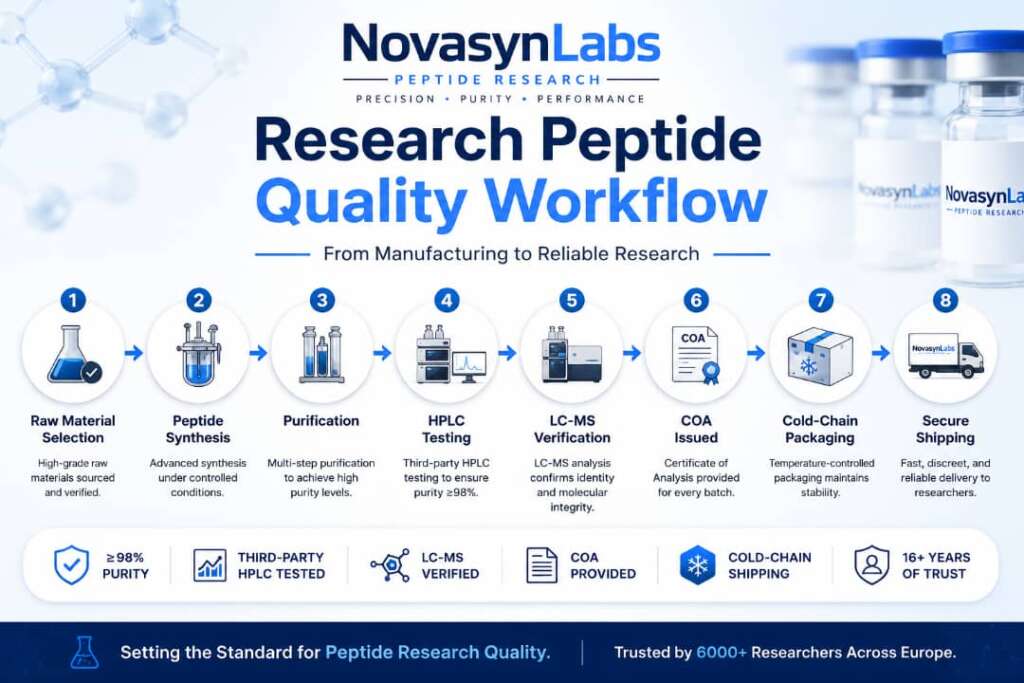
Our Quality-Control Process
Raw Material Selection
↓
Peptide Manufacturing
↓
Purification
↓
Third-Party HPLC Testing
↓
LC-MS Verification
↓
Certificate of Analysis (COA)
↓
Cold-Chain Packaging
↓
Quality Inspection
↓
Shipment
Why HPLC and LC-MS Matter
Two of the most important analytical methods used in peptide quality assurance are High-Performance Liquid Chromatography (HPLC) and Liquid Chromatography–Mass Spectrometry (LC-MS).
| Method | Purpose |
| HPLC | Measures peptide purity and detects impurities. |
| LC-MS | Confirms molecular identity and molecular weight. |
Together, these techniques provide researchers with greater confidence that the supplied material matches the documented specifications.
Storage and Stability Best Practices
Proper storage is essential for maintaining peptide integrity throughout a research project.
Before Reconstitution
- Store in a cool, dry, dark location.
- Refrigerate at 2–8°C (36–46°F) for long-term storage when recommended.
- Protect from moisture and direct sunlight.
- Keep vials in their original packaging until use.
During Reconstitution
- Use sterile technique appropriate to the laboratory protocol.
- Add diluent slowly along the inside wall of the vial.
- Gently swirl until dissolved.
- Avoid vigorous shaking.
After Reconstitution
- Refrigerate at 2–8°C (36–46°F).
- Protect from light.
- Avoid repeated freeze–thaw cycles.
- Record the preparation date and beyond-use date.
- Inspect the solution before each use.
Common Misconceptions About Weight Loss Peptides
As newer metabolic peptides gain attention across Europe, misconceptions have become increasingly common. Understanding the science behind these compounds helps researchers make informed decisions and design more meaningful studies.
Misconception #1: There Is One “Best” Weight Loss Peptide
Reality: There is no universal “best” peptide. The most appropriate choice depends on the research objective, receptor targets being investigated, and the study design.
Misconception #2: Newer Peptides Are Automatically Better
Reality: Emerging peptides such as Retatrutide, Amycretin, Survodutide, and Mazdutide are generating significant interest, but Semaglutide and Tirzepatide remain among the most extensively studied compounds. A newer peptide is not inherently superior simply because it is more recent
Misconception #3: All Weight Loss Peptides Work the Same Way
Reality: These peptides target different biological pathways.
- Semaglutide: GLP-1 receptor
- Tirzepatide: GLP-1 + GIP receptors
- Retatrutide: GLP-1 + GIP + glucagon receptors
- Cagrilintide: Amylin pathway
- Amycretin: GLP-1 + amylin pathways
- Survodutide: GLP-1 + glucagon receptors
- Mazdutide: GLP-1 + glucagon receptors
Their differing receptor profiles make them suitable for different types of metabolic research.
Misconception #4: Peptide Purity Doesn’t Matter
Reality: Analytical quality is fundamental to reliable research. Peptides supported by HPLC testing, LC-MS verification, batch-specific Certificates of Analysis (COAs), and consistent manufacturing standards help reduce avoidable experimental variability.
Misconception #5: Storage Has Little Impact on Research
Reality: Improper storage, repeated freeze–thaw cycles, and inadequate documentation can compromise peptide integrity and affect research reproducibility.
Frequently Asked Questions
1. What is the best weight loss peptide in Europe?
There is no single answer. The most suitable peptide depends on the biological pathway and research objective. Semaglutide, Tirzepatide, Retatrutide, Amycretin, Cagrilintide, Survodutide, and Mazdutide each offer different receptor profiles for different areas of metabolic research
2. Which weight loss peptide is the most researched?
Semaglutide remains one of the most extensively studied GLP-1 receptor agonists, supported by a large body of peer-reviewed scientific literature.
3. Why is Tirzepatide receiving so much attention?
Tirzepatide activates both GLP-1 and GIP receptors, allowing researchers to investigate dual incretin signaling in metabolic studies.
4. Why is Retatrutide considered a next-generation peptide?
Retatrutide simultaneously targets GLP-1, GIP, and glucagon receptors, making it one of the most actively investigated triple-agonist peptides in metabolic research.
5. What is Amycretin?
Amycretin is an emerging peptide being studied for its combined GLP-1 and amylin pathway activity, with ongoing research exploring its potential role in metabolic signaling.
6. What makes Cagrilintide different?
Cagrilintide is an amylin analogue rather than a GLP-1 receptor agonist, making it valuable for research focused on amylin-related pathways.
7. Why are Survodutide and Mazdutide attracting attention?
Both peptides combine GLP-1 receptor activity with glucagon receptor activation, expanding opportunities to investigate multi-pathway metabolic signaling.
8. Why are HPLC and LC-MS testing important?
HPLC helps assess peptide purity, while LC-MS confirms molecular identity. Together, they provide documented analytical verification to support laboratory research.
9. Why is a Certificate of Analysis important?
A Certificate of Analysis (COA) documents analytical testing results, helping researchers verify batch specifications before beginning experiments.
10. How should research peptides be stored?
Researchers should follow product-specific storage instructions. In general, lyophilized peptides should be protected from heat, moisture, and light, while reconstituted peptides are typically refrigerated according to the recommended protocol.
11. Why do laboratories record lot numbers?
Recording lot numbers improves traceability, supports quality assurance, and makes it easier to compare results across different experiments.
12. How long has NovaSyn Labs supplied research peptides?
NovaSyn Labs has supplied research peptides for more than 16 years, serving over 6,000–7,000 research customers across Europe while providing comprehensive analytical documentation and quality-control support.
13. What quality standards does NovaSyn Labs provide?
Every batch is supported by:
- ≥98% purity
- Third-party HPLC testing
- LC-MS verification
- Certificate of Analysis (COA)
- Quality-controlled packaging
- Cold-chain shipping
- Manufacturing standards
14. Why do researchers compare receptor targets?
Different receptor combinations help researchers investigate different biological pathways. Choosing the appropriate receptor profile depends on the scientific objectives of the study.
15. Which NovaSyn Labs resources can help researchers learn more?
Researchers can explore additional educational guides covering:
- Semaglutide
- Tirzepatide
- Retatrutide
- Cagrilintide
- Peptide purity testing
- Peptide storage and handling
- GLP-1 research
Quick Comparison Summary
| Peptide | Main Receptor Target(s) | Research Focus |
| Semaglutide | GLP-1 | Established GLP-1 signaling |
| Tirzepatide | GLP-1 + GIP | Dual incretin biology |
| Retatrutide | GLP-1 + GIP + Glucagon | Triple receptor signaling |
| Amycretin | GLP-1 + Amylin | Emerging multi-pathway research |
| Cagrilintide | Amylin | Appetite-related pathway research |
| Survodutide | GLP-1 + Glucagon | Dual metabolic signaling |
| Mazdutide | GLP-1 + Glucagon | Emerging metabolic research |
Key Takeaways
- There is no universally “best” weight loss peptide; the most appropriate choice depends on the research question and receptor targets being investigated.
- Europe continues to be a major center for research on established and emerging metabolic peptides.
- Understanding receptor biology is essential when comparing GLP-1 agonists, dual agonists, and triple agonists.
- Peptide quality, analytical testing, proper storage, and standardized documentation are critical for reproducible laboratory research.
- Third-party HPLC testing, LC-MS verification, and batch-specific COAs provide valuable quality assurance before experiments begin.
Final Thoughts
The field of metabolic peptide research is evolving rapidly, with Europe playing a central role in advancing our understanding of GLP-1 receptor agonists, dual agonists, triple agonists, and other emerging peptide classes.
Rather than focusing on a single “best” weight loss peptide, researchers increasingly evaluate compounds based on receptor targets, study objectives, and the strength of available scientific evidence. Established peptides such as Semaglutide continue to serve as reference compounds, while Tirzepatide, Retatrutide, Amycretin, Cagrilintide, Survodutide, and Mazdutide are expanding opportunities to investigate complex metabolic pathways.
For more than 16 years, NovaSyn Labs has supported laboratories throughout Europe by supplying research peptides backed by ≥98% purity, third-party HPLC testing, LC-MS verification, batch-specific Certificates of Analysis (COAs), quality-controlled packaging, and cold-chain shipping. These quality standards help researchers begin their studies with well-characterized materials and documented analytical data.
As new discoveries continue to emerge, combining rigorous experimental design with high-quality peptide materials and thorough documentation will remain essential for advancing metabolic research.
Continue Your Research
Explore related resources from NovaSyn Labs:
- Semaglutide Research Peptide
- Retatrutide Research Peptide
- Peptide Storage Guide
- Peptide Purity Guide
- How Long Does It Take for Semaglutide to Suppress Appetite?
- GLP-1 vs Other Peptides: Which Should You Choose?
External References
- European Association for the Study of Diabetes (EASD) – Position statements and conference research.
- The Lancet – Peer-reviewed publications on obesity and metabolic medicine.
- New England Journal of Medicine (NEJM) – Semaglutide and tirzepatide clinical research.
- JAMA – Studies on metabolic therapies and obesity.
- Nature Reviews Endocrinology – Reviews on incretin biology and metabolic signaling.
- PubMed – Primary source for peer-reviewed literature on GLP-1 receptor agonists and emerging metabolic peptides.

