



No products in the cart.
How Long Does It Take for Semaglutide to Suppress Appetite? The Exact Week-by-Week Timeline (Research Guide 2026)
How Long Does It Take for Semaglutide to Suppress Appetite?
One of the most frequently asked questions surrounding semaglutide research is “How long does it take for semaglutide to suppress appetite?” While there is no universal timeline that applies to every individual or research model, available scientific literature and laboratory observations suggest that appetite-related changes may begin within the first week for some, while others may require two to four weeks before more noticeable effects are observed.
The timing depends on several variables, including dose-escalation protocols, biological variability, GLP-1 receptor responsiveness, experimental design, and the integrity of the peptide itself. Proper storage, handling, and product quality also play an important role in ensuring research consistency.
At NovaSyn Labs, we have supplied high-purity semaglutide for more than 16 years to over 600 research customers. Throughout this time, we’ve seen that researchers consistently emphasize not only the importance of the peptide itself but also standardized handling procedures, documentation, and quality assurance practices. Every batch is supported by third-party HPLC and LC-MS testing, accompanied by a Certificate of Analysis (COA), and shipped using cold-chain packaging designed to preserve peptide integrity during transit.
This guide explores the appetite suppression timeline from a research perspective, explains why responses vary, compares semaglutide with other GLP-1 receptor agonists, and provides practical laboratory insights to help researchers design reproducible studies.
Important: This article is intended for educational and research purposes only. It does not provide medical advice or recommend the use of semaglutide outside approved clinical settings.
Quick Answer: How Long Does It Take for Semaglutide to Suppress Appetite?
Research findings and laboratory observations indicate that some individuals may notice appetite-related changes within approximately one week, while others may require two to four weeks before experiencing more consistent appetite suppression.
Several factors influence this timeline, including:
- Dose-escalation schedules
- Individual biological differences
- GLP-1 receptor responsiveness
- Gastric emptying rate
- Experimental protocol consistency
- Peptide purity and stability
- Proper storage after reconstitution
Rather than expecting immediate changes after a single administration, researchers generally evaluate appetite-related outcomes over several weeks while maintaining standardized protocols and documenting observations carefully.
Key Takeaways
| Question | Quick Answer |
| Can appetite changes begin within one week? | Some research observations suggest yes. |
| Does everyone experience appetite changes at the same time? | No. Biological variability is expected. |
| When are more consistent appetite-related effects often evaluated? | Around Weeks 2-4 in many research protocols. |
| What influences the timeline? | Dose escalation, peptide quality, storage, protocol consistency, and individual variability. |
| Does higher purity matter? | High-purity material helps support research consistency, though it does not determine biological outcomes on its own. |
Why Does Semaglutide Reduce Appetite?
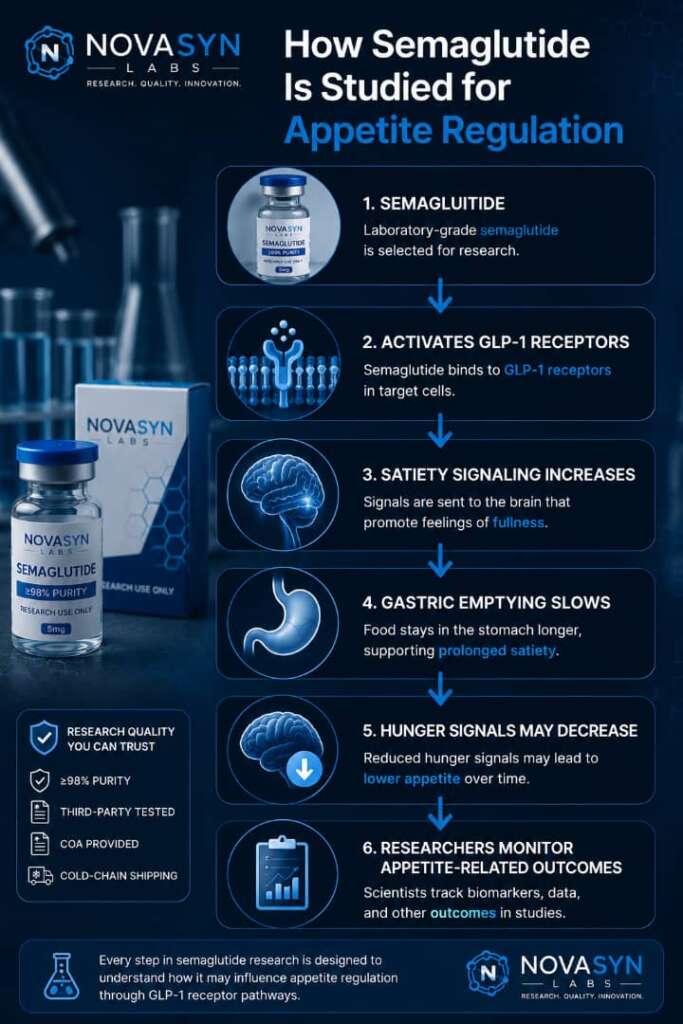
Semaglutide belongs to a class of compounds known as GLP-1 receptor agonists. These peptides are designed to activate the glucagon-like peptide-1 (GLP-1) receptor, a signaling pathway involved in glucose regulation, gastric emptying, and appetite-related processes.
Researchers study semaglutide because GLP-1 receptors are distributed throughout several organs involved in metabolic regulation, including the gastrointestinal tract, pancreas, and regions of the brain associated with satiety.
Although research continues to evolve, semaglutide is thought to influence appetite through several interconnected mechanisms.
- Activation of GLP-1 Receptors
Semaglutide binds to GLP-1 receptors and initiates intracellular signaling pathways that researchers associate with appetite regulation and metabolic function.
- Increased Satiety Signaling
Experimental studies suggest activation of GLP-1 pathways may enhance signals associated with fullness, contributing to reduced food intake in some research settings.
- Delayed Gastric Emptying
Semaglutide has also been studied for its effects on gastric emptying. Slower movement of food from the stomach may contribute to prolonged feelings of fullness after meals, although the extent of this effect can vary.
- Central Nervous System Effects
Researchers continue to investigate how GLP-1 receptor activation influences neural circuits involved in appetite regulation. These mechanisms are believed to contribute to changes in hunger signaling observed in research.
The Exact Week-by-Week Semaglutide Appetite Timeline
Although every research protocol differs, the following timeline summarizes observations commonly discussed in published literature and standardized laboratory workflows.
Week 1
During the first week, researchers typically focus on establishing baseline measurements and monitoring initial responses.
Some studies and observational reports indicate that appetite-related changes may begin during this period. However, many subjects show little or no noticeable difference at this early stage.
Researchers generally avoid drawing conclusions after only a few days because biological adaptation varies considerably.
Laboratory Focus
- Verify experimental protocol
- Record baseline biomarkers
- Confirm storage conditions
- Document dosing schedule
- Maintain environmental consistency
Week 2
By the second week, some experimental models demonstrate more consistent GLP-1 receptor activity.
Researchers may begin documenting measurable changes in appetite-related observations while continuing standardized monitoring procedures.
Importantly, variability remains common, and not every subject follows the same timeline.
Researchers Often Monitor
- Appetite scoring systems
- Food intake measurements
- Body weight trends
- Protocol adherence
- Sample integrity
Weeks 3–4
This period often represents one of the most informative phases for appetite-related research.
Where dose-escalation protocols are used, researchers evaluate responses after allowing sufficient time for biological adaptation.
Many published protocols include detailed observations during this stage because consistent methodology becomes increasingly important.
Weeks 5–8
By Weeks 5 through 8, many research projects shift from monitoring initial responses to evaluating sustained trends.
Researchers compare:
- Appetite measurements
- Biomarker changes
- Protocol consistency
- Reproducibility
- Data quality
Attention also turns toward identifying sources of variability that may influence experimental outcomes.
Weeks 9–12
Longer-term studies frequently focus on maintaining standardized conditions while collecting additional data for statistical analysis.
Researchers often review:
- Laboratory records
- Instrument calibration
- Reagent batches
- Storage documentation
- Experimental reproducibility
Rather than concentrating solely on appetite-related observations, this stage emphasizes overall data quality and consistency across the study.
Week-by-Week Timeline Table
| Time | Common Research Focus | Typical Observations |
| Week 1 | Baseline measurements and protocol verification | Some may begin noticing appetite-related changes; others may not. |
| Week 2 | Continued monitoring and documentation | Appetite-related observations may become more apparent for some research subjects. |
| Weeks 3-4 | Evaluation after protocol adaption | More consistent trends may emerge depending on the study design. |
| Week 5-8 | Reproducibility and sustained monitoring | Researchers assess longer-term patterns and protocol consistency. |
| Weeks 9-12 | Data analysis and quality review | Emphasis on reproducibility, documentation, and comprehensive evaluation. |
Expert Insight from NovaSyn Labs
Over more than 16 years supplying semaglutide to 600+ research customers, one observation has remained remarkably consistent: the quality of laboratory procedures often has as much impact on research consistency as the peptide itself.
Researchers who carefully document storage temperatures, reconstitution dates, aliquot preparation, environmental conditions, and instrument calibration frequently produce experiments that are easier to reproduce and compare over time.
Every batch of semaglutide supplied by NovaSyn Labs is supported by:
- ≥98% purity
- Third-party HPLC testing
- LC-MS verification
- Certificate of Analysis (COA)
- Cold-chain shipping
- Quality-controlled packaging
- Manufacturing standards designed to support research consistency
While these measures do not determine biological outcomes, they help provide confidence that researchers are working with well-characterized material and documented quality standards.
Why Does Semaglutide Suppress Appetite Faster for Some People Than Others?
One of the most important findings across published GLP-1 research is that there is no single appetite suppression timeline that applies to everyone. While some research participants appear to experience appetite-related changes within approximately one week, others may require two to four weeks or longer before consistent changes are documented.
This variability does not necessarily indicate that a research protocol has failed. Instead, it reflects the complex interaction between biology, study design, dosing strategies, and experimental consistency.
Understanding these variables allows researchers to design more reproducible studies and interpret results more accurately.
Factors That Influence the Appetite Suppression Timeline
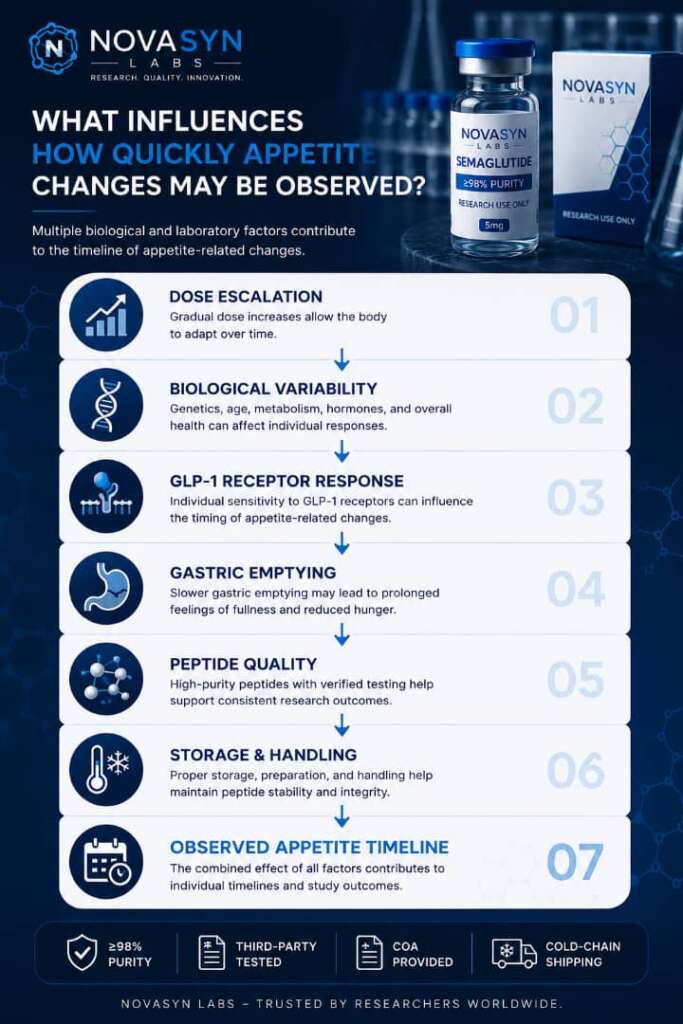
1. Dose Escalation Protocol
Semaglutide is commonly studied using gradual dose-escalation protocols rather than beginning with higher concentrations immediately.
This approach helps researchers:
- Reduce gastrointestinal responses
- Improve protocol consistency
- Observe biological adaptation over time
- Standardize experimental conditions
Because dosage often increases gradually, appetite-related changes may become more apparent only after several weeks.
Research Insight
Many published studies evaluate appetite-related outcomes after multiple weeks rather than expecting significant changes during the first few days.
2. Individual Biological Variability
Every research subject responds differently.
Several biological factors may influence the timing of appetite-related observations, including:
- GLP-1 receptor sensitivity
- Body composition
- Metabolic rate
- Hormonal environment
- Age
- Existing metabolic characteristics
These differences explain why two otherwise similar research subjects can produce different timelines despite following identical protocols.
3. Gastric Emptying
One mechanism frequently investigated in semaglutide research is delayed gastric emptying.
When food remains in the stomach longer, researchers may observe prolonged feelings of fullness in some study models.
However, the degree of gastric emptying varies naturally between individuals.
Factors influencing gastric emptying include:
- Meal composition
- Hydration
- Digestive physiology
- Experimental conditions
Consequently, appetite-related observations may appear earlier in some subjects than others.
4. Consistency of Experimental Protocols
Even small inconsistencies can influence research quality.
Researchers often standardize:
- Time of administration
- Sample collection
- Laboratory temperature
- Instrument calibration
- Reagent preparation
- Data recording procedures
Standardization improves reproducibility and helps distinguish biological variability from procedural variability.
5. Peptide Quality and Integrity
High-quality research begins with well-characterized materials.
If peptide integrity is compromised through improper storage or repeated freeze-thaw cycles, researchers risk introducing unnecessary variability into their experiments.
At NovaSyn Labs, every batch of semaglutide is supported by:
- ≥98% purity
- Third-party HPLC testing
- LC-MS verification
- Certificate of Analysis (COA)
- Cold-chain shipping
- Quality-controlled packaging
These measures help ensure researchers begin their experiments with material that meets documented quality standards.
Table: What Influences the Appetite Suppression Timeline?
| Factor | Why It Matters | Research Consideration |
| Dose escalation | Allows gradual biological adaptation | Evaluate results over several weeks |
| Biological variability | Responses differ naturally | Avoid assuming identical timelines |
| Gastric emptying | May influence satiety | Can vary between individuals |
| Protocol consistency | Reduces experimental variation | Standardize procedures |
| Peptide quality | Supports reliable experiments | Verify COA and purity before use |
| Storage conditions | Helps maintain peptide integrity | Follow recommended handling procedures |
Semaglutide vs Other GLP-1 Receptor Agonists
Semaglutide is one of several GLP-1 receptor agonists used in metabolic research. Researchers often compare it with compounds such as tirzepatide and retatrutide to better understand differences in receptor activity, pharmacology, and experimental outcomes.
Although these compounds belong to the same broader therapeutic area, they are not identical.
Comparison Table
| Feature | Semaglutide | Tirzepatide | Retatrutide |
| Primary Target | GLP-1 receptor | GLP-1 + GIP receptors | GLP-1 + GIP + Glucagon receptors |
| Generation | Second-generation GLP-1 agonist | Dual agonist | Triple agonist |
| Typical Research Interest | Appetite regulation, metabolic pathways | Metabolic signaling and dual receptor activation | Multi-receptor metabolic research |
| Dose Escalation Often Used | Yes | Yes | Yes |
| Appetite-Related Timeline | Variable; often assessed over several weeks | Variable | Variable |
| Published Research | Extensive | Extensive | Growing |
Common Misconceptions About Semaglutide Appetite Suppression
Misunderstanding the expected timeline is one of the main reasons people develop unrealistic expectations.
Myth 1: Appetite Should Disappear After the First Dose
Reality: Appetite-related changes may begin early for some individuals, but many studies evaluate outcomes over several weeks rather than days.
Myth 2: If Appetite Doesn’t Change During Week One, Semaglutide Isn’t Working
Reality: Biological responses vary considerably. Two research subjects following identical protocols may produce different timelines.
Myth 3: Higher Doses Always Produce Faster Results
Reality: Higher doses are not designed simply to accelerate appetite-related effects. Research protocols frequently use gradual dose escalation to maintain consistency and monitor responses carefully.
Myth 4: All GLP-1 Receptor Agonists Behave the Same
Reality: Semaglutide, tirzepatide, and retatrutide interact with different receptor combinations, making direct comparisons more complex than they first appear.
Myth 5: Product Quality Doesn’t Matter
Reality: Research reproducibility depends on many factors, including peptide characterization, storage conditions, handling procedures, and documentation. High-quality materials help reduce avoidable sources of experimental variability.
Expert Insight from NovaSyn Labs
Over 16+ years of supplying semaglutide to more than 600 research customers, we’ve found that laboratories with the most reproducible outcomes share one common characteristic: they prioritize consistency.
Successful research teams routinely:
- Verify each batch using the Certificate of Analysis (COA)
- Record lot numbers and preparation dates
- Standardize reconstitution procedures
- Minimize freeze–thaw cycles
- Monitor storage temperatures throughout the study
- Maintain detailed laboratory notebooks
These practices don’t guarantee a specific biological response, but they help ensure that observed differences are more likely to reflect genuine experimental findings rather than preventable procedural variation.
Laboratory Case Study #1: GLP-1 Receptor Signaling Research
Real-world laboratory documentation often provides valuable insights into how standardized procedures support reproducible research. The following anonymous case study illustrates how one academic laboratory incorporated semaglutide into a controlled GLP-1 receptor signaling project.
Disclaimer: This case study is presented for educational and research purposes only. It describes laboratory workflows and quality-control practices rather than clinical outcomes.
Research Group
Academic Cell Biology Laboratory (Anonymous)
Why the Laboratory Selected Semaglutide
The research team selected semaglutide because it is one of the most extensively studied GLP-1 receptor agonists available in published scientific literature. Using a well-characterized peptide allowed the investigators to compare their experimental findings with previously reported studies while maintaining consistency across laboratory protocols.
Research Objective
The laboratory aimed to investigate GLP-1 receptor signaling pathways in cultured cells while evaluating changes in intracellular signaling markers under carefully standardized laboratory conditions.
Laboratory Timeline
| Timeline | Laboratory Activity |
| Week 1 | Received shipment, reviewed Certificate of Analysis (COA), verified storage temperature, documented lot numbers. |
| Week 2 | Reconstituted aliquots using standardized procedures while minimizing freeze-thaw cycles. |
| Weeks 3-6 | Performed receptor activation assays, documented incubation times, reagent batches, and instrument settings. |
| Week 7 | Compared results across experimental batches and completed quality-control review. |
Lessons Learned
The laboratory concluded that careful documentation significantly improved research traceability.
Key observations included:
- Recording storage temperatures improved consistency between experiments.
- Tracking aliquot preparation reduced unnecessary variability.
- Standardizing assay conditions simplified comparisons across multiple experimental batches.
- Maintaining detailed laboratory records improved reproducibility.
Laboratory Case Study #2: Metabolic Research Laboratory
A second anonymous laboratory incorporated semaglutide into a metabolic research workflow focused on standardized biomarker evaluation.
Again, the emphasis was not on clinical outcomes but on maintaining reproducible laboratory procedures.
Research Group
Independent Biomedical Research Laboratory (Anonymous)
Why Researchers Selected Semaglutide
Investigators selected semaglutide because it frequently appears in metabolic research literature and serves as a valuable reference compound when comparing experimental protocols across published studies.
Research Objective
The laboratory aimed to establish a reproducible workflow for evaluating biomarker responses while maintaining comprehensive quality-control documentation throughout the project.
Experimental Timeline
| Timeline | Laboratory Activity |
| Day 1 | Verified shipment integrity and documented storage temperature upon arrival. |
| Days 2-5 | Prepared working aliquots and recorded each preparation step. |
| Weeks 2-4 | Conducted scheduled assays while documenting environmental conditions, calibration records, and reagent batches. |
| Week 5 | Reviewed laboratory notebooks and confirmed protocol consistency across all experimental runs. |
Lessons Learned
Researchers identified several practices that improved consistency throughout the study.
These included:
- Comprehensive documentation of every preparation step.
- Standardized handling procedures across laboratory personnel.
- Routine instrument calibration.
- Careful tracking of storage conditions.
- Consistent laboratory notebooks that simplified quality assurance.
What 16+ Years of Experience Has Taught NovaSyn Labs
For more than 16 years, NovaSyn Labs has supplied semaglutide to over 600 research customers across a wide range of laboratory applications.
One lesson has remained remarkably consistent:
High-quality research depends on much more than peptide purity alone.
Successful laboratories consistently combine high-quality materials with disciplined documentation, standardized handling procedures, and rigorous quality-control practices.
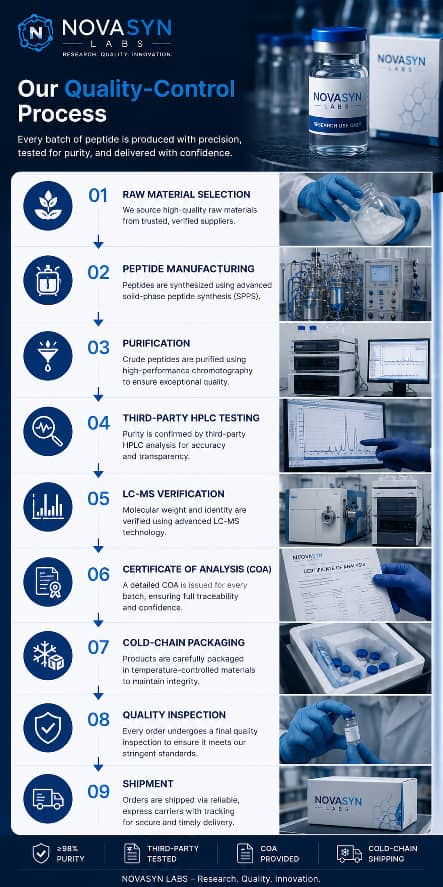
Every semaglutide batch supplied by NovaSyn Labs undergoes multiple quality-control measures before shipment.
Our Quality-Control Process
Why Laboratory Quality Matters
Researchers invest significant time and resources into designing experiments.
Using well-characterized materials helps reduce avoidable sources of variability.
NovaSyn Labs supports research with:
- ≥98% purity
- Third-party HPLC testing
- LC-MS verification
- Certificate of Analysis (COA)
- Cold-chain shipping
- Quality-controlled packaging
- Manufacturing standards designed to support research consistency
These practices provide researchers with documented quality information before experiments begin.
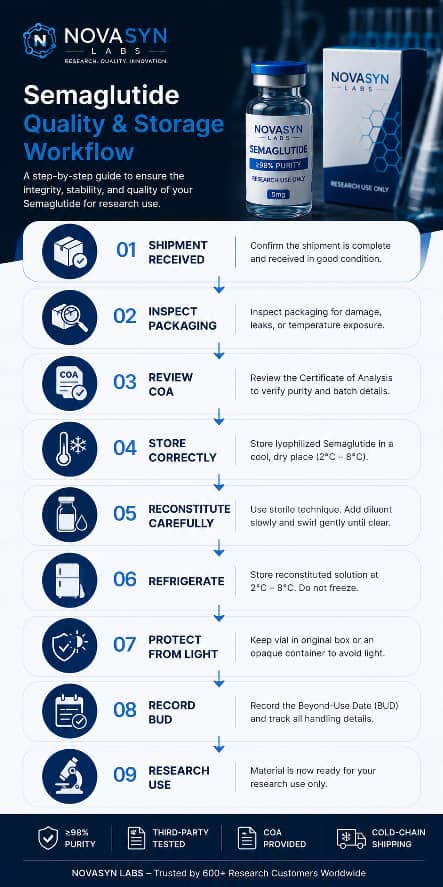
Proper Storage Before Reconstitution
Semaglutide is commonly supplied as a lyophilized (freeze-dried) powder, which offers improved stability compared with reconstituted solutions. Even so, proper storage before reconstitution remains essential for preserving peptide integrity.
Recommended Storage Conditions
- Store in a cool, dry, dark location.
- Refrigeration at 2°C–8°C (36°F–46°F) is recommended for long-term storage.
- Stable room temperature may be suitable for limited periods when protected from heat and moisture, in accordance with product guidance.
- Keep the vial inside its original packaging to reduce light exposure.
Avoid
- Direct sunlight
- High humidity
- Excessive heat
- Frequent temperature fluctuations
- Accidental freezing
Proper Reconstitution
How semaglutide is reconstituted can influence peptide integrity.
Researchers generally recommend gentle handling throughout the preparation process.
Best Practices
✔ Allow refrigerated materials to reach the appropriate handling temperature if required by your protocol.
✔ Use sterile bacteriostatic water when appropriate for the research protocol.
✔ Direct the liquid slowly against the inside wall of the vial rather than directly onto the lyophilized powder.
✔ Gently swirl the vial until the solution becomes clear.
Never Shake the Vial
Vigorous shaking may increase mechanical stress on delicate peptide molecules.
Instead:
- Roll gently between your fingers.
- Swirl slowly.
- Allow complete dissolution naturally.
Storage After Reconstitution
Once reconstituted, semaglutide requires considerably more careful handling.
Recommended Conditions
| Recommendation | Best Practice |
| Temperature | Refrigerated at 2°C–8°C (36°F–46°F) |
| Light | Store inside the original box or an opaque container |
| Placement | Middle Shelf of the refrigerator |
| Door Storage | Avoid due to temperature fluctuations |
| Freezing | Never freeze |
| Beyond-Use Date | Follow the labeled beyond-use date or laboratory protocol |
The Biggest Storage Mistakes Researchers Make
Even experienced laboratories occasionally encounter preventable handling errors.
Common mistakes include:
❌ Leaving the vial at room temperature for extended periods.
❌ Repeated freeze–thaw cycles.
❌ Shaking during reconstitution.
❌ Storing near refrigerator cooling elements where accidental freezing may occur.
❌ Failing to record preparation dates.
❌ Using cloudy or discolored solutions.
❌ Ignoring beyond-use dates.
Research Storage Checklist
Before beginning any experiment, verify the following:
✔ Certificate of Analysis reviewed.
✔ Lot number documented.
✔ Refrigeration confirmed.
✔ Storage temperature recorded.
✔ Reconstitution date recorded.
✔ Beyond-use date documented.
✔ Light protection maintained.
✔ Solution visually inspected.
✔ Laboratory notebook updated.
Frequently Asked Questions About How Long It Takes for Semaglutide to Suppress Appetite
Adding a comprehensive FAQ section helps answer common reader questions, improves user experience, and can increase the likelihood of appearing in Google’s AI Overviews and featured snippets.
1. How long does it take for semaglutide to suppress appetite?
There is no single timeline that applies to everyone. Based on published research and laboratory observations, some individuals may notice appetite-related changes within approximately one week, while others may require two to four weeks before more consistent changes are observed. Factors such as dose-escalation protocols, biological variability, and study design all influence the timeline.
2. Does semaglutide reduce appetite immediately?
Not typically. Although some individuals report early appetite changes, semaglutide generally works gradually as GLP-1 receptor activity increases over time. Most research evaluates appetite-related outcomes across multiple weeks rather than expecting immediate effects.
3. Why does appetite suppression happen faster for some people?
Researchers believe several factors contribute to differences in response, including:
- Individual biology
- GLP-1 receptor responsiveness
- Dose-escalation schedules
- Gastric emptying
- Experimental conditions
- Overall protocol consistency
These differences mean that identical study protocols can still produce different timelines.
4. Does a higher dose make appetite suppression happen sooner?
Not necessarily. Higher doses are not intended simply to speed appetite-related changes. Many research protocols gradually increase dosing to allow adaptation while maintaining consistency throughout the study.
5. Does peptide purity affect research quality?
High-purity material supports experimental consistency by helping researchers begin with well-characterized compounds. At NovaSyn Labs, every semaglutide batch is verified through third-party HPLC and LC-MS testing and supplied with a Certificate of Analysis (COA). While purity alone does not determine biological outcomes, it is an important component of quality assurance.
6. How should semaglutide be stored before reconstitution?
Lyophilized semaglutide should be kept in a cool, dry, dark location. Refrigerated storage at 2°C–8°C (36°F–46°F) is generally recommended for long-term stability, while protecting the vial from moisture, excessive heat, and direct light.
7. How should semaglutide be stored after reconstitution?
After reconstitution, the solution should remain refrigerated at 2°C–8°C (36°F–46°F), protected from light, and handled according to the labeled beyond-use date or laboratory protocol. The vial should never be frozen and should be discarded if it becomes cloudy or contains visible particles.
8. Can repeated freeze–thaw cycles damage semaglutide?
Yes. Repeated freeze–thaw cycles may compromise peptide integrity and introduce unnecessary variability into research. Preparing appropriately sized aliquots helps minimize repeated temperature changes.
9. How do researchers improve experimental consistency?
Many laboratories improve reproducibility by:
- Reviewing the COA before beginning experiments
- Documenting lot numbers
- Recording storage temperatures
- Standardizing reconstitution procedures
- Calibrating instruments regularly
- Maintaining detailed laboratory notebooks
10. How does semaglutide compare with tirzepatide?
Semaglutide primarily targets the GLP-1 receptor, while tirzepatide activates both GLP-1 and GIP receptors. Because they have different pharmacological profiles, direct comparisons should consider the specific study design, research objectives, and measured outcomes.
11. Does NovaSyn Labs test every batch of semaglutide?
Yes. NovaSyn Labs supplies semaglutide supported by:
- ≥98% purity
- Third-party HPLC testing
- LC-MS verification
- Certificate of Analysis (COA)
- Cold-chain shipping
- Quality-controlled packaging
These quality measures help researchers work with well-characterized materials.
12. Is semaglutide intended for research use?
Researchers should always follow applicable regulations and institutional requirements for the intended use of semaglutide. NovaSyn Labs provides laboratory-quality materials accompanied by documentation to support research applications.
Quick Summary Table
| Question | Summary |
| When may appetite-related changes begin? | Approximately one week for some individuals, while others may require two to four weeks or longer. |
| Does everyone respond at the same speed? | No. Biological variability is expected. |
| What influences the timeline? | Dose escalation, GLP-1 receptor responsiveness, gastric emptying, protocol consistency, and peptide quality. |
| Does storage matter? | Yes. Proper storage supports peptide integrity and research consistency. |
| Should expectations be realistic? | Yes. Research timelines vary and should be interpreted within the context of the study design. |
Key Takeaways
- Appetite-related changes associated with semaglutide vary between individuals and research models.
- Some observations may occur within the first week, while others become more apparent over two to four weeks.
- Consistent laboratory procedures, accurate documentation, and high-quality materials support reproducible research.
- Proper storage before and after reconstitution helps preserve peptide integrity.
- Understanding biological variability leads to more accurate interpretation of research findings.
Final Thoughts
Answering the question “How long does it take for semaglutide to suppress appetite?” requires more than quoting a single timeline. Scientific evidence and laboratory experience consistently demonstrate that appetite-related changes depend on a combination of biological factors, study design, dose-escalation strategies, and careful experimental execution.
Throughout more than 16 years of supplying semaglutide to over 600 research customers, NovaSyn Labs has seen that successful research is built on three pillars:
- High-quality, well-characterized peptides
- Standardized laboratory procedures
- Thorough documentation from shipment through data analysis
These principles help researchers generate experiments that are more consistent, reproducible, and easier to compare with published scientific literature.
Whether you are investigating GLP-1 receptor signaling, metabolic pathways, or biomarker responses, maintaining rigorous quality standards—from verifying the Certificate of Analysis to following recommended storage practices—supports the integrity of your research.
Continue Your Research
Explore related resources from NovaSyn Labs:
- Semaglutide Research Peptide
- Tirzepatide Research Peptide
- Retatrutide Research Peptide
- GLP-1 vs Other Peptides: Which Should You Choose?
- How to Store Research Peptides Properly
- How Peptide Purity Is Verified Using HPLC and LC-MS
References

