


No products in the cart.
What Are Research Peptides? Complete Guide to Types, Manufacturing, Quality Testing & Laboratory Research (2026)
Table of Contents
What Are Research Peptides?
Research peptides have become an increasingly important area of interest in modern laboratory science. Universities, biotechnology companies, pharmaceutical researchers, and academic institutions use synthetic peptides to investigate cellular signaling pathways, receptor interactions, protein functions, tissue biology, metabolism, neuroscience, immunology, and many other scientific fields.
As peptide technology has advanced, researchers have gained access to highly purified laboratory-grade peptides manufactured using sophisticated synthesis techniques and verified through analytical testing methods such as High-Performance Liquid Chromatography (HPLC) and Liquid Chromatography-Mass Spectrometry (LC-MS).
Despite their growing popularity, many people still ask:
- What are research peptides?
- How are research peptides manufactured?
- How do peptides differ from proteins?
- Why is peptide purity important?
- What analytical testing should laboratories look for?
- How should research peptides be stored?
This comprehensive guide answers those questions while explaining the science behind peptide manufacturing, quality assurance, laboratory handling, and the major categories of research peptides available today.
Drawing on more than 25 years of experience, NovaSyn Labs has supplied laboratory-grade peptides to over 30,000 research customers worldwide. Throughout that time, we’ve seen that reliable documentation, consistent manufacturing standards, and responsive technical support can help laboratories maintain organized procurement and research workflows.
What Are Research Peptides?
Research peptides are short chains of amino acids produced for laboratory and scientific research purposes. Amino acids are often described as the building blocks of proteins, and peptides are formed when these amino acids are linked together by peptide bonds.
Unlike larger proteins, peptides generally contain fewer amino acids, making them easier to synthesize, characterize, and study under controlled laboratory conditions.
Scientists use research peptides to investigate:
- Cellular communication
- Receptor signaling
- Protein interactions
- Gene regulation
- Tissue biology
- Molecular pathways
- Immune system mechanisms
- Metabolic regulation
- Neuroscience
- Drug discovery
Because peptides can interact with highly specific biological targets, they provide valuable tools for understanding complex biological processes.
Importantly, research peptides are manufactured and supplied for laboratory investigation. Researchers should always follow applicable institutional policies, regulations, and laboratory protocols when working with these materials.
Why Are Research Peptides Important?
Modern biomedical research depends heavily on molecules that allow scientists to isolate and investigate individual biological pathways.
Research peptides help scientists study:
- Cellular signaling pathways
- Hormone receptor interactions
- Protein folding
- Cell migration
- Inflammatory pathways
- Tissue remodeling
- Mitochondrial biology
- Experimental metabolic pathways
- Molecular pharmacology
Because peptides can be designed with high specificity, they often serve as valuable research tools when investigating complex biological mechanisms.
Research Peptides vs Proteins
Although peptides and proteins are both composed of amino acids, they differ significantly in size, structure, and complexity.
| Feature | Research Peptides | Proteins |
| Composition | Short amino acid chains | Longer amino acid chains |
| Molecular Size | Smaller | Larger |
| Structural Complexity | Relatively simple | Highly complex |
| Laboratory Synthesis | common using chemical synthesis | Often requires biological expression systems |
| Experimental Applications | Molecular research, receptor studies, signaling investigations | Structural biology, enzymatic research, physiological studies |
Generally speaking, proteins contain many more amino acids than peptides and often fold into highly complex three-dimensional structures. Research peptides are typically easier to manufacture consistently using synthetic chemistry.
A Brief History of Research Peptides
Peptide science has progressed rapidly over the past century.
Early researchers recognized that naturally occurring peptides played important roles in biological signaling. As analytical chemistry advanced, scientists developed methods to synthesize peptides in laboratories with increasing accuracy.
A major breakthrough occurred with the development of Solid-Phase Peptide Synthesis (SPPS) by Dr. Robert Bruce Merrifield in the 1960s. This technique transformed peptide chemistry by making peptide production faster, more reliable, and easier to automate.
Today, automated peptide synthesizers can produce highly purified research peptides used by laboratories around the world.
Advances in purification technologies, analytical testing, and manufacturing quality systems have further improved consistency and documentation, helping support reproducible scientific research.
How Are Research Peptides Synthesized?
Most laboratory-grade peptides are produced using Solid-Phase Peptide Synthesis (SPPS).
Rather than attempting to build an entire peptide in solution, chemists assemble amino acids one at a time while the growing peptide remains attached to a solid resin.
This approach offers several advantages:
- Precise amino acid sequencing
- Efficient purification
- High reproducibility
- Automated manufacturing
- Reduced contamination
- Improved batch consistency
Once synthesis is complete, the peptide is carefully removed from the resin before undergoing purification and analytical testing.
The Research Peptide Manufacturing Process
High-quality peptide manufacturing involves multiple stages designed to verify product identity and purity before shipment.
Step 1: Peptide Design
Scientists determine the desired amino acid sequence based on the objectives of the research project.
Step 2: Solid-Phase Peptide Synthesis
Automated synthesizers sequentially add protected amino acids to construct the peptide chain.
Step 3: Cleavage
The completed peptide is separated from the synthesis resin and protective groups are removed.
Step 4: Purification
The crude peptide contains desired product along with synthesis by-products.
Purification techniques help isolate the target peptide.
Step 5: HPLC Purity Testing
High-Performance Liquid Chromatography (HPLC) evaluates peptide purity by separating components within the sample.
Many laboratories prefer suppliers that provide HPLC chromatograms with every production batch.
Step 6: LC-MS Identity Verification
Liquid Chromatography-Mass Spectrometry (LC-MS) helps verify that the molecular mass matches the intended peptide sequence.
Identity verification provides an additional level of analytical confidence alongside purity testing.
Step 7: Batch Review
Before release, manufacturing documentation, analytical results, and quality records are reviewed to ensure they meet predefined specifications.
Step 8: Secure Packaging
Research peptides are packaged to help protect product integrity during transportation.
Secure labeling and traceable batch information support laboratory documentation and inventory management.
Step 9: Cold-Chain Shipping
Temperature-controlled shipping practices may be used where appropriate to help maintain product quality during transit.
Why Manufacturing Quality Matters
Laboratories often focus on purity percentages, but quality encompasses much more than a single analytical value.
Reliable suppliers typically emphasize:
- Standardized manufacturing procedures
- HPLC purity testing
- LC-MS identity verification
- Batch consistency
- Secure packaging
- Cold-chain shipping where appropriate
- Responsive technical support
- Clear documentation
Together, these practices can support traceability and reduce one potential source of experimental variability.
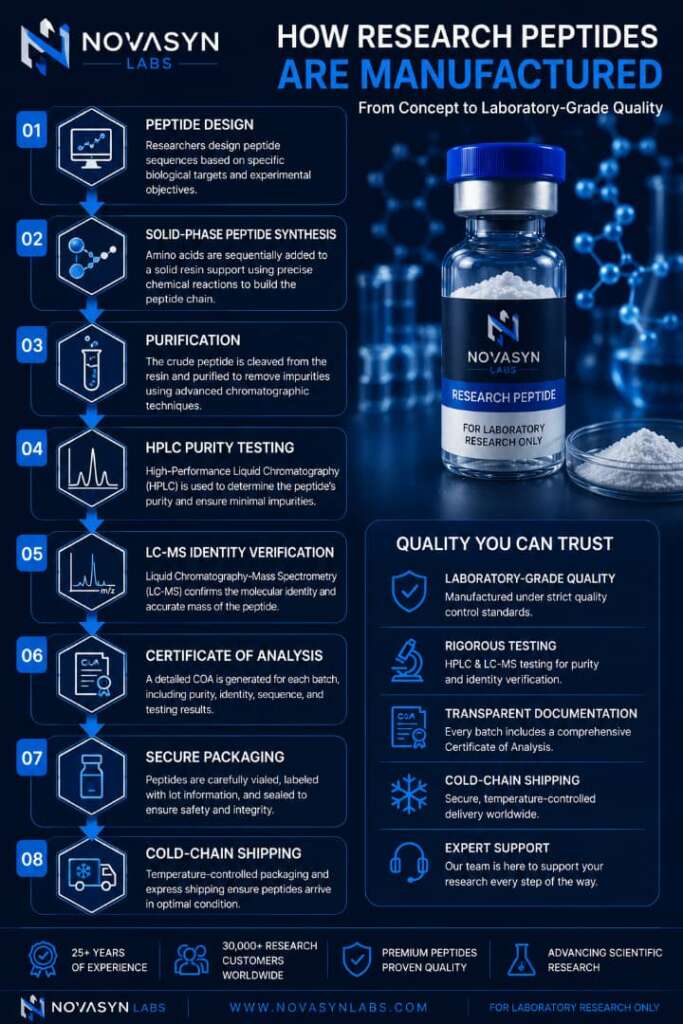
Overview of the laboratory workflow used to manufacture, test, document, and prepare research peptides for shipment.
Common Categories of Research Peptides
Research peptides are often grouped according to the biological systems or experimental pathways they are designed to investigate. Each category has unique characteristics and research applications, making it important for laboratories to select peptides that align with their specific scientific objectives.
Below are some of the most widely studied categories of research peptides.
| Category | Representative Research Peptides | Common Areas of Laboratory Research |
| Recovery Peptides | BPC-157, TB-500, KPV, ARA-290 | Tissue biology, cell migration, inflammatory pathways |
| GLP-1 Peptides | Semaglutide, Tirzepatide, Liraglutide | Metabolic research, receptor biology |
| Growth Hormone Secretagogues | CJC-1295, Ipamorelin, Tesamorelin | Growth hormone signaling research |
| Cosmetic Peptides | GHK-Cu | Skin biology, extracellular matrix research |
| Longevity Peptides | Epitalon, MOTS-c, SS-31 | Cellular aging, mitochondrial biology |
| Nootropic Peptides | Semax, Selank | Neuroscience, neurobiology research |
Each peptide category serves different experimental purposes, and researchers typically choose peptides based on the biological pathways they wish to investigate.
Recovery Peptides
Recovery peptides are commonly studied for their roles in tissue biology, cellular signaling, and inflammatory pathways.
Examples include:
- BPC-157
- TB-500
- KPV
- ARA-290
Research involving these peptides frequently investigates:
- Cellular migration
- Connective tissue biology
- Angiogenesis
- Extracellular matrix interactions
- Experimental inflammatory pathways
NovaSyn Labs offers a dedicated Recovery Peptides category to support laboratories conducting research in these areas.
GLP-1 Research Peptides
GLP-1 peptides have become an important focus of metabolic research.
Examples include:
- Semaglutide
- Tirzepatide
- Liraglutide
Researchers investigate GLP-1 peptides to better understand:
- Receptor signaling
- Glucose metabolism
- Hormonal regulation
- Gastrointestinal physiology
- Experimental metabolic pathways
These peptides remain an active area of scientific investigation across universities and biotechnology laboratories.
Growth Hormone Secretagogues
Growth hormone secretagogues stimulate interest because of their interactions with growth hormone-related signaling pathways.
Examples include:
- Ipamorelin
- CJC-1295
- Tesamorelin
Research topics often include:
- Endocrine signaling
- Hormone receptor biology
- Growth hormone regulation
- Cellular communication
Cosmetic Research Peptides
Cosmetic peptides are frequently investigated within dermatological and cosmetic science.
One of the most recognized examples is:
GHK-Cu
Laboratory studies may examine:
- Collagen biology
- Skin remodeling
- Copper-binding mechanisms
- Extracellular matrix research
Longevity Research Peptides
Researchers investigating cellular aging frequently explore peptides that may interact with biological pathways associated with aging and mitochondrial function.
Examples include:
- Epitalon
- MOTS-c
- SS-31
Current areas of investigation include:
- Oxidative stress
- Cellular senescence
- Telomere biology
- Mitochondrial function
- Cellular energy regulation
While these remain active areas of research, many questions continue to be explored by the scientific community.
Nootropic Research Peptides
Nootropic peptides are studied primarily within neuroscience research.
Examples include:
- Semax
- Selank
Researchers investigate these peptides in relation to:
- Neural signaling
- Neurotransmitter pathways
- Brain-derived signaling molecules
- Experimental neurobiology
How Research Peptides Are Used in Laboratory Research
Research peptides support investigations across many scientific disciplines.
Common research fields include:
- Molecular biology
- Cell biology
- Pharmacology
- Immunology
- Neuroscience
- Regenerative biology
- Metabolic research
- Oncology research
- Biochemistry
- Biotechnology
Their relatively small molecular size and highly specific biological interactions make peptides valuable tools for studying complex cellular processes.
Why Peptide Quality Matters
Two peptide samples may appear identical visually while differing significantly in analytical quality.
For this reason, experienced laboratories evaluate more than purity percentage alone.
Important quality considerations include:
- Manufacturing consistency
- Analytical verification
- Documentation
- Packaging
- Shipping practices
- Technical support
NovaSyn Labs has supplied laboratory-grade research peptides for more than 25 years, serving over 30,000 research customers. Throughout that time, we’ve found that consistent documentation and responsive customer support help laboratories manage procurement and maintain organized research workflows.
HPLC Purity Testing
High-Performance Liquid Chromatography (HPLC) is one of the most widely used analytical methods in peptide quality assessment.
During HPLC analysis:
- Sample components are separated.
- Relative purity is measured.
- Chromatograms are generated for review.
Many research laboratories request HPLC chromatograms before introducing a peptide into experimental workflows.
Although HPLC is an important analytical technique, it is only one part of a comprehensive quality assurance program.
LC-MS Identity Verification
Liquid Chromatography-Mass Spectrometry (LC-MS) complements HPLC by helping confirm the molecular identity of a peptide.
Rather than focusing primarily on purity, LC-MS compares the measured molecular mass with the expected peptide sequence.
Using HPLC together with LC-MS provides a more complete analytical profile than relying on either method alone.
Batch Consistency
Long-term research projects often require multiple peptide batches over months or even years.
Consistent manufacturing practices help laboratories:
- Maintain organized documentation
- Track peptide lots
- Compare experiments more effectively
- Improve traceability
- Support procurement planning
Batch consistency does not eliminate experimental variability, but it can reduce one potential source of inconsistency.
Secure Packaging
Proper packaging helps protect research peptides during storage and transportation.
Quality suppliers generally provide:
- Clearly labeled vials
- Lot numbers
- Secure seals
- Protective packaging
- Batch documentation
These measures also simplify inventory management for research laboratories.
Cold-Chain Shipping
Temperature-sensitive research materials may require carefully managed shipping conditions.
Cold-chain shipping helps reduce unnecessary temperature exposure during transportation and supports recommended storage practices upon arrival.
Researchers should inspect shipments promptly and follow supplier storage recommendations after delivery.
Technical Support
A reliable supplier offers more than a finished product.
Technical support can assist laboratories with:
- Analytical documentation
- Certificate of Analysis requests
- Storage recommendations
- Product handling information
- Batch traceability questions
Responsive support can save valuable time during laboratory procurement and documentation processes.
Quality Assurance Checklist
| Quality Measure | Why It Matters |
| HPLC Purity Testing | Measures relative peptide purity |
| LC-MS Identity Verification | Confirms molecular identity |
| Batch Consistency | Supports long-term research continuity |
| Secure Packaging | Helps protect product integrity |
| Cold-chain Shipping | Supports recommended storage conditions |
| Technical Support | Assists with documentation and product information |
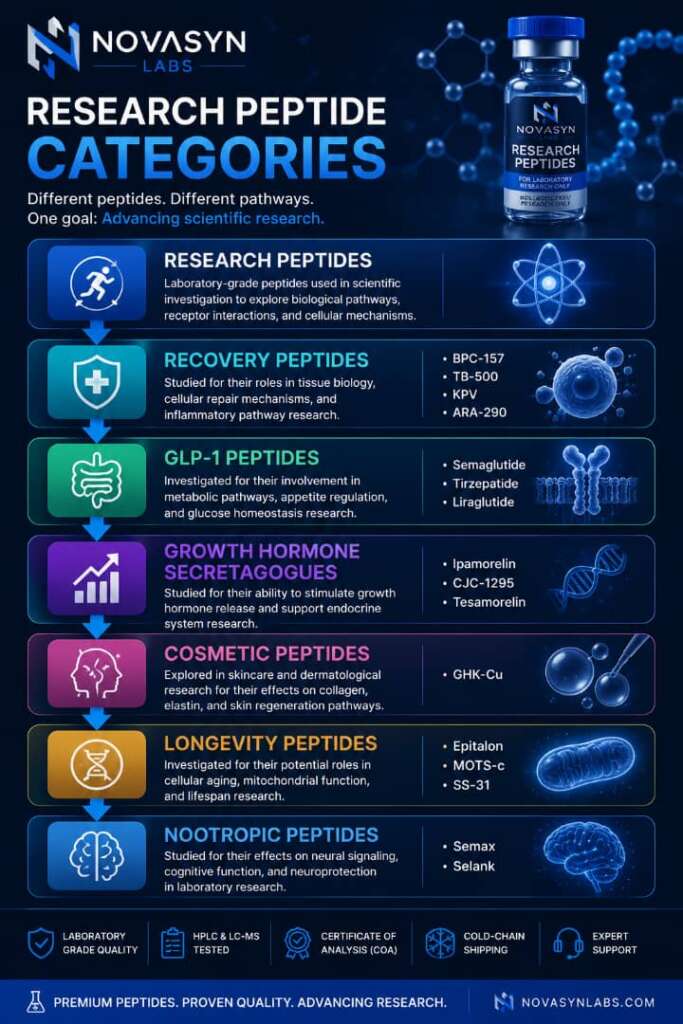
Overview of the major categories of research peptides and their common areas of laboratory investigation.
Storage and Handling of Research Peptides
Proper storage and handling are essential components of peptide quality management. Even when a research peptide has been manufactured to a high analytical standard, improper handling after delivery may introduce unnecessary variables into laboratory workflows.
While storage recommendations may differ depending on the peptide and supplier, laboratories should always follow the product-specific guidance provided with the Certificate of Analysis (COA) or accompanying documentation.
General best practices include:
- Review the Certificate of Analysis before use.
- Store peptides according to the supplier’s recommendations.
- Use clean laboratory techniques during handling.
- Record preparation dates and storage conditions.
- Label aliquots clearly if multiple portions are prepared.
- Minimize unnecessary handling and repeated freeze-thaw cycles.
- Maintain detailed laboratory records for traceability.
Proper documentation can help laboratories investigate potential sources of variability and maintain organized research workflows.
Common Mistakes When Purchasing Research Peptides
Selecting a supplier involves more than comparing prices. Several factors can influence the quality of documentation and consistency between production batches.
Common purchasing mistakes include:
- Choosing products based only on price.
- Not requesting a Certificate of Analysis.
- Ignoring HPLC purity testing data.
- Failing to verify LC-MS identity confirmation.
- Purchasing from suppliers with inconsistent documentation.
- Overlooking storage and shipping practices.
- Not reviewing batch information before beginning long-term projects.
Experienced laboratories often evaluate suppliers using standardized procurement criteria that prioritize documentation, analytical testing, and traceability.
Choosing a Reliable Research Peptide Supplier
When selecting a research peptide supplier, laboratories should consider the complete quality assurance process rather than relying on a single specification.
A reliable supplier typically provides:
- High-purity laboratory-grade peptides.
- HPLC purity testing.
- LC-MS identity verification.
- Batch-specific Certificates of Analysis.
- Lot traceability.
- Secure packaging.
- Appropriate shipping practices.
- Responsive technical support.
For more than 25 years, NovaSyn Labs has supplied laboratory-grade research peptides to over 30,000 research customers worldwide. Throughout that time, we have focused on providing consistent documentation, affordable pricing, dependable shipping, and responsive customer support to help laboratories maintain efficient procurement processes.
Illustrative Case Study 1: Consistent Documentation Improves Research Reproducibility
Background
A university laboratory conducting preclinical metabolic research used the same research peptide across several months. Early in the project, researchers experienced variability between experimental runs, making it difficult to determine whether differences resulted from the study design or changes in the research material.
Approach
The laboratory implemented standardized procurement practices by sourcing peptide lots that included:
- Certificate of Analysis (COA)
- HPLC purity data
- LC-MS identity confirmation
- Lot numbers for traceability
- Standardized storage documentation
Researchers also documented:
- Reconstitution dates
- Storage temperatures
- Freeze-thaw events
- Batch numbers used in each experiment
Outcome
After introducing consistent documentation and lot tracking:
- Experimental records became easier to compare.
- Researchers quickly identified which peptide lot was used in each study.
- Internal quality assurance procedures became more efficient.
- Laboratory traceability improved across multiple projects.
Key Takeaway
Standardized documentation does not guarantee experimental outcomes, but it can improve traceability and help laboratories identify potential sources of variability.
Illustrative Case Study 2: Reliable Supply Supports Research Continuity
Background
A biotechnology research group planned a six-month peptide-based laboratory project. During a previous study, inconsistent documentation and shipment delays from multiple suppliers interrupted the experimental schedule.
Approach
The laboratory selected a supplier that consistently provided:
- Clearly labeled peptide vials
- Batch-specific Certificates of Analysis
- HPLC chromatograms
- LC-MS identity verification
- Stable cold-chain shipping
- Responsive technical support
- Consistent documentation across every order
An inventory management system was also introduced to monitor remaining stock and track batch numbers before reordering.
Outcome
Throughout the project:
- Research materials remained available without interruption.
- Documentation stayed consistent between shipments.
- Administrative delays were reduced.
- Researchers spent more time focusing on experiments instead of procurement issues.
Key Takeaway
Supplier reliability extends beyond product delivery. Consistent documentation, traceability, and dependable logistics can help support organized laboratory workflows.
Common Myths About Research Peptides
| Myth | Reality |
| Research peptides are approved medicines. | Many research peptides are supplied for laboratory research purposes. Regulatory status varies by peptide and jurisdiction. |
| Every peptide supplier provides identical quality. | Manufacturing processes, analytical testing, documentation, and quality systems differ between suppliers. |
| HPLC testing is unnecessary. | HPLC is widely used to assess peptide purity and is an important component of quality assurance. |
| Certificates of Analysis are not important. | COAs provide analytical documentation that supports traceability and procurement decisions. |
| Storage conditions do not affect peptide quality. | Appropriate storage and handling are important for maintaining product integrity according to supplier recommendations. |
| Every peptide serves the same research purpose. | Different peptides are designed for different experimental pathways and scientific investigations. |
Frequently Asked Questions
What are research peptides?
Research peptides are short chains of amino acids synthesized for laboratory investigations into biological pathways, receptor interactions, cellular signaling, and other scientific applications.
How are research peptides manufactured?
Most research peptides are produced using Solid-Phase Peptide Synthesis (SPPS), followed by purification, HPLC purity testing, LC-MS identity verification, quality review, and secure packaging.
Why is HPLC testing important?
HPLC helps evaluate the relative purity of a peptide sample by separating its components and generating a chromatogram for analytical review.
What is LC-MS used for?
LC-MS helps verify that the molecular mass of a peptide matches its intended sequence, providing additional confidence in product identity.
Why is a Certificate of Analysis important?
A COA documents analytical testing results, including purity, identity verification, batch information, and other quality-related data that support laboratory traceability.
Are all research peptides the same?
No. Research peptides differ in amino acid sequence, biological targets, experimental applications, manufacturing methods, and analytical documentation.
How should research peptides be stored?
Storage recommendations vary by peptide and manufacturer. Researchers should always follow the supplier’s instructions and maintain accurate laboratory records.
Conclusion
Research peptides continue to play an important role in modern laboratory science by supporting investigations across molecular biology, metabolism, neuroscience, immunology, regenerative biology, and many other research fields.
Understanding how peptides are synthesized, purified, tested, documented, stored, and supplied allows researchers to make more informed procurement decisions and maintain organized laboratory workflows.
Equally important is selecting suppliers that emphasize analytical testing, traceability, batch consistency, and responsive technical support. While no single quality measure guarantees research outcomes, comprehensive documentation and standardized manufacturing practices can reduce one potential source of experimental variability.
With more than 25 years of experience and over 30,000 research customers served worldwide, NovaSyn Labs remains committed to providing laboratory-grade research peptides supported by HPLC purity testing, LC-MS identity verification, batch-specific Certificates of Analysis, secure packaging, and dependable customer support.
Explore More from NovaSyn Labs
Continue learning with these related resources:
- What Is Peptide Reconstitution?
- How Peptide Purity Is Maintained During Storage
- Complete Guide to BPC-157 Research
- Complete Guide to TB-500 Research
- Recovery Peptides
Scientific References
- National Institutes of Health (NIH)
- PubMed
- National Center for Biotechnology Information (NCBI)
- IUPAC
- Merrifield RB. Solid Phase Peptide Synthesis. Journal of the American Chemical Society.
- World Health Organization (WHO) – Laboratory Quality Management resources
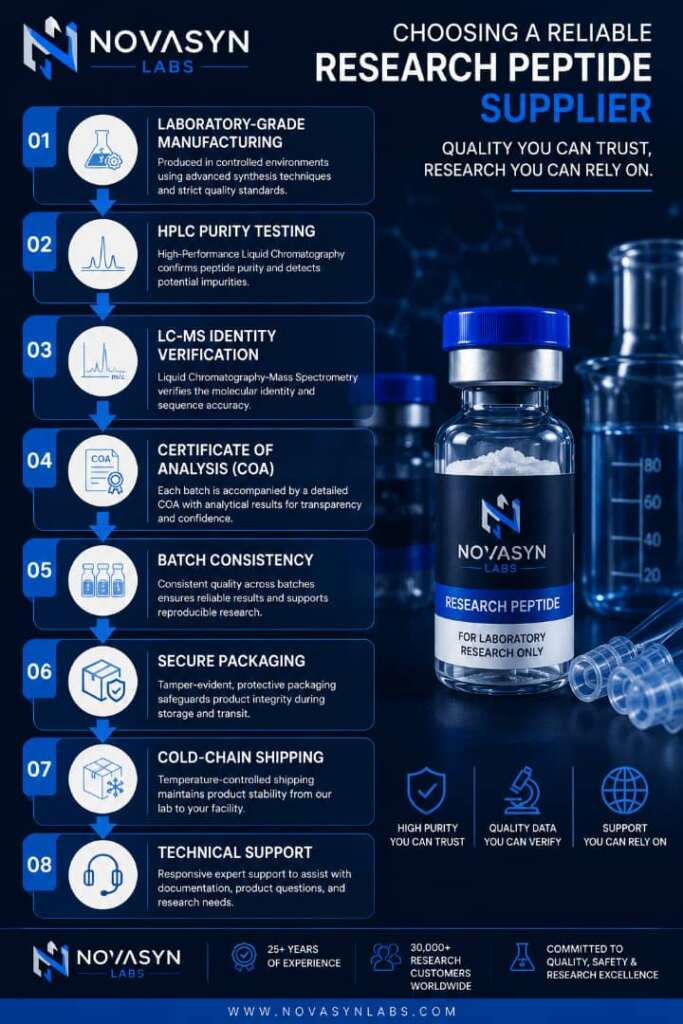
Key quality assurance steps to evaluate when selecting a research peptide supplier for laboratory research.


Comment
How Are Research Peptides Made? Complete Guide To Peptide Manufacturing & Quality Control (2026)
[…] Research peptides have become indispensable tools across modern scientific disciplines, supporting investigations in molecular biology, cell signaling, immunology, endocrinology, metabolism, neuroscience, and many other laboratory fields. Yet despite their widespread use, one question continues to surface among both new and experienced researchers: […]