



No products in the cart.
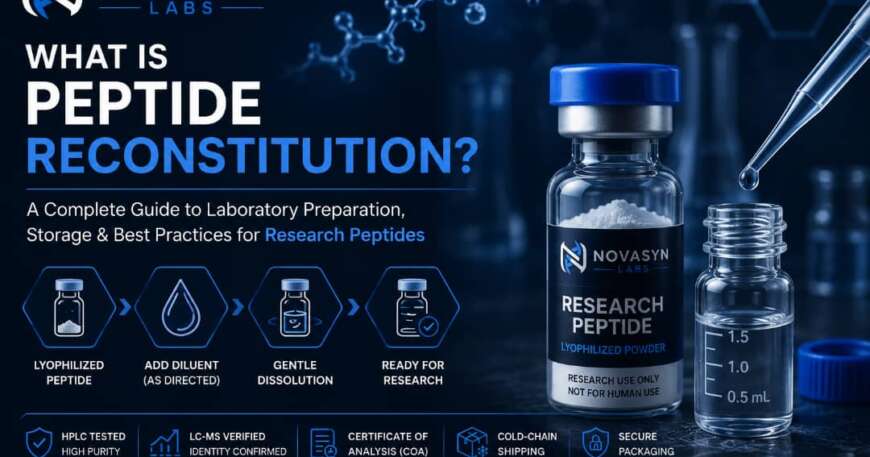
What Is Peptide Reconstitution? Complete Guide to Laboratory Preparation, Storage & Best Practices (2026)
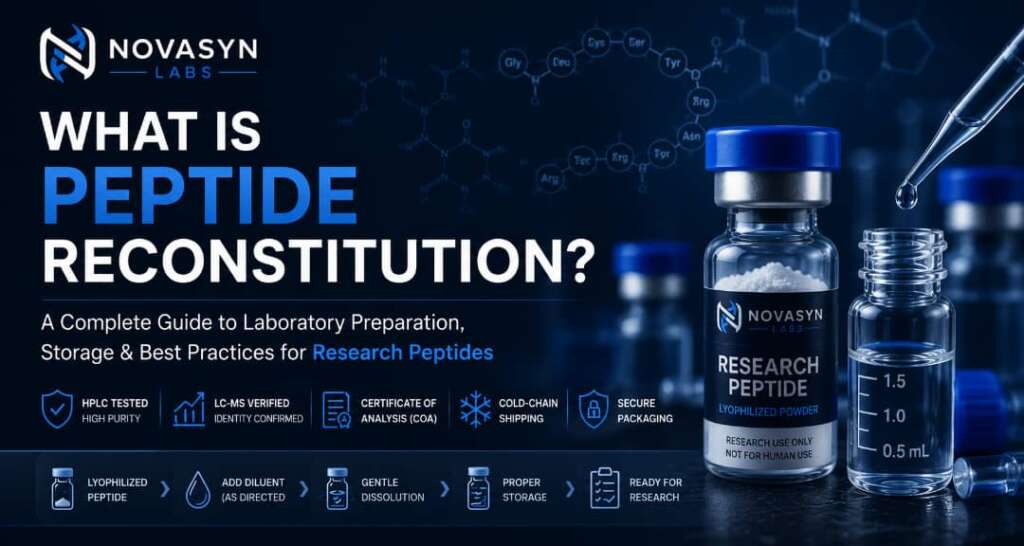
Table of Contents
What Is Peptide Reconstitution?
Peptide reconstitution is one of the most important steps in preparing lyophilized peptides for laboratory research. Whether researchers are working in universities, biotechnology companies, pharmaceutical laboratories, or independent research facilities, proper peptide reconstitution helps support consistent handling practices and well-documented experimental workflows.
Although the process itself is often discussed online, many articles provide only a brief explanation or overlook critical topics such as peptide quality, storage conditions, freeze-drying, analytical testing, and quality assurance. These factors can influence the consistency of laboratory materials and are therefore important considerations for research teams.
This comprehensive guide explains what peptide reconstitution is, why peptides are commonly supplied in lyophilized form, how storage practices relate to peptide stability, why analytical testing matters, and the quality control measures researchers should consider before beginning laboratory work.
At NovaSyn Labs, we have supplied laboratory-grade peptides for more than 13 years, serving approximately 350–400+ research customers worldwide. Throughout that time, we have worked with universities, biotechnology organizations, and research laboratories that rely on consistent peptide quality, transparent analytical documentation, and dependable customer support.
To help support research quality, every production batch is accompanied by comprehensive analytical documentation, including:
- High-Performance Liquid Chromatography (HPLC) purity testing
- Liquid Chromatography–Mass Spectrometry (LC-MS) identity verification
- Batch-specific Certificates of Analysis (COAs)
- Batch consistency monitoring
- Secure packaging
- Cold-chain shipping where appropriate
These quality assurance measures provide researchers with objective information about the materials they receive before those materials enter laboratory workflows.
Important: This article is intended for educational purposes and discusses peptide reconstitution in the context of laboratory research. Researchers should always follow the specific instructions and documentation supplied with their products and comply with applicable institutional procedures.
What Is Peptide Reconstitution?
Peptide reconstitution is the process of returning a lyophilized (freeze-dried) peptide to a liquid form suitable for laboratory use by adding an appropriate laboratory diluent according to the manufacturer’s recommendations and established laboratory procedures.
Many research peptides are supplied as dry powders because this form generally provides improved stability during storage and transportation compared with liquid preparations. Once researchers are ready to begin laboratory work, the peptide is reconstituted under controlled conditions consistent with product documentation and institutional protocols.
The goal of peptide reconstitution is not simply to convert a powder into a liquid. It is also an opportunity to maintain standardized laboratory practices through:
- Careful documentation
- Appropriate storage
- Consistent handling
- Review of analytical documentation
- Adherence to laboratory standard operating procedures (SOPs)
When these practices are followed consistently, laboratories may reduce avoidable sources of experimental variability and improve the organization of their research workflows.
Table 1. Key Concepts in Peptide Reconstitution
| Concept | Description |
| Peptide Reconstitution | Preparing a lyophilized peptide for laboratory use by adding an appropriate laboratory diluent according to product guidance |
| Lyophilization | Freeze-drying process used to improve storage stability |
| Laboratory Diluent | A suitable laboratory solution used according to supplier recommendations |
| Certificate of Analysis (COA) | Analytical document summarizing batch-specific testing |
| HPLC Testing | Analytical method used to assess peptide purity |
| LC-MS Verification | Analytical method used to confirm peptide identity |
Why Are Peptides Supplied Lyophilized?
One of the first questions researchers often ask is why peptides are shipped as dry powders instead of ready-to-use liquid solutions.
The answer lies in lyophilization, commonly known as freeze-drying.
Lyophilization is a manufacturing process that removes water from a peptide under carefully controlled conditions. By minimizing residual moisture, manufacturers can improve the stability of many research peptides during storage and transportation.
For this reason, the majority of laboratory-grade peptides supplied by reputable manufacturers are provided in lyophilized form.
The freeze-drying process offers several practical advantages for research laboratories:
- Improved stability during storage
- Reduced moisture exposure
- More efficient shipping
- Easier long-term inventory management
- Support for standardized laboratory preparation
Once researchers are ready to begin an experiment, the peptide can be reconstituted according to the product-specific recommendations and laboratory protocols.
How Lyophilization Works
Although the manufacturing process involves specialized equipment, the basic principle is straightforward.
The peptide solution is first frozen. Under reduced pressure, the frozen water is then removed by sublimation, a process in which ice changes directly into vapor without passing through the liquid phase.
This leaves behind a dry peptide cake or powder that is generally more stable than the original solution when stored under recommended conditions.
Because moisture is one of the factors that can influence peptide stability, reducing water content helps preserve product quality during storage and transport.
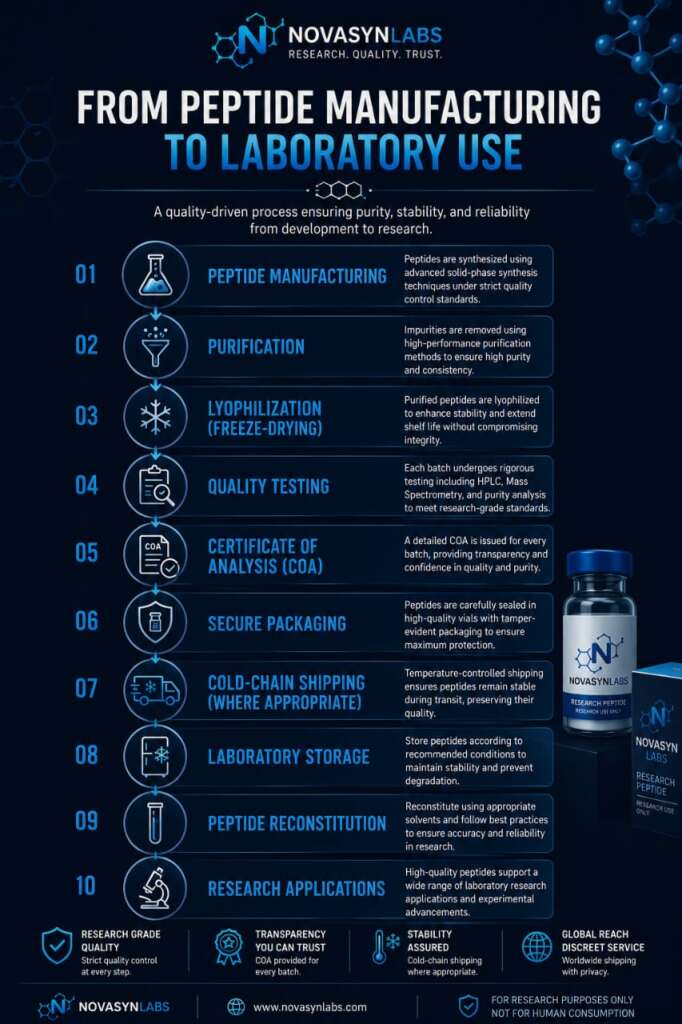
Benefits of Freeze-Drying
Freeze-drying has become the preferred preservation method for many research peptides because it supports both product quality and laboratory logistics.
Although individual peptides have different stability characteristics, lyophilization generally offers several advantages compared with shipping peptides in liquid form.
1. Improved Storage Stability
Removing moisture can help reduce degradation processes that may occur in aqueous solutions during storage.
For many laboratory peptides, the dry form provides greater flexibility for inventory management prior to reconstitution.
2. Easier Transportation
Shipping a dry peptide is often more practical than transporting a liquid solution.
Combined with secure packaging and appropriate shipping practices, lyophilization helps manufacturers deliver research materials more efficiently.
3. Reduced Moisture Exposure
Water can influence peptide stability over time.
By removing most of the water during manufacturing, lyophilization helps protect peptides until they are prepared for laboratory use.
4. Better Inventory Management
Research laboratories frequently maintain peptide inventories for ongoing projects.
Lyophilized products, when stored according to the manufacturer’s recommendations, can simplify inventory management by allowing laboratories to prepare materials when they are needed rather than immediately upon receipt.
Table 2. Lyophilized vs Reconstituted Peptides
| Feature | Lyophilized Peptides | Reconstituted Peptides |
| Physical Form | Freeze-dried powder | Liquid solution |
| Storage Stability | Generally higher when stored as recommended | May require additional handling and appropriate storage |
| Transportation | Convenient for shipping | Typically prepared within the laboratory |
| Moisture Content | Very low | Contains added laboratory diluent |
| Laboratory Preparation | Requires reconstitution before use | Ready for laboratory workflows after preparation |
Common Laboratory Diluents: A General Overview
Before peptide reconstitution, laboratories should review the product documentation and applicable institutional procedures to determine the appropriate diluent for their specific research material.
Different peptides may have different preparation requirements depending on their characteristics, so there is no single reconstitution approach that applies to every peptide.
Commonly referenced laboratory diluents in research settings include:
- Sterile laboratory water
- Bacteriostatic water
- Other laboratory-grade diluents specified by the manufacturer or research protocol
Researchers should always use the product-specific guidance supplied with their peptide and ensure that preparation is carried out using appropriate sterile laboratory techniques where applicable.
Avoid assuming that procedures suitable for one peptide are automatically appropriate for another, as preparation recommendations can vary between products.
Storage Before Peptide Reconstitution
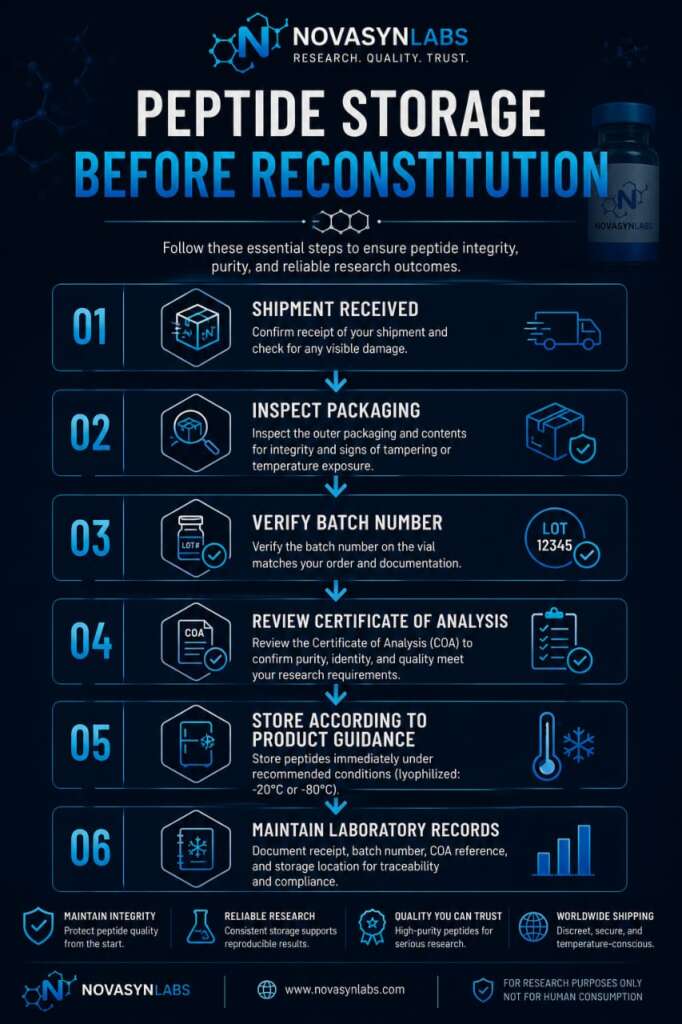
Proper storage is an essential component of peptide reconstitution and overall peptide quality. Before a lyophilized peptide is prepared for laboratory use, researchers should ensure it is stored according to the recommendations provided with the product and its accompanying documentation.
Although lyophilized peptides are generally more stable than reconstituted solutions, storage conditions still play an important role in maintaining product integrity over time.
Before beginning any research project, laboratories should:
- Review the Certificate of Analysis (COA)
- Verify the product and batch number
- Check the recommended storage conditions
- Inspect packaging for any signs of damage
- Record receipt dates and inventory information
Establishing these procedures helps laboratories maintain consistent quality assurance practices throughout the research workflow.
Best Practices Before Reconstitution
Researchers commonly follow these general laboratory practices:
- Store peptides according to the manufacturer’s recommendations.
- Keep vials tightly sealed until needed.
- Protect products from unnecessary exposure to heat, moisture, and direct sunlight.
- Maintain organized inventory records.
- Retain the Certificate of Analysis with laboratory documentation.
Well-organized storage systems help reduce avoidable errors and simplify future experiment planning.
Table 3. Storage Before Reconstitution
| Laboratory Step | Best Practice |
| Shipment Received | Inspect packaging and documentation |
| Product Verification | Confirm product name and batch number |
| COA Review | Review purity and identity documentation |
| Storage | Follow manufacturer recommendations |
| Environment | Protect from excessive heat, moisture, and direct light |
| Documentation | Record receipt date and storage location |
Storage After Peptide Reconstitution
Once peptide reconstitution has been completed, handling procedures become even more important.
Unlike lyophilized peptides, reconstituted peptide solutions may require more careful storage and documentation. Laboratories typically follow the storage recommendations supplied with each product and their own institutional standard operating procedures (SOPs).
Good laboratory organization includes:
- Labeling every prepared vial
- Recording preparation dates
- Recording the final concentration
- Documenting the solvent used
- Recording storage location
- Maintaining traceable laboratory records
These practices help researchers maintain consistency, particularly in collaborative or long-term studies.
General Laboratory Recommendations
Following reconstitution, laboratories commonly:
Store the peptide according to the manufacturer’s recommendations.
Clearly label each prepared vial.
Use standardized documentation procedures.
Limit unnecessary handling.
Monitor storage conditions throughout the research project.
These steps support reproducibility and facilitate internal quality reviews.
Table 4. Before vs After Reconstitution
| Stage | General Considerations |
| Before Reconstitution | Lyophilized peptide stored according to product guidance |
| After Reconstitution | Store according to product recommendations and laboratory SOPs |
| Documentation | Record preparation details and storage information |
| Quality Review | Maintain traceability using batch documentation |
Understanding Peptide Stability
One of the primary reasons peptide reconstitution receives so much attention is because peptide stability is influenced by multiple environmental and handling factors.
Peptide stability refers to the ability of a peptide to maintain its intended characteristics under appropriate storage and laboratory conditions.
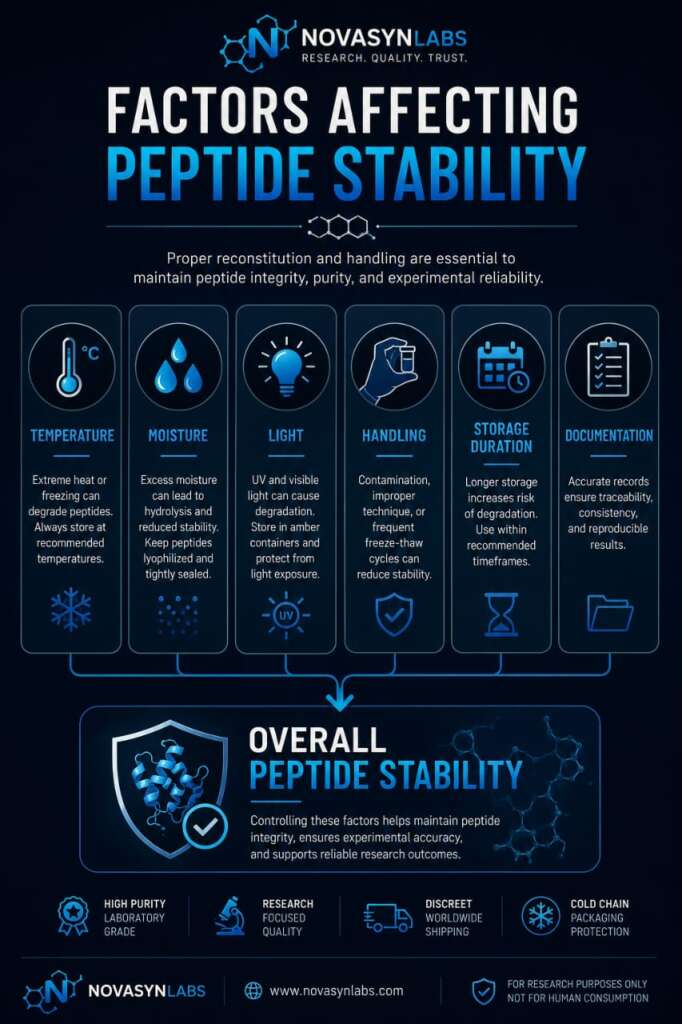
Numerous variables may influence stability, including:
- Temperature
- Moisture
- Light exposure
- Oxygen exposure
- Handling frequency
- Storage duration
- Laboratory procedures
For this reason, researchers often develop standardized handling protocols to reduce unnecessary variability between experiments.
Factors That Influence Peptide Stability
Temperature
Temperature is one of the most significant environmental factors affecting peptide storage. Researchers should always follow the storage guidance supplied with the product documentation.
Moisture
Lyophilization removes much of the water from peptide formulations. Protecting the product from excess moisture before reconstitution helps preserve quality.
Light
Some laboratory materials may be sensitive to prolonged exposure to direct light. Appropriate storage conditions help reduce unnecessary environmental exposure.
Handling
Frequent opening, repeated transfers, or inconsistent preparation procedures may introduce additional variability into laboratory workflows.
Standardized handling procedures help improve consistency across research teams.
Table 5. Factors Affecting Peptide Stability
| Factor | Importance |
| Temperature | Follow product-specific storage guidance |
| Moisture | Keep lyophilized peptides dry until use |
| Light | Minimize unnecessary exposure where appropriate |
| Handling | Standardize laboratory procedures |
| Documentation | Record preparation and storage information |
| Storage Duration | Monitor according to laboratory protocols |
Understanding Freeze–Thaw Cycles
Among the most frequently discussed aspects of peptide reconstitution is the effect of repeated freeze–thaw cycles.
A freeze–thaw cycle occurs when a stored peptide solution is frozen, thawed for use, and then frozen again. Repeating this process multiple times may affect the stability of some peptide preparations, depending on the peptide and storage conditions.
Because of this, many laboratories establish procedures designed to minimize unnecessary freeze–thaw events.
Why Laboratories Monitor Freeze–Thaw Cycles
Researchers often monitor freeze–thaw history because it helps:
- Maintain consistent laboratory records
- Support reproducibility
- Reduce avoidable handling variation
- Improve inventory management
- Standardize preparation procedures across research teams
Rather than relying on memory, many laboratories document the number of freeze–thaw events for each prepared sample as part of their quality management process.
Table 6. Freeze–Thaw Best Practices
| Practice | Purpose |
| Record preparation date | Improve traceability |
| Document freeze-thaw events | Support laboratory records |
| Label storage containers | Reduce identification errors |
| Follow laboratory SOPs | Promote consistency |
| Review storage guidelines | Maintain standardized handling |
Common Mistakes During Peptide Reconstitution
Even experienced laboratories benefit from standardized procedures. Some of the most common mistakes include:
- Assuming every peptide follows the same reconstitution procedure.
- Using a diluent without consulting the product documentation.
- Incomplete or inconsistent record keeping.
- Ignoring storage recommendations.
- Repeated freeze–thaw cycles without documentation.
- Failing to review the Certificate of Analysis before beginning laboratory work.
- Inconsistent labeling of prepared samples.
Avoiding these issues can improve workflow consistency and simplify future data review.
Quality Control in Peptide Reconstitution
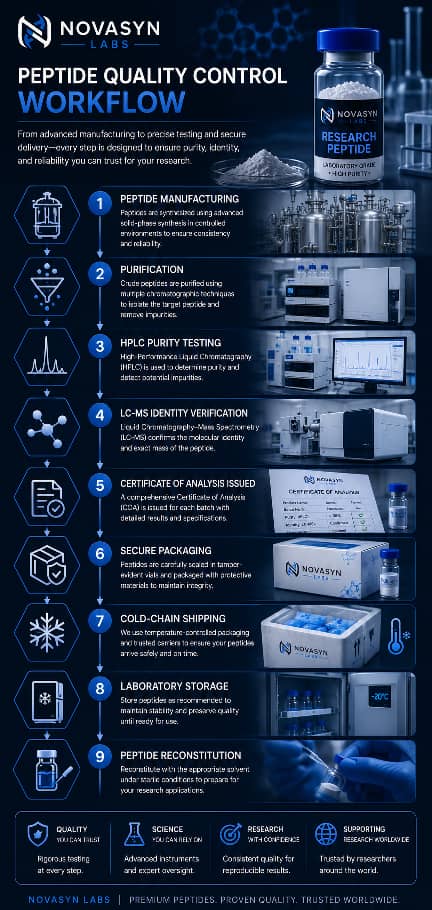
Successful peptide reconstitution begins long before a peptide reaches the laboratory. High-quality manufacturing, analytical testing, and documentation help researchers verify the identity and quality of the material they are working with before reconstitution takes place.
At NovaSyn Labs, quality assurance has been a core part of our operations for more than 13 years. During that time, we have supplied laboratory-grade peptides to approximately 350–400+ research customers, emphasizing transparency through analytical documentation and standardized manufacturing practices.
Our quality assurance process includes:
- High-Performance Liquid Chromatography (HPLC) purity testing
- Liquid Chromatography–Mass Spectrometry (LC-MS) identity verification
- Batch-specific Certificates of Analysis (COAs)
- Batch consistency monitoring
- Secure packaging
- Cold-chain shipping where appropriate
Together, these measures help researchers evaluate peptide quality before beginning laboratory work.
Understanding HPLC Purity Testing
High-Performance Liquid Chromatography (HPLC) is one of the most widely used analytical techniques in peptide manufacturing.
HPLC separates compounds within a sample, allowing analytical laboratories to estimate the percentage of the desired peptide relative to detectable impurities.
The results are commonly presented as a chromatogram and summarized within the Certificate of Analysis.
Researchers frequently review HPLC data to:
- Assess peptide purity
- Compare production batches
- Support laboratory quality assurance
- Document research materials
- Verify supplier transparency
LC-MS Identity Verification
While HPLC focuses on purity, Liquid Chromatography–Mass Spectrometry (LC-MS) is primarily used to confirm peptide identity.
Mass spectrometry measures molecular mass with high precision, helping laboratories verify that the synthesized peptide corresponds to the expected molecular structure.
Reviewing both HPLC and LC-MS results provides a more complete picture of peptide quality.
Table 7. HPLC vs LC-MS
| Analytical Method | Primary Purpose | Information Provided |
| HPLC | Purity Assessment | Purity percentage and chromatogram |
| LC-MS | Identity Verification | Molecular mass confirmation |
| COA | Batch Documentation | Summary of analytical testing |
Why Certificates of Analysis (COAs) Matter
A Certificate of Analysis (COA) is one of the most valuable documents accompanying a laboratory-grade peptide.
Rather than relying on marketing claims, researchers can review batch-specific analytical data before beginning peptide reconstitution.
A comprehensive COA typically includes:
- Product name
- Batch or lot number
- Manufacturing date
- HPLC purity results
- LC-MS identity verification
- Appearance
- Storage recommendations
- Testing methods
- Analyst approval
Maintaining COAs alongside laboratory records also supports internal audits, quality assurance, and long-term project documentation.
Case Study 1: Improved Experimental Consistency Through Better Storage Practices
Organization: Anonymous University-Affiliated Molecular Biology Laboratory
A molecular biology laboratory experienced inconsistent findings across several peptide-based research projects. Although incoming peptide batches consistently met purity specifications, an internal review revealed differences in storage temperatures, reconstitution procedures, and freeze–thaw handling between researchers.
To improve consistency, the laboratory implemented a standardized protocol that included:
- Storing lyophilized peptides under recommended conditions
- Preparing smaller aliquots after reconstitution where appropriate
- Recording solvent type, concentration, preparation date, and storage location
- Minimizing repeated freeze–thaw cycles
- Maintaining standardized laboratory documentation
Over subsequent projects, the laboratory reported lower variability between replicate experiments and improved reproducibility of laboratory data.
Key Takeaway: Standardized storage, documentation, and handling procedures can help reduce one source of experimental variability.
Case Study 2: Standardized Reconstitution Records Improved Laboratory Documentation
Organization: Anonymous University Research Department
A university research department conducting peptide-based investigations found that inconsistent documentation made it difficult to reproduce experiments months after they had been completed.
Researchers recorded preparation details using different formats, resulting in incomplete historical records.
The department introduced a standardized reconstitution record containing:
- Peptide batch number
- Certificate of Analysis reference
- Solvent used
- Final concentration
- Date and time of preparation
- Storage temperature
- Number of freeze–thaw events
Several months later, investigators reported improved traceability, easier internal audits, and more efficient collaboration between multiple research teams.
Key Takeaway: Consistent documentation supports reproducibility, collaboration, and long-term record management.
Common Misconceptions About Peptide Reconstitution
Several misconceptions continue to appear in online discussions about peptide reconstitution. Distinguishing between common myths and evidence-based laboratory practices helps researchers make more informed decisions.
| Myth | Evidence-Based Perspective |
| Every peptide is reconstituted the same way | Preparation recommendations may differ between peptides. Always follow product-specific guidance. |
| Any water can be used | Laboratories should use the appropriate diluent specified for the product or research protocol. |
| Reconstituted peptides never degrade | Stability depends on the peptide, storage conditions, and handling practices. |
| Freeze-thaw cycles do not matter | Many laboratories monitor and minimize unnecessary freeze-thaw events as part of quality management. |
| Storage conditions are unimportant | Appropriate storage helps maintain peptide quality and supports consistent laboratory workflows. |
Choosing a High-Quality Peptide Supplier
Selecting a supplier involves more than comparing prices. Researchers should evaluate whether a supplier provides the documentation and quality assurance needed to support reproducible research.
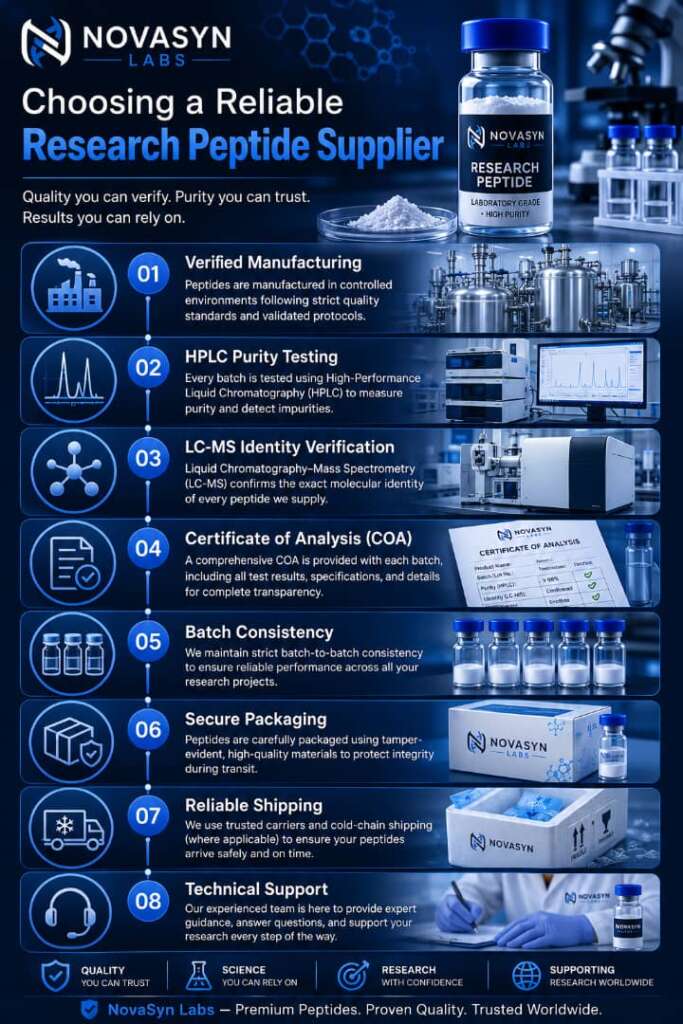
Supplier Checklist
✅ HPLC purity testing
✅ LC-MS identity verification
✅ Batch-specific Certificates of Analysis
✅ Batch consistency
✅ Secure packaging
✅ Cold-chain shipping where appropriate
✅ Transparent quality documentation
✅ Responsive technical support
Frequently Asked Questions
What is peptide reconstitution?
Peptide reconstitution is the process of preparing a lyophilized peptide for laboratory use by adding an appropriate laboratory diluent according to product guidance.
Why are peptides supplied as lyophilized powders?
Lyophilization helps improve storage stability and facilitates transportation before laboratory preparation.
Does every peptide use the same reconstitution procedure?
No. Preparation recommendations may differ depending on the peptide and manufacturer.
What is a Certificate of Analysis?
A COA is a batch-specific document summarizing analytical testing such as HPLC purity and LC-MS identity verification.
Why is HPLC testing important?
HPLC provides information about peptide purity and supports quality assurance.
What does LC-MS verify?
LC-MS confirms the molecular identity of the peptide.
Why should laboratories document freeze–thaw cycles?
Documentation helps support traceability and standardized laboratory practices.
Why is storage important after reconstitution?
Appropriate storage helps maintain peptide quality and supports consistent research workflows.
Conclusion
Understanding peptide reconstitution is an important part of responsible laboratory research. While the process itself is straightforward in principle, maintaining quality depends on much more than simply preparing a lyophilized peptide for use.
Proper storage, standardized documentation, careful handling, HPLC purity testing, LC-MS identity verification, and batch-specific Certificates of Analysis all contribute to well-organized and reproducible laboratory workflows.
For more than 13 years, NovaSyn Labs has supported approximately 350–400+ research customers by supplying laboratory-grade peptides backed by transparent analytical documentation and rigorous quality standards.
If you’re looking for laboratory-grade research peptides, explore our peptide categories, read our Peptide Storage & Handling Guide, or contact the NovaSyn Labs technical support team to learn more about our quality assurance processes and Certificates of Analysis.
Related Articles
References
- National Center for Biotechnology Information (NCBI)
- PubMed
- National Institute of Health (NIH)
- International Union of Pure and Applied Chemistry (IUPAC)
Scientific Disclaimer
This article is intended for educational and informational purposes only and discusses peptide reconstitution in the context of laboratory research. It does not provide medical advice or instructions for human use. Researchers should follow product-specific documentation, institutional procedures, and applicable regulations when handling laboratory-grade peptides.

