


No products in the cart.
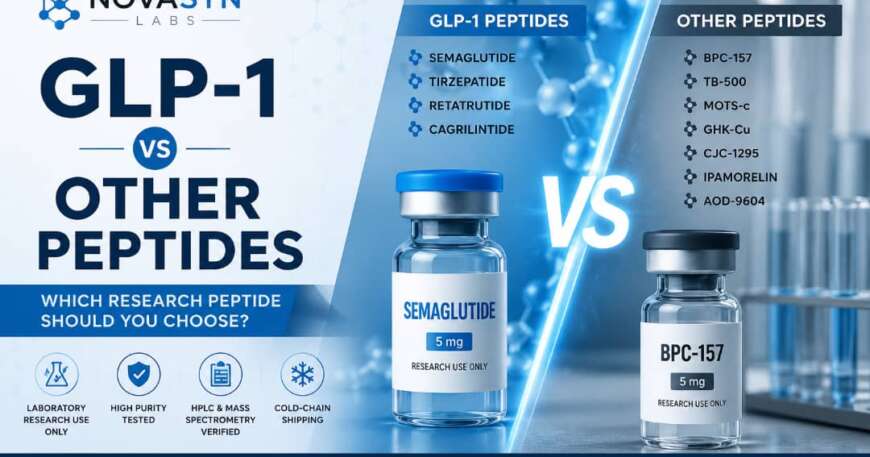
GLP-1 vs Other Peptides: Which Research Peptide Should You Choose?
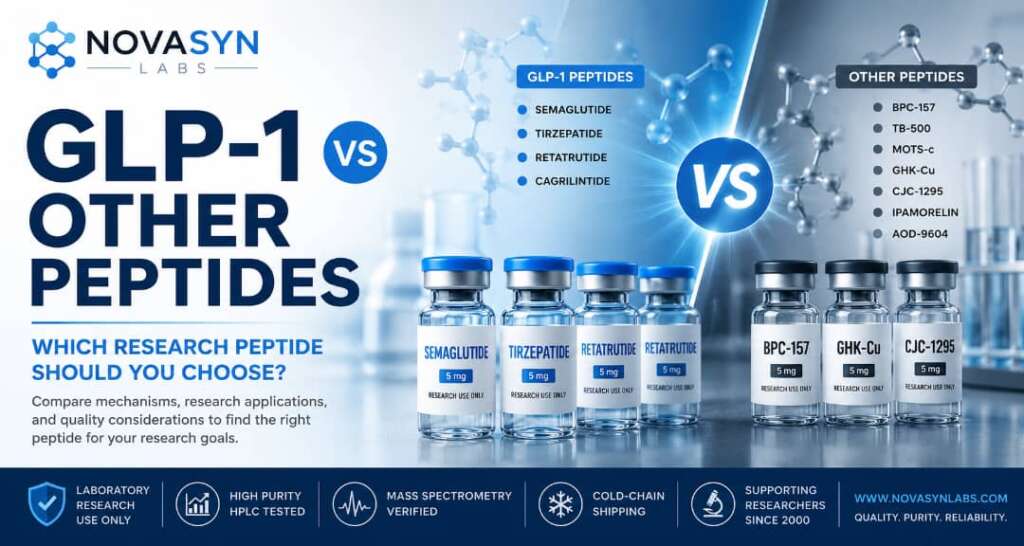
Table of Contents
GLP-1 vs Other Peptides: Which Research Peptide Should You Choose?
Peptides have become one of the most actively studied classes of biomolecules across metabolic, regenerative, endocrine, cosmetic, and longevity research. As interest continues to grow, many newcomers encounter an important question:
Should I choose a GLP-1 peptide or another type of research peptide?
At first glance, the answer may seem straightforward. After all, they’re all peptides. However, this assumption is one of the most common misconceptions among new researchers.
In reality, GLP-1 peptides and other research peptides often target entirely different biological pathways, making them suitable for very different experimental objectives. Selecting the appropriate peptide begins not with popularity but with understanding its mechanism of action and how it aligns with your research goals.
At NovaSyn Labs, we’ve supplied laboratory-grade research peptides since 2000, serving researchers worldwide with high-purity products supported by analytical testing and documented quality control. Over the years, we’ve found that researchers who begin by defining their scientific objectives are far more likely to build efficient, reproducible study designs than those who simply choose whichever peptide is trending online.
This guide explains how GLP-1 peptides compare with other commonly studied peptide categories, what differentiates them, and the practical considerations that should guide your selection process.
Research Use Only: The peptides discussed in this article are intended for laboratory and scientific research purposes only. This content is educational and should not be interpreted as medical advice or as promoting human use.
What Are GLP-1 Peptides?
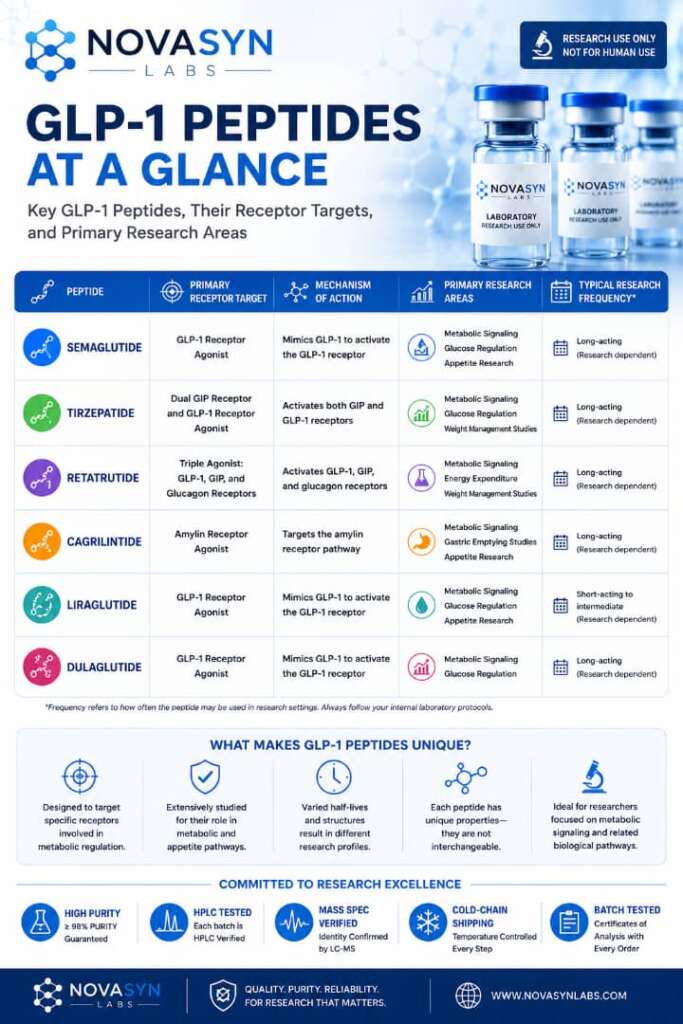
GLP-1 peptides belong to a class of compounds designed to interact primarily with the glucagon-like peptide-1 (GLP-1) receptor, a receptor involved in metabolic signaling.
Although often grouped together under one name, GLP-1 peptides are not identical molecules. Each has unique structural characteristics that influence receptor activity, stability, half-life, and other pharmacological properties.
Some of the most recognized GLP-1-related research peptides include:
- Semaglutide
- Tirzepatide
- Retatrutide
- Cagrilintide
- Liraglutide
- Dulaglutide
While these compounds share similarities, they are not interchangeable from a research perspective.
For example:
- Semaglutide primarily acts as a GLP-1 receptor agonist.
- Tirzepatide has dual activity involving both GIP and GLP-1 receptors.
- Retatrutide is investigated for activity across multiple receptor pathways.
- Cagrilintide belongs to a different peptide class and is commonly studied alongside GLP-1 receptor agonists in metabolic research.
These molecular differences contribute to variations in receptor interactions, dosing schedules in clinical settings, and stability characteristics.
Key Characteristics of GLP-1 Peptides
| Characteristic | Description |
| Primary Target | GLP-1 receptor (varies by compound) |
| Main Research Area | Metabolic signaling |
| Biological Focus | Glucose regulation, appetite signaling, gastric emptying |
| Examples | Semaglutide, Tirzepatide, Retatrutide, Cagrilintide |
| Mechanism | Receptor agonism (compound dependent) |
What Are Other Research Peptides?
The term “research peptide” encompasses a wide variety of molecules investigated for different biological processes. Unlike GLP-1 peptides, these compounds are not united by a single receptor target or biological function.
Instead, each peptide is designed or investigated for a specific research application.
Some examples include:
| Peptide | Common Research Focus |
| BPC-157 | Tissue and recovery research |
| TB-500 | Cellular migration and repair research |
| GHK-Cu | Skin biology and cosmetic research |
| MOTS-c | Mitochondrial and metabolic research |
| CJC-1295 | Growth hormone research |
| Ipamorelin | Growth hormone secretagogue research |
| AOD-9604 | Fat metabolism research |
Although these compounds are all peptides, their biological pathways differ significantly.
For example:
- BPC-157 is investigated in studies involving tissue repair and angiogenesis.
- GHK-Cu is commonly researched in skin biology and regenerative science.
- MOTS-c has attracted interest for its role in mitochondrial function and metabolic regulation.
- CJC-1295 and Ipamorelin are studied for their influence on growth hormone signaling.
- AOD-9604 is researched in relation to fat metabolism pathways.
The key takeaway is that “peptide” describes a molecular category—not a shared biological purpose.
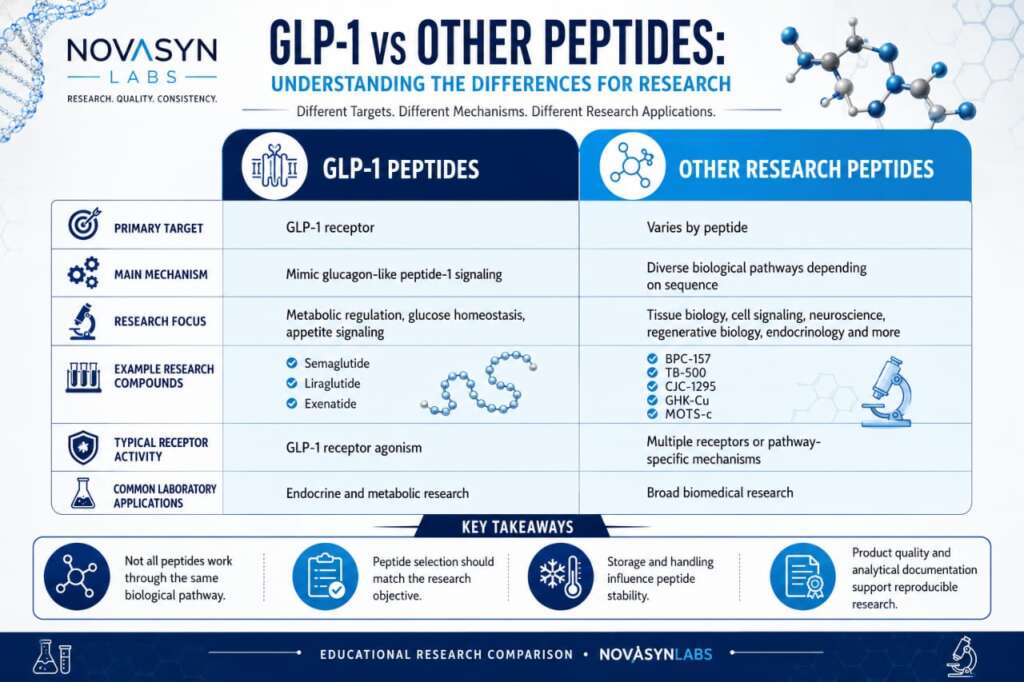
GLP-1 vs Other Peptides: A Side-by-Side Comparison
Understanding the distinction between peptide categories can help researchers choose compounds that align with their experimental objectives.
| Feature | GLP-1 Peptides | Other Research Peptides |
| Primary Target | GLP-1 receptor (or related receptors) | Varies depending on peptide |
| Mechanism | Receptor agonism | Multiple biological mechanisms |
| Research Focus | Metabolic signaling | Recovery, longevity, cosmetic, endocrine, mitochondrial, and more |
| Examples | Semaglutide, Tirzepatide, Retatrutide | BPC-157, TB-500, GHK-Cu, MOTS-c, CJC-1295 |
| Selection Criteria | Metabolic research objective | Goal-specific biological pathway |
This comparison highlights why researchers should avoid assuming that all peptides perform similar roles simply because they belong to the same molecular class.
Understanding the Different Peptide Categories
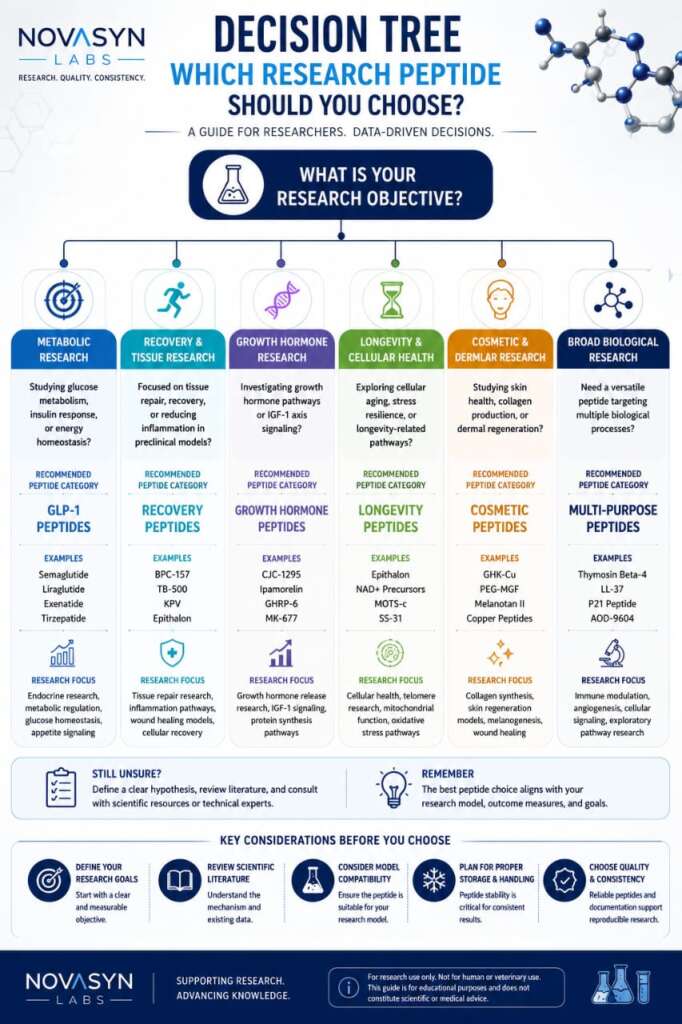
One of the simplest ways to choose a research peptide is to begin with the scientific question you are trying to answer.
Rather than asking, “Which peptide is the most popular?” ask:
“Which biological pathway is most relevant to my research objective?”
This approach reduces confusion and helps align compound selection with study design.
Common Research Objectives and Corresponding Peptide Categories
| Research Objective | Peptide Category | Examples |
| Metabolic signaling | GLP-1 peptides | Semaglutide, Tirzepatide, Retatrutide |
| Tissue recovery | Recovery peptides | BPC-157, TB-500 |
| Growth hormone research | Secretagogues | CJC-1295, Ipamorelin |
| Cosmetic and skin biology | Cosmetic peptides | GHK-Cu |
| Mitochondrial function | Longevity peptides | MOTS-c |
| Fat metabolism | Metabolic peptides | AOD-9604 |
This framework reinforces an important principle:
The right peptide depends on your research objective—not on market popularity.
At NovaSyn Labs, this is the guidance we consistently provide to researchers. Choosing compounds based on clearly defined scientific goals can simplify study planning and reduce confusion when comparing peptide categories.
Three Common Misconceptions About GLP-1 Peptides
After supplying laboratory-grade research peptides for researchers worldwide since 2000, our team has answered thousands of questions about peptide selection. While interest in GLP-1 peptides continues to grow, we frequently encounter several misconceptions that can lead to confusion when planning research.
Understanding these misconceptions can help researchers make more informed decisions and choose compounds that better align with their scientific objectives.
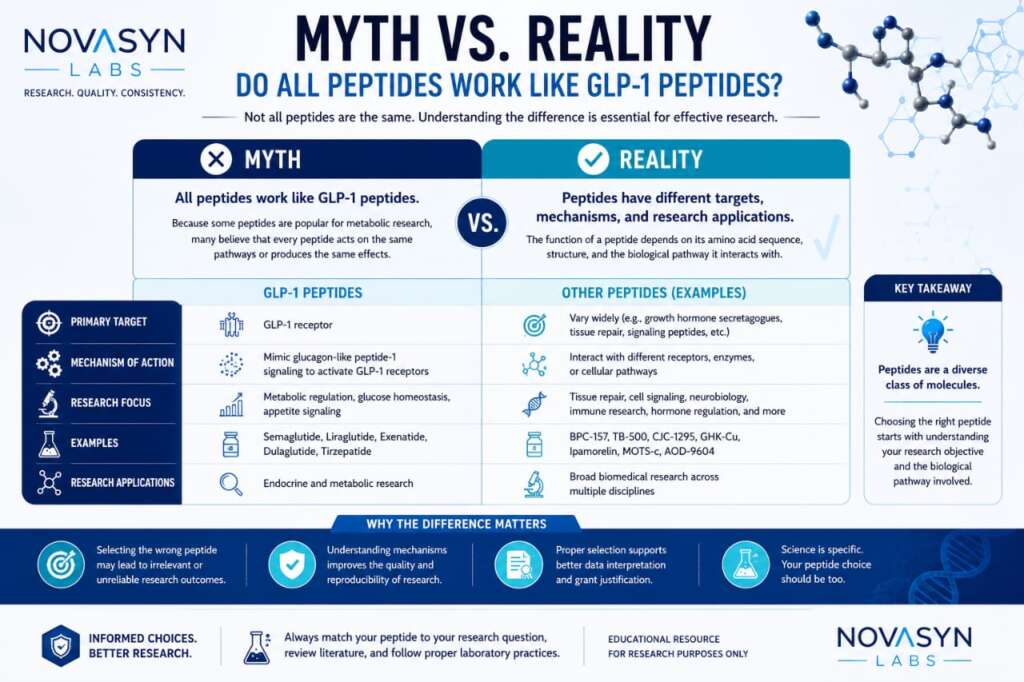
Misconception #1: “All Peptides Work Like GLP-1 Peptides.”
This is by far the most common misunderstanding we hear.
Because compounds like Semaglutide and Tirzepatide receive significant attention, many newcomers assume that every peptide functions in a similar way.
However, “peptide” simply describes a class of molecules composed of amino acids—it does not define a common biological function.
Each peptide is designed or investigated for different biological pathways.
For example:
| Peptide | Primary Research Focus |
| Semaglutide | GLP-1 receptor signaling |
| Tirzepatide | GIP and GLP-1 receptor signaling |
| BPC-157 | Tissue repair research |
| TB-500 | Cellular migration and repair research |
| GHK-Cu | Skin biology research |
| MOTS-c | Mitochondrial research |
| CJC-1295 | Growth hormone signaling research |
Although every compound listed above is technically a peptide, they should not be viewed as interchangeable research tools.
Expert Insight: Always begin with your research question, then identify the peptide category that best matches the biological pathway under investigation.
Misconception #2: “Every GLP-1 Peptide Is the Same.”
Another common assumption is that all GLP-1 receptor agonists are essentially identical.
In reality, important differences exist between these compounds, including:
- Molecular structure
- Receptor activity
- Half-life
- Stability
- Pharmacological profile
- Clinical development history
For example:
- Semaglutide primarily targets the GLP-1 receptor.
- Tirzepatide has dual activity involving both GIP and GLP-1 receptors.
- Retatrutide is investigated for activity across multiple receptor pathways.
- Liraglutide and Dulaglutide also belong to the GLP-1 receptor agonist class but differ structurally and pharmacologically.
These differences are one reason researchers should avoid treating all GLP-1 peptides as interchangeable.
Misconception #3: “Higher Purity Automatically Means Better Biological Performance.”
High purity is an essential indicator of research quality—but purity alone does not determine the quality of experimental materials or research outcomes.
Even a peptide with excellent analytical purity can degrade if it is improperly handled.
Several factors influence peptide integrity, including:
- Proper storage
- Correct reconstitution
- Accurate dosing
- Shipping conditions
- Temperature exposure
- Freeze-thaw cycles
- Moisture exposure
For this reason, experienced researchers evaluate much more than the purity percentage listed on a Certificate of Analysis.
Quality Depends on the Entire Process
| Factor | Why It Matters |
| HPLC purity testing | Verifies chemical purity |
| Mass Spectrometry | Confirms molecular identity |
| Cold-chain shipping | Helps maintain stability during transport |
| Proper storage | Reduce degradation risk |
| Correct reconstitution | Supports material integrity |
| Batch documentation | Improves traceability and consistency |
At NovaSyn Labs, these considerations are part of our broader quality-control approach because reproducible research begins with reliable laboratory materials.
How to Choose the Right Research Peptide
One of the questions we hear most often is:
“Which peptide should I choose?”
Our answer is always the same:
Choose the peptide that aligns with your research objective—not the one that is currently the most popular.
Popularity may influence online discussions, but it should never replace scientific reasoning.
Instead, begin by asking a series of practical questions.
Step 1: Define Your Research Objective
Ask yourself:
- Which biological pathway am I studying?
- What scientific question am I trying to answer?
- Which peptide category best matches that objective?
This simple step often eliminates unsuitable options before comparing individual compounds.
Step 2: Compare Peptide Categories
| Research Goal | Recommended Category |
| Metabolic signaling | GLP-1 peptides |
| Tissue recovery | BPC-157, TB-500 |
| Growth hormone research | CJC-1295, Ipamorelin |
| Longevity research | MOTS-c |
| Cosmetic research | GHK-Cu |
| Fat metabolism research | AOD-9604 |
Notice that the decision begins with the research goal, not the peptide name.
Step 3: Evaluate Product Quality
Before selecting a supplier, consider whether each batch includes:
- Certificate of Analysis (COA)
- HPLC purity testing
- Mass spectrometry verification
- Batch traceability
- Proper cold-chain shipping
- Reliable storage guidance
These quality indicators help researchers compare suppliers using objective criteria rather than marketing claims.
Step 4: Plan for Proper Handling
Even the highest-quality peptide can lose integrity if it is:
- Stored incorrectly
- Exposed to excessive heat
- Subjected to repeated freeze-thaw cycles
- Reconstituted improperly
- Left at room temperature for extended periods
Proper laboratory practices are an important part of maintaining sample quality throughout a study.
Why Quality Matters Beyond Purity
Purity is one of the first specifications researchers examine—but experienced laboratories know that it tells only part of the story.
A reliable research peptide should also be supported by analytical verification, consistent manufacturing standards, and careful handling throughout the supply chain.
At NovaSyn Labs, our quality process focuses on several key elements that help researchers evaluate product consistency.
HPLC Purity Testing
High-Performance Liquid Chromatography (HPLC) is widely used to assess peptide purity by separating components within a sample.
This analysis helps determine the proportion of the desired peptide relative to impurities and is a standard quality-control technique in peptide manufacturing.
Mass Spectrometry Confirmation
While HPLC measures purity, mass spectrometry (LC-MS/MS or related methods) is commonly used to verify molecular identity.
Together, these analytical techniques provide complementary information that helps confirm a peptide matches its expected specifications.
Cold-Chain Shipping
Temperature fluctuations can affect peptide stability during transportation.
Cold-chain shipping helps reduce unnecessary thermal exposure and supports the preservation of product integrity while the material is in transit.
Proper Storage
Once peptides arrive at the laboratory, storage practices become equally important.
Researchers should always follow the storage recommendations provided with the product, paying close attention to factors such as refrigeration or freezing, protection from moisture, and minimizing repeated freeze-thaw cycles where appropriate.
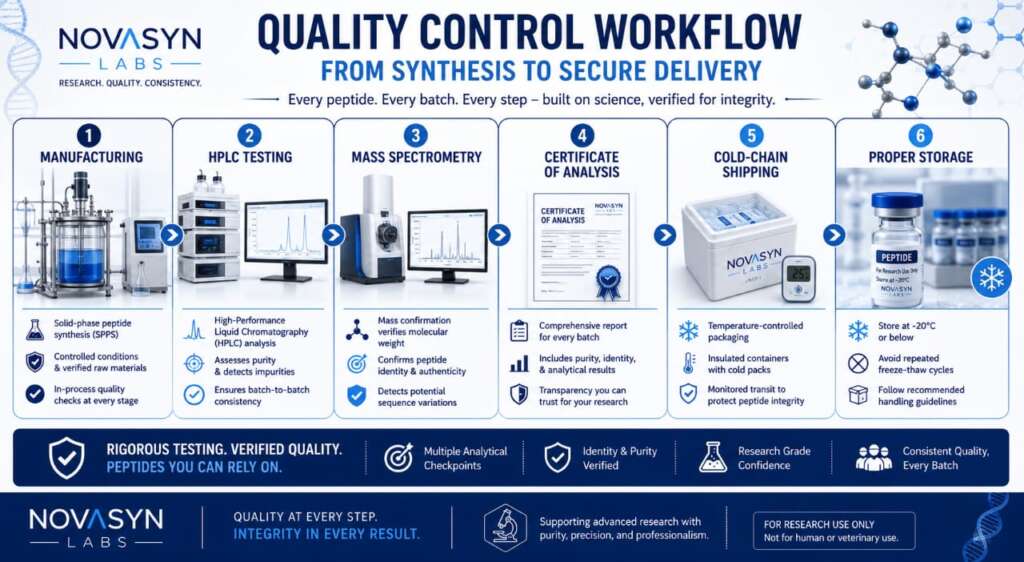
Quality Control Workflow
| Quality Step | Purpose |
| Peptide Manufacturing | Controlled production process |
| HPLC Testing | Verify analytical purity |
| Mass Spectrometry | Confirm molecular identity |
| Certificates of Analysis | Document analytical results |
| Cold-chain Shipping | Maintain temperature stability |
| Proper Storage | Help preserve sample integrity |
Real Laboratory Experience: Why Peptide Selection and Quality Matter
Scientific literature provides valuable information about peptide biology, but practical laboratory experience also offers important lessons about sourcing, consistency, and research planning.
The following anonymized case studies are based on experiences shared by researchers and are intended to illustrate good laboratory practices rather than biological outcomes.
Case Study 1: Switching Suppliers Improved Research Consistency
A university research laboratory studying peptide stability purchased research peptides from several suppliers over multiple projects.
Although each supplier provided Certificates of Analysis (COAs), the research team noticed differences in chromatographic profiles, documentation quality, and lot-to-lot consistency.
To reduce unnecessary variability, the laboratory standardized purchasing through a single supplier that provided:
- Comprehensive HPLC purity reports
- Mass spectrometry confirmation
- Consistent manufacturing standards
- Batch-specific documentation
- Reliable cold-chain shipping
Over subsequent research cycles, the team reported improved consistency between experimental materials. This simplified protocol standardization and reduced time spent investigating variability related to reagent sourcing.
Key Takeaway
The researchers emphasized that consistent documentation, analytical verification, and proper storage practices were valuable contributors to reproducible laboratory workflows. Rather than changing their experimental objectives, they reduced variability by standardizing the quality of their research materials.
Case Study 2: Choosing the Appropriate Peptide Category
An independent researcher who was new to peptide science initially selected compounds based primarily on online popularity.
After reviewing educational resources and discussing their research objectives with knowledgeable technical support, they realized that a different peptide category was more closely aligned with the biological pathway they intended to investigate.
The researcher adjusted their purchasing decisions, selected compounds based on scientific objectives instead of trends, and implemented standardized storage and handling procedures.
As a result, their laboratory workflow became more organized, and selecting compounds according to study design improved consistency in research planning.
Key Takeaway
No conclusions were drawn regarding biological efficacy. Instead, the experience demonstrated the value of:
- Defining research objectives first
- Understanding peptide mechanisms
- Choosing the correct peptide category
- Following proper storage and handling practices
- Maintaining organized laboratory documentation
Frequently Asked Questions
Are all peptides GLP-1 peptides?
No. GLP-1 peptides represent just one category of research peptides. Other categories—including recovery peptides, growth hormone secretagogues, cosmetic peptides, and longevity peptides—investigate different biological pathways.
Which GLP-1 peptides are commonly studied?
Commonly studied GLP-1-related peptides include:
- Semaglutide
- Tirzepatide
- Retatrutide
- Cagrilintide
- Liraglutide
- Dulaglutide
Each differs in molecular structure, receptor activity, and research applications.
Is Tirzepatide the same as Semaglutide?
No.
Although both are associated with metabolic research, Tirzepatide interacts with both GIP and GLP-1 receptors, whereas Semaglutide primarily targets the GLP-1 receptor.
What makes GLP-1 peptides different from BPC-157 or TB-500?
GLP-1 peptides primarily investigate metabolic signaling pathways, while BPC-157 and TB-500 are commonly researched in relation to tissue repair and cellular recovery pathways. They are designed for different research objectives and should not be considered interchangeable.
Does higher purity guarantee better research outcomes?
No.
High purity is an important quality indicator, but research quality also depends on:
- Proper storage
- Accurate handling
- Appropriate reconstitution
- Analytical verification
- Batch consistency
- Experimental design
Why is HPLC testing important?
High-Performance Liquid Chromatography (HPLC) helps verify the analytical purity of peptide samples and is widely used as part of peptide quality control.
Why is mass spectrometry used alongside HPLC?
Mass spectrometry confirms molecular identity, while HPLC evaluates purity. Together, these techniques provide complementary information about a peptide’s quality.
Why is cold-chain shipping important?
Cold-chain shipping helps minimize temperature fluctuations during transport, reducing the risk of degradation before peptides reach the laboratory.
How should researchers choose a peptide?
Rather than selecting the most popular compound, researchers should:
- Define the biological pathway they wish to investigate.
- Choose the peptide category that aligns with that objective.
- Verify analytical quality through HPLC and mass spectrometry.
- Follow recommended storage and handling procedures.
Where can I learn more about different peptide categories?
Explore the educational resources available on the NovaSyn Labs blog to compare peptide categories, understand laboratory best practices, and learn how quality-control measures contribute to reliable research materials.
Final Thoughts
Interest in GLP-1 peptides has expanded rapidly in recent years, but it’s important to remember that GLP-1 peptides represent only one branch of a much broader peptide research landscape.
Compounds such as Semaglutide, Tirzepatide, Retatrutide, and Cagrilintide are investigated for metabolic signaling, while peptides including BPC-157, TB-500, GHK-Cu, MOTS-c, CJC-1295, Ipamorelin, and AOD-9604 are studied for entirely different biological pathways.
At NovaSyn Labs, we’ve found that researchers achieve more organized and consistent workflows when they begin by asking:
“What is my research objective?”
Answering that question first helps identify the most appropriate peptide category and reduces the likelihood of choosing compounds based on trends rather than scientific rationale.
Quality should also remain a central consideration. Analytical verification through HPLC and mass spectrometry, proper cold-chain shipping, and correct storage practices all contribute to maintaining peptide integrity and supporting reproducible laboratory work.
Whether you’re new to peptide research or comparing peptide categories for your next study, understanding the differences between GLP-1 peptides and other research peptides is an important first step toward making informed, objective decisions.
Compare Research Peptide Categories at NovaSyn Labs
Explore our collection of laboratory-grade research peptides, supported by:
- High-purity peptides with batch-specific Certificates of Analysis (COAs)
- HPLC purity testing and mass spectrometry confirmation
- Cold-chain shipping to help maintain peptide integrity
- Comprehensive documentation for research use
- Educational resources to assist in selecting peptides based on scientific objectives
Browse our peptide categories to compare GLP-1 peptides, recovery peptides, longevity peptides, growth hormone secretagogues, cosmetic peptides, and more.
Research Use Only: Products offered by NovaSyn Labs are intended exclusively for laboratory research and scientific investigation. They are not approved for human or veterinary use.
Related Articles
- What Are Peptides and How Do They Work?
- How Is Peptide Purity Maintained During Storage?
- Peptide Storage and Handling Guide
- Are Peptides Safe?
- Different Categories of Peptides
References

