



No products in the cart.

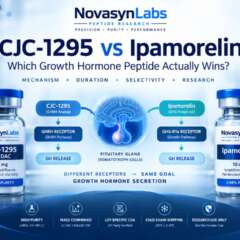
CJC-1295 vs Ipamorelin: Which Growth Hormone Peptide Actually Wins?

Table of Contents
Introduction
When researchers compare CJC-1295 vs Ipamorelin, the obvious question is: which growth hormone peptide is better?
The more scientifically useful question is different:
What does each peptide actually do, which signaling pathway does it engage, and which experimental model is best suited to that mechanism?
CJC-1295 and Ipamorelin are frequently discussed together because they influence growth hormone (GH) secretion through different biological pathways. CJC-1295 is associated with the growth hormone-releasing hormone (GHRH) pathway, while Ipamorelin acts primarily through the growth hormone secretagogue receptor (GHS-R1a), also known as the ghrelin receptor.
That distinction is central to understanding the CJC-1295 vs Ipamorelin comparison.
There is another important complication: not all CJC-1295 is the same from a research perspective. CJC-1295 No DAC, often referred to as Modified GRF 1-29, has substantially different pharmacokinetic characteristics from CJC-1295 with DAC. Comparing CJC-1295 with Ipamorelin without specifying which CJC-1295 variant is being discussed can therefore produce a misleading conclusion.
For laboratory researchers, biotechnology teams, and procurement/QC specialists, the most useful comparison involves five questions:
- How do the compounds work?
- How long do their effects persist?
- How selective are their receptor interactions?
- How controllable is the experimental signal?
- Can the material being tested actually be verified analytically?
This article examines those questions from a research perspective and explains why the ultimate “winner” may depend on the experimental objective.
«Research-use disclaimer: CJC-1295 and Ipamorelin discussed here are presented for laboratory research and preclinical investigation only. This article is not a recommendation for human use, dosing, treatment, or self-administration.»
CJC-1295 vs Ipamorelin at a Glance
Before examining the mechanisms in detail, the following table provides a high-level comparison.
| Characteristics | CJC-1295 No DAC | CJC-1295 with DAC | Ipamorelin |
| Primary pathway | GHRH receptor | GHRH receptor | GHS-R1a / ghrelin receptor |
| General research role | GHRH-pathway stimulation | Sustained GHRH-pathway research | Selective GH secretagogue research |
| Approximate duration | Shorter acting | Much longer acting | Relatively short acting |
| Temporal control | High | Lower | High |
| Receptor pathway | GHRH | GHRH | GHS-R1a |
| Research interest | Pulsatile/controlled signaling | Prolonged exposure models | Selective secretagogue signaling |
| Major distinction | Shorter exposure profile | Albumin-binding DAC modification | Selective GHS-R agonism |
| Best comparison | Ipamorelin | Ipamorelin for duration-focused studies | CJC-1295 variants |
| Combination research interest | High | Different experimental objective | High |
The table immediately illustrates why asking “CJC-1295 vs Ipamorelin— which is stronger?” is not necessarily the most scientifically meaningful question.
The compounds are not simply two versions of the same molecule.
They stimulate different receptor systems.
1. CJC-1295 and Ipamorelin Work Through Different Pathways
The most important distinction in the CJC-1295 vs Ipamorelin comparison is their mechanism of action.
CJC-1295: the GHRH pathway
CJC-1295 is a modified peptide related to GHRH signaling. Its research interest centers on interaction with the GHRH receptor on pituitary somatotroph cells.
GHRH receptor activation participates in the signaling cascade that regulates GH secretion.
In simplified terms:
CJC-1295 → GHRH receptor → intracellular signaling → GH secretion
This makes CJC-1295 particularly interesting in experimental models investigating the GHRH side of GH regulation.
Ipamorelin: the GHS-R pathway
Ipamorelin takes a different route.
It is a growth hormone secretagogue associated with activation of GHS-R1a, the receptor commonly associated with ghrelin-mediated signaling.
The simplified pathway is:
Ipamorelin → GHS-R1a → intracellular signaling → GH secretion
Therefore, CJC-1295 and Ipamorelin can influence the same downstream physiological endpoint—GH secretion—while beginning at different receptor systems.
That is the foundation of their research interest as complementary compounds.

2. CJC-1295 No DAC vs CJC-1295 with DAC: Why the Difference Matters
One of the most common mistakes in discussions of CJC-1295 vs Ipamorelin is treating all CJC-1295 as pharmacologically equivalent.
It isn’t.
CJC-1295 No DAC
CJC-1295 No DAC, frequently referred to as Modified GRF 1-29, has a relatively short duration compared with the DAC-modified form.
This shorter profile makes it attractive for researchers interested in:
- Temporal control
- Short-duration exposure experiments
- Pulsatile signaling models
- Comparing discrete secretagogue responses
- Studying the relationship between exposure and GH secretion
Its shorter profile is one reason researchers frequently discuss CJC-1295 No DAC in conjunction with Ipamorelin.
CJC-1295 with DAC
CJC-1295 with DAC incorporates a Drug Affinity Complex modification that substantially changes its pharmacokinetic behavior.
The DAC modification facilitates binding to circulating albumin, contributing to a much longer apparent half-life, commonly reported in the range of several days.
Consequently, CJC-1295 with DAC is better thought of as a long-duration experimental tool, rather than simply a stronger version of CJC-1295 No DAC.
This distinction matters enormously when designing an experiment.
A short-duration model and a prolonged-exposure model are asking different scientific questions.
3. Why Researchers Compare CJC-1295 and Ipamorelin
The interest in CJC-1295 vs Ipamorelin goes beyond popularity.
Researchers can use the compounds to investigate two distinct components of GH secretagogue biology.
CJC-1295 provides a model for studying GHRH receptor signaling.
Ipamorelin provides a model for studying GHS-R1a-mediated secretagogue signaling.
That creates an interesting experimental framework:
| Experimental Question | Compound of Interest |
| What happens when the GHRH pathway is stimulated? | CJC-1295 |
| What happens when GHS-R1a is stimulated? | Ipamorelin |
| How does exposure duration influence the response? | CJC-1295 variant comparison |
| How selective is secretagogue signaling? | Ipamorelin |
| What happens when complementary pathways are investigated together? | CJC-1295 + Ipamorelin |
This is considerably more informative than simply ranking one peptide above the other.
4. Ipamorelin’s Selectivity Is One of Its Most Interesting Features
Ipamorelin is often distinguished from earlier-generation growth hormone-releasing peptides because of its relative selectivity for GH-secretagogue signaling.
Older secretagogues such as GHRP-2 and GHRP-6 have broader endocrine effects in experimental settings.
Ipamorelin has attracted research interest because it can stimulate GH secretion while exhibiting comparatively limited effects on other pituitary hormones such as ACTH/cortisol and prolactin under studied conditions.
That makes selectivity an important category in the CJC-1295 vs Ipamorelin comparison.
If the primary research question involves receptor selectivity and minimizing confounding endocrine pathways, Ipamorelin can have an important experimental advantage.
Does Ipamorelin “win” on selectivity?
For this particular criterion, Ipamorelin has the advantage.
But that does not automatically make it the better compound overall.
A highly selective compound isn’t necessarily the best choice for an experiment investigating a different receptor pathway.
5. Does CJC-1295 Win on Temporal Control?
This is where CJC-1295 No DAC becomes particularly interesting.
Because CJC-1295 No DAC has a substantially shorter exposure profile than the DAC-modified form, researchers can investigate GH-secretagogue signaling with greater temporal resolution.
That can be valuable when studying:
- Exposure-response relationships
- Short-duration signaling
- Pulsatile endocrine models
- Receptor responsiveness
- Interactions between secretagogue pathways
By contrast, the DAC modification intentionally extends the compound’s persistence.
Therefore:
CJC-1295 No DAC = greater temporal control
CJC-1295 with DAC = longer experimental exposure
Neither characteristic is inherently “better.”
They simply answer different questions.
6. Why the CJC-1295 + Ipamorelin Combination Gets So Much Research Attention
This is arguably the most interesting part of the entire CJC-1295 vs Ipamorelin discussion.
CJC-1295 and Ipamorelin don’t simply compete for the same receptor.
They engage different upstream pathways.
Conceptually:
CJC-1295 → GHRH receptor
and
Ipamorelin → GHS-R1a
Both pathways can converge on GH secretion at the pituitary level.
This creates a scientifically interesting hypothesis:
«Could simultaneous activation of complementary GH-secretagogue pathways generate a different response from activation of either pathway individually?»
That question explains why CJC-1295 + Ipamorelin combinations have attracted substantial research interest.
Importantly, synergy should not be assumed merely because two pathways are different. It should be demonstrated experimentally under defined conditions.
That distinction is important for responsible scientific writing.
7. Illustrative Laboratory Scenario: Single Pathway vs Dual Pathway
Consider a hypothetical preclinical experiment involving cultured pituitary cells.
Experimental objective
Researchers want to investigate whether stimulation of the GHRH receptor and GHS-R1a produces different GH responses from stimulation of either pathway individually.
Three experimental conditions are established:
- CJC-1295 No DAC alone
- Ipamorelin alone
- CJC-1295 No DAC + Ipamorelin
The researchers then compare GH secretion under standardized experimental conditions.
Hypothetical interpretation
The individual compounds produce measurable secretagogue responses.
The combined condition produces a larger cumulative response than either individual pathway under the selected experimental conditions.
The important scientific observation would not simply be:
“The combination is stronger.”
The more useful conclusion would be:
“Concurrent engagement of complementary receptor pathways produced a different GH-secretory profile than isolated pathway stimulation.”
That wording matters because experimental synergy depends on concentration, timing, receptor expression, model system, assay conditions, and other variables.
This is an illustrative laboratory scenario, not a claim of a specific NovaSynLabs experiment or a universal result across models.
8. CJC-1295 vs Ipamorelin: Which One Wins on Mechanism?
There isn’t a single winner.
Instead, the answer depends on the pathway being investigated.
CJC-1295 advantage
CJC-1295 is the logical choice when the research question centers on:
- GHRH receptor signaling
- GHRH analog biology
- Exposure duration
- Short versus prolonged GHRH-pathway stimulation
- Differences between DAC and No DAC modifications
Ipamorelin advantage
Ipamorelin becomes particularly interesting when the research question centers on:
- GHS-R1a signaling
- Selective GH-secretagogue activity
- Ghrelin-receptor biology
- Comparison with other secretagogues
- Minimizing certain off-target endocrine responses
Combination advantage
For researchers specifically studying cross-talk or complementary pathway stimulation, the combination provides another experimental dimension.
Thus, the most defensible conclusion is:
CJC-1295 wins for GHRH-pathway research. Ipamorelin wins for selective GHS-R1a research. The combination is particularly interesting for dual-pathway research.
9. The Quality of the Peptide Can Matter More Than the Name on the Vial
A scientifically sophisticated comparison of CJC-1295 vs Ipamorelin cannot stop at mechanism.
The material itself must be verified.
A researcher can choose the theoretically ideal compound and still obtain unreliable data if the test material contains:
- Truncated peptide sequences
- Oxidized material
- Synthesis by-products
- Incorrect molecular species
- Excess moisture
- Residual salts
- Poorly characterized impurities
- Batch-to-batch variation
This is why analytical characterization should be treated as part of experimental design.
10. Why “98% HPLC” Alone Isn’t the Complete Answer
A peptide supplier may report ≥98% purity by RP-HPLC.
That is useful information—but it does not establish everything a researcher needs to know.
RP-HPLC
Reverse-phase HPLC primarily provides chromatographic information about the sample’s components.
A high principal peak area can indicate high chromatographic purity.
But HPLC peak area does not necessarily prove molecular identity.
Mass spectrometry
Mass spectrometry provides complementary information.
It can help determine whether the major molecular species has the expected molecular mass.
This is particularly important for detecting situations where a synthesis problem produces a truncated peptide that might complicate interpretation.
The ideal QC question is therefore not:
“Does the peptide have a 98% HPLC result?”
It is:
“Does the batch demonstrate both appropriate chromatographic purity and expected molecular identity?”
For critical research applications, that distinction can prevent significant experimental errors.
11. A Common QC Problem: Sequence Truncation
Solid-phase peptide synthesis (SPPS) involves sequential amino-acid coupling.
If one coupling or deprotection step is incomplete, an unintended shorter sequence can potentially remain in the final material.
This creates an important analytical lesson.
A sample could potentially show a strong HPLC peak while still requiring molecular-mass confirmation.
That is why:
HPLC answers one question.
Mass spectrometry answers another.
Using both provides a more comprehensive analytical picture.
This principle applies to CJC-1295, Ipamorelin, and essentially any synthetic peptide where sequence integrity matters.
12. Salt and Moisture Can Also Complicate Peptide Research
Another issue that receives less attention is the difference between nominal vial weight and actual peptide content.
Peptides may contain associated counterions, residual solvent, salts, or moisture.
If these factors are not properly controlled or characterized, mass-based calculations can become less straightforward.
For researchers, the lesson is simple:
Do not judge a peptide solely by vial appearance, label weight, or a single purity number.
Look for a comprehensive analytical package.
13. Lyophilization and Storage Matter Too
CJC-1295 and Ipamorelin are commonly supplied as lyophilized, or freeze-dried, powders for research use.
Lyophilization is intended to improve stability compared with leaving a peptide in an aqueous environment, but it does not make peptides indestructible.
Temperature, moisture, light, handling, and repeated exposure to unsuitable conditions can affect peptide integrity.
For long-term storage, research suppliers commonly recommend appropriately controlled frozen storage, while short-term conditions can differ depending on the specific peptide and validated stability data.
The key point is that storage recommendations should come from the material’s documented stability profile rather than generic assumptions applied to every peptide.
Researchers should also distinguish between:
- Stability of the lyophilized material
- Stability after reconstitution
- Stability during shipping
- Stability during repeated handling
These are separate questions.
14. CJC-1295 vs Ipamorelin: The Research Decision Matrix
Here is a practical way to interpret the comparison.
| Research Priority | Most Relevant Choice |
| GHRH receptor investigation | CJC-1295 |
| GHS-R1a investigation | Ipamorelin |
| Shorter exposure profile | CJC-1295 No DAC |
| Extended exposure model | CJC-1295 with DAC |
| Selective secretagogue investigation | Ipamorelin |
| Temporal control | CJC-1295 No DAC |
| Long-duration pharmacokinetic research | CJC-1295 with DAC |
| Complementary pathway research | CJC-1295 + Ipamorelin |
| Molecular identity verification | HPLC + MS |
| Batch comparability | Lot-specific analytical documentation |

This is why the phrase “which peptide wins?” needs context.
15. CJC-1295 DAC vs Ipamorelin: A Different Comparison
The comparison changes considerably when the CJC-1295 variant is DAC.
CJC-1295 with DAC has a much longer apparent half-life because the DAC modification promotes association with albumin.
Therefore, the experimental question becomes less about short-duration pulsatile control and more about sustained exposure.
Ipamorelin, by comparison, provides a different receptor mechanism and a shorter experimental profile.
So:
If the objective is prolonged GHRH-pathway exposure:
CJC-1295 with DAC becomes particularly relevant.
If the objective is GHS-R1a-selective signaling:
Ipamorelin becomes particularly relevant.
If the objective is comparing duration:
CJC-1295 DAC provides a dramatically different pharmacokinetic model.
Therefore, CJC-1295 DAC vs Ipamorelin should not be interpreted as a simple potency contest.
16. Why Researchers Should Be Careful With the Word “Synergy”
The word “synergy” is frequently used when discussing CJC-1295 + Ipamorelin.
Scientifically, however, synergy has a specific meaning.
Two compounds producing a greater response together does not automatically prove pharmacological synergy.
Researchers need an appropriate experimental design and quantitative analysis to determine whether the combined effect exceeds what would be expected from the individual effects.
That makes the distinction between these terms useful:
- Additive effect: combined response approximately corresponds to the expected sum.
- Synergistic effect: combined response exceeds the predicted additive interaction.
- Antagonistic effect: one compound reduces the expected effect of another.
17. What Should Researchers Look for When Buying CJC-1295 or Ipamorelin?
The compound’s name is only the beginning.
A research-grade procurement checklist should include:
1. Lot-specific COA
The certificate should correspond to the actual batch being purchased.
2. HPLC data
Look for chromatographic purity data rather than simply a percentage printed on a product page.
3. Mass spectrometry
The reported molecular mass should be consistent with the expected compound.
4. Test date and laboratory identification
Researchers should be able to determine when and where the analytical work was performed.
5. Batch/lot number
The documentation should be traceable to the physical vial.
6. Storage information
The supplier should provide appropriate handling and storage information.
7. Manufacturing traceability
A robust supply chain should make it possible to trace the material back through production and QC documentation.
For researchers, this documentation can be as important as the product description itself.
18. How NovaSynLabs Approaches CJC-1295 and Ipamorelin Research Materials
For research procurement, NovaSynLabs emphasizes analytical characterization rather than relying solely on a product label.
The target specification is ≥98% purity by RP-HPLC, accompanied by molecular identity confirmation through techniques such as LC-MS or MALDI-TOF where applicable.
The objective is to give researchers two complementary forms of information:
Chromatography → How clean is the sample?
Mass spectrometry → Is the molecular species consistent with the expected peptide?
Batch-level documentation is particularly important because the same product name does not guarantee that every production lot has identical analytical characteristics.
This approach is consistent with a broader principle in peptide research.
A research peptide should be evaluated as a characterized analytical material-not simply as a name and vial size.
For researchers evaluating CJC-1295 No DAC, CJC-1295 DAC, or Ipamorelin, lot traceability and analytical verification should therefore be part of the purchasing decision.
So, Which One Actually Wins?
After comparing mechanisms, duration, selectivity, and analytical considerations, the answer becomes clearer.
CJC-1295 No DAC wins for temporal control
Its shorter experimental profile makes it attractive when researchers want to investigate controlled GHRH-pathway stimulation.
CJC-1295 DAC wins for long-duration exposure research
The DAC modification produces a fundamentally different pharmacokinetic profile, making it relevant for sustained-exposure experimental models.
Ipamorelin wins on selective GHS-R1a research
Its receptor selectivity is one of its defining research characteristics.
CJC-1295 wins for GHRH-pathway research
It directly addresses a different component of GH-secretagogue biology.
The combination wins when the research question involves complementary pathways
CJC-1295 and Ipamorelin are scientifically interesting together because they engage different receptor systems.
But the most important word is “when.”
There is no universal winner independent of experimental objective.
Final Verdict: CJC-1295 vs Ipamorelin
So, CJC-1295 vs Ipamorelin—which growth hormone peptide actually wins?
The scientifically defensible answer is:
Neither wins every category.
CJC-1295 and Ipamorelin are better understood as complementary research tools rather than direct substitutes.
CJC-1295 is associated with GHRH receptor signaling, while Ipamorelin operates primarily through GHS-R1a. CJC-1295 No DAC offers a shorter exposure profile suited to experiments requiring greater temporal control, while CJC-1295 with DAC provides a substantially prolonged pharmacokinetic profile.
Ipamorelin’s relative selectivity makes it particularly interesting for studies investigating GHS-R1a-mediated GH-secretagogue activity.
And when researchers are investigating interactions between the two pathways, CJC-1295 + Ipamorelin becomes the more interesting experimental question.
Ultimately, the “winner” should be determined by the research hypothesis—not by marketing claims.
Just as importantly, the quality of the experimental material matters. A peptide with an attractive name but inadequate analytical characterization can compromise an otherwise well-designed experiment.
For serious peptide research, the better question is therefore not simply:
“Which peptide is stronger?”
It is:
“Which receptor pathway, exposure profile, and analytical specification best match the research question?”
That is the real answer to the CJC-1295 vs Ipamorelin debate.
Frequently Asked Questions
Is CJC-1295 the same as Ipamorelin?
No. CJC-1295 and Ipamorelin are different peptides that engage different receptor pathways. CJC-1295 is associated with GHRH receptor signaling, whereas Ipamorelin primarily acts through GHS-R1a.
What is the difference between CJC-1295 No DAC and CJC-1295 DAC?
The major distinction is pharmacokinetic. CJC-1295 No DAC has a much shorter exposure profile, whereas the DAC modification substantially extends the apparent half-life through albumin association.
Is CJC-1295 or Ipamorelin better for research?
Neither is universally better. CJC-1295 is particularly relevant to GHRH-pathway research, while Ipamorelin is relevant to GHS-R1a/secretagogue research. The appropriate choice depends on the experimental question.
Why are CJC-1295 and Ipamorelin often researched together?
They engage different upstream signaling pathways involved in GH secretion. This makes their combination scientifically interesting for experiments investigating complementary or interacting secretagogue pathways.
Is CJC-1295 No DAC the same as CJC-1295 DAC?
No. They have substantially different pharmacokinetic characteristics and should be treated as distinct research materials.
Why is mass spectrometry important for peptide testing?
Mass spectrometry provides molecular-mass information that complements chromatographic purity measurements. HPLC and MS therefore answer different analytical questions.
Is ≥98% HPLC purity enough to verify a peptide?
Not necessarily. HPLC provides valuable chromatographic purity information, but molecular identity should ideally be supported by an appropriate mass-spectrometric analysis.
What should a peptide COA contain?
A useful lot-specific COA should identify the compound and batch, provide relevant analytical results, identify the testing laboratory where applicable, and provide sufficient information for researchers to connect the documentation to the physical material.
Can CJC-1295 and Ipamorelin be studied together?
They can be investigated together in appropriately designed laboratory or preclinical research, but experimental compatibility, concentrations, timing, model selection, and analytical endpoints should be determined by qualified researchers rather than assumed from marketing claims.
What is the biggest mistake when comparing CJC-1295 and Ipamorelin?
Treating them as interchangeable compounds. Their receptor targets, pharmacokinetic characteristics, and research applications differ, and CJC-1295 itself exists in materially different DAC and No DAC forms.
External References

