


No products in the cart.
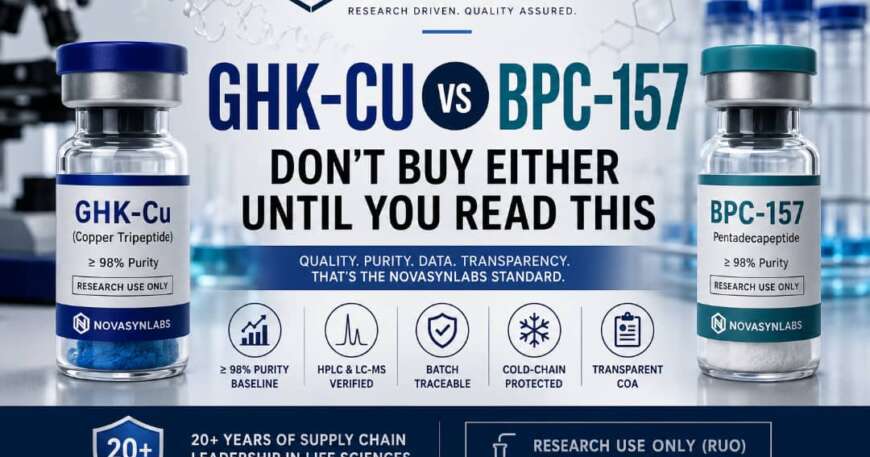
GHK-Cu vs BPC-157: Don’t Buy Either Until You Read This

Table of Contents
GHK-Cu vs BPC-157: Don’t Buy Either Until You Read This
If you are researching GHK-Cu vs BPC-157, the biggest mistake you can make is treating the decision as a simple question of which peptide is “better.”
It isn’t.
GHK-Cu and BPC-157 are fundamentally different research compounds with different molecular structures, different areas of scientific interest, and different quality-control considerations. More importantly, the quality of the material you purchase can have a major impact on reproducibility.
A vial labeled “99% pure” does not automatically mean you are receiving a thoroughly characterized research reagent.
At Novasynlabs, we have spent more than two decades working within international supply chains serving the life-sciences and research sector. We have processed tens of thousands of orders for academic institutions, private research groups, and independent laboratories across Europe, the United States, Canada, and the United Kingdom.
GHK-Cu and BPC-157 are among the compounds we encounter most frequently. That experience has given us an extensive practical perspective on batch consistency, documentation, packaging, transportation, storage, and the analytical questions researchers should ask before purchasing.
This guide explains GHK-Cu vs BPC-157 from that quality-first perspective.
«Research Use Only (RUO): GHK-Cu and BPC-157 products discussed in this article are chemical research reagents intended for laboratory and in-vitro research. This article does not provide instructions for human use, treatment, diagnosis, or cosmetic application.»

GHK-Cu vs BPC-157: Quick Comparison
Before getting into the chemistry, here is the high-level comparison.
| Feature | GHK-Cu | BPC-157 |
| Basic structure | Copper-binding tripeptide | Synthetic 15-amino-acid peptide |
| Primary research interest | Cellular signaling, extracellular matrix and remodeling pathways | Cytoprotective, vascular and tissue-response pathways |
| Research areas | Fibroblast biology, collagen-related pathways, skin/follicular cellular signaling | Tissue-response, vascular signaling and gastrointestinal/mucosal models |
| Key quality concern | Copper complexation and moisture management | Sequence identity, purity and salt-form documentation |
| Important analytical tests | HPLC + mass spectrometry | HPLC + mass spectrometry |
| Documentation priority | Batch-specific purity and molecular identity | Batch-specific purity, molecular identity and salt form |
| Storage concern | Moisture, light and temperature | Temperature, formulation and environmental conditions |
| Appropriate framework | Research Use Only | Research Use Only |
The important point is that GHK-Cu vs BPC-157 isn’t an apples-to-apples comparison. Researchers should select the compound according to the biological question being investigated—not according to whichever product page makes the strongest marketing claims.
What Is GHK-Cu?
GHK-Cu is a copper-binding tripeptide consisting of the peptide sequence commonly referred to as GHK associated with copper.
Its scientific interest comes partly from its relationship with copper-dependent cellular processes, extracellular matrix biology and cellular signaling.
Research involving GHK-Cu has investigated areas including:
- Extracellular matrix biology
- Fibroblast activity
- Collagen-related pathways
- Cellular signaling
- Gene-expression-related pathways
- Matrix remodeling
- Skin and follicular cellular models
- Copper-dependent biological processes
That makes GHK-Cu particularly interesting when the experimental question involves cellular signaling and extracellular matrix remodeling.
However, researchers should distinguish laboratory findings from clinical claims. A compound producing an interesting response in a cell or experimental model does not automatically demonstrate a therapeutic effect in humans.
This distinction is especially important because GHK-Cu is heavily marketed online using cosmetic and anti-aging terminology.
For laboratory research, the more useful question is:
What molecular pathways are being investigated, and can the reagent produce reproducible experimental results?
What Is BPC-157?
BPC-157 is a synthetic peptide consisting of 15 amino acids. It has attracted considerable interest in preclinical research involving tissue-response and cytoprotective pathways.
Experimental research has investigated mechanisms involving areas such as:
- Cellular migration
- Vascular signaling
- Nitric oxide-related pathways
- Growth-factor-associated signaling
- Tissue-response mechanisms
- Gastrointestinal and mucosal models
- Inflammatory-response pathways
BPC-157 is therefore scientifically distinct from GHK-Cu.
Where GHK-Cu research frequently intersects with extracellular matrix and copper-associated cellular signaling, BPC-157 research is more commonly associated with cytoprotective and tissue-response mechanisms.
Again, these are research areas—not promises of therapeutic outcomes.
One of the biggest mistakes we see in peptide discussions is taking a promising preclinical mechanism and converting it into a guaranteed human outcome.
A responsible research supplier should never do that.
GHK-Cu vs BPC-157: The Biggest Difference
The simplest way to understand GHK-Cu vs BPC-157 is to start with the research question.
If a laboratory is investigating extracellular matrix biology, fibroblast signaling, collagen-related pathways or copper-associated cellular processes, GHK-Cu may be the more relevant research compound.
If the research model is investigating cytoprotective mechanisms, vascular signaling, tissue-response pathways or gastrointestinal/mucosal biology, BPC-157 may be the more relevant compound.
Neither should automatically be considered “better.”
Research objective matters more than popularity.
| Research question | Compound of greater research relevance |
| Extracellular matrix signaling | GHK-Cu |
| Fibroblast-related research | GHK-Cu |
| Copper-dependent cellular pathways | GHK-Cu |
| Collagen-related cellular research | GHK-Cu |
| Cytoprotective pathway research | BPC-157 |
| Vascular signaling research | BPC-157 |
| Tissue-response models | BPC-157 |
| Gastrointestinal/mucosal research | BPC-157 |
These categories describe areas of scientific investigation and should not be interpreted as recommendations for human treatment.
The Quality Problem Most Buyers Miss
This is where the GHK-Cu vs BPC-157 discussion becomes much more interesting.
Researchers often compare products by:
Price → vial size → advertised purity
We recommend reversing that process:
Identity → purity → analytical evidence → formulation → documentation → storage → shipping → price
A cheap vial is not necessarily economical if its characterization is inadequate.
Likewise, a “99% pure” claim is not particularly meaningful if the supplier cannot provide convincing batch-specific analytical evidence.
GHK-Cu Quality: Why Copper Complexation Matters
GHK-Cu presents a quality-control consideration that is different from ordinary peptide purity.
The copper component is fundamental to the compound’s identity and chemistry.
During manufacturing and post-processing, appropriate complexation and handling are therefore important considerations.
In our supply-chain experience, we have encountered material where physical appearance raised questions about the consistency of the copper-peptide complex. However, appearance alone should never be treated as a definitive analytical test.
A visual difference can trigger further investigation, but techniques such as analytical chromatography and mass spectrometry are much more appropriate for confirming identity and purity.
Moisture is another important consideration.
GHK-Cu can be sensitive to environmental moisture, making proper lyophilization and vial sealing important.
If a lyophilized peptide is inadequately sealed, ambient humidity can enter the vial over time and potentially affect the physical and chemical characteristics of the material.
This is why manufacturing quality doesn’t end when synthesis is complete.
Post-synthesis purification, lyophilization, vial sealing, packaging and transportation are all part of peptide quality.
BPC-157 Quality: Sequence and Salt-Form Transparency
BPC-157 creates a different documentation challenge.
Researchers should know exactly what form of material they are purchasing and what has actually been characterized.
A supplier’s documentation should clearly identify:
- Compound name
- Lot or batch number
- Molecular identity
- Analytical purity
- Salt/formulation information where applicable
- Testing date
- Analytical method
- Laboratory or testing provider
Why does this matter?
Because experimental conditions can interact with the physical and chemical form of a research reagent.
In particular, researchers conducting controlled pH or formulation studies should not assume that every material sold simply as “BPC-157” has identical physicochemical characteristics.
The experimental material needs to be clearly characterized before the experiment begins.
HPLC vs Mass Spectrometry: Why You Want Both
One of the most important lessons from our experience is that purity percentage and molecular identity are not the same thing.
Novasynlabs uses a dual analytical approach involving:
Reverse-Phase HPLC
High-performance liquid chromatography can help quantify chromatographic purity and identify related impurities or degradation products.
A high-quality chromatogram should provide meaningful analytical information rather than simply displaying a percentage in a text box.
ESI-MS / MALDI-TOF Mass Spectrometry
Mass spectrometry provides molecular-weight information that helps confirm whether the material corresponds to the expected molecular species.
This is particularly valuable because a peptide can have a high chromatographic purity percentage while still requiring additional confirmation of molecular identity.
The ideal approach
HPLC answers:
“How chromatographically pure is the material?”
Mass spectrometry helps answer:
“Is the molecular species what we expect it to be?”
Together, these methods provide a much stronger quality-control picture.
How to Read a Peptide COA Before Buying
A Certificate of Analysis should be more than a decorative PDF.

Before purchasing GHK-Cu or BPC-157, examine the COA carefully.
Look for:
| COA element | Why it matters |
| Exact product name | Confirms what was tested |
| Lot/batch number | Connects the report to your material |
| Test date | Establishes when analysis occurred |
| HPLC result | Provides chromatographic purity information |
| HPLC chromatogram | Allows assessment beyond a stated percentage |
| Mass spectrometry | Supports molecular identity |
| Expected molecular mass | Allows comparison with analytical result |
| Testing laboratory | Establishes analytical provenance |
| Salt/form information | Important for certain formulations |
| Clear methodology | Helps establish what was actually tested |
Red flag: the “99% pure” badge
One of the easiest marketing tricks is displaying:
99% PURE
in large text on a product page without providing a meaningful, batch-specific chromatogram.
A static purity badge isn’t analytical evidence.
A serious researcher should ask:
99% according to what test, performed on which batch, using which analytical method?
Case Study: GHK-Cu and Reproducibility Problems
One anonymized research model illustrates why this matters.
A cell-culture laboratory was investigating extracellular matrix synthesis and observed inconsistent results between experimental runs using GHK-Cu sourced from a budget supplier.
The researchers initially suspected their experimental protocol.
However, the material itself warranted investigation.
Physical inspection revealed a noticeably lighter blue powder. Subsequent analytical work, including LC-MS and UV-Vis characterization, raised concerns about the consistency of copper complexation and the presence of free copper species.
The researchers found that the material was contributing to experimental variability, including observations consistent with oxidative stress in the cell system.
The laboratory subsequently changed its research material to a better-characterized GHK-Cu preparation with documented analytical identity and purity.
The important lesson isn’t:
“Blue powder equals good GHK-Cu.”
The lesson is:
When experimental results are inconsistent, don’t automatically blame the protocol. Investigate the research reagent.
Appearance can be a useful quality-control observation, but analytical testing should remain the deciding factor.
Case Study: BPC-157 and Formulation Matters
A second anonymized research model involved an academic team studying gastrointestinal barrier responses under controlled low-pH conditions.
The researchers were experiencing rapid loss of detectable BPC-157 during their experimental incubation period.
Their original supplier’s documentation did not clearly identify the material’s salt/formulation.
Further investigation identified the formulation as a critical variable for their experimental system.
The team changed to a clearly documented BPC-157 formulation that was more appropriate for the experimental conditions and subsequently obtained more consistent analytical results.
The key lesson:
«Don’t treat the compound name as the entire specification.»
For controlled laboratory work, formulation and physicochemical characteristics can matter just as much as the headline purity percentage.
The Purity ROI: Why the Cheapest Vial May Not Be the Cheapest
Researchers frequently compare prices without calculating the amount of analytically pure peptide represented by the vial.
Consider a simplified example.
Supplier A
- 50 mg labeled material
- 90% purity
- $30
Approximate analytically pure peptide:
50 mg × 0.90 = 45 mg
Approximate cost per mg of pure peptide:
$30 ÷ 45 = $0.67/mg
Supplier B
- 50 mg labeled material
- 99% purity
- $50
Approximate analytically pure peptide:
50 mg × 0.99 = 49.5 mg
Approximate cost per mg:
$50 ÷ 49.5 ≈ $1.01/mg
In this simplified example, Supplier A is still cheaper per milligram.
But that is not the whole story.
If impurities, unidentified material, inadequate documentation or poor stability compromise an experiment, the real cost can include:
- Wasted reagents
- Repeated experiments
- Lost laboratory time
- Failed assays
- Delayed projects
- Unreliable datasets
Therefore, purity ROI should not be reduced to price per milligram.
For serious research, the value of a reagent also includes characterization, traceability, reproducibility and appropriate handling.
Don’t Ignore Net Peptide Content
Another common purchasing mistake is confusing:
Total vial mass
with
net peptide content.
Peptide materials can contain counter-ions, residual moisture and formulation components.
Therefore, researchers should examine the supplier’s specification carefully and understand exactly what the stated quantity represents.
A credible supplier should make the product specification sufficiently clear for researchers to interpret the quantity correctly.
Storage: Protecting Your Research Material
Even a well-manufactured peptide can be compromised by poor storage.
For lyophilized research material, appropriate temperature and moisture control are important.
For long-term storage, many peptide research protocols use frozen conditions such as approximately −20°C, while short-term storage may involve refrigerated conditions depending on the compound and validated stability data.
The manufacturer’s specific storage specification should take precedence.
Once material is reconstituted
Reconstituted solutions generally require substantially more careful handling than unopened lyophilized powder.
Researchers should consider:
- Temperature
- Light exposure
- Container compatibility
- Number of freeze-thaw cycles
- Time in solution
- Sterility requirements appropriate to the experiment
- Compound-specific stability data
Avoid unnecessary freeze-thaw cycling
Repeatedly freezing and thawing a research solution can increase the risk of chemical and physical degradation.
Where the experimental design permits, researchers can consider appropriately sized aliquots to reduce unnecessary temperature cycling.
Protect light-sensitive materials
GHK-Cu should be protected from excessive direct light during storage and handling.
Opaque or appropriately protective packaging can reduce unnecessary light exposure.
Don’t vigorously shake peptide solutions
Gentle handling is preferable to aggressive agitation when working with peptide solutions.
The objective is simple:
Minimize avoidable physical and environmental stress on the research reagent.

Five Questions to Ask Before Buying GHK-Cu or BPC-157
Before purchasing either compound, ask the supplier:
- Can you provide a batch-specific COA?
Not a generic certificate.
The documentation should correspond to the actual lot being supplied.
- Does the COA contain analytical data?
Look for HPLC and appropriate molecular identity testing.
- Is the molecular identity independently verified?
Mass spectrometry provides valuable confirmation.
- Is the formulation clearly identified?
This is particularly important when different salt or formulation forms may exist.
- How is the product protected during shipping?
A high-quality product can still be compromised by inappropriate transportation or storage.
Five Red Flags When Buying Research Peptides
1. Extremely low prices
Price isn’t proof of poor quality, but unusually low pricing deserves investigation.
2. Generic “99% purity” graphics
Ask for actual batch-specific analytical evidence.
3. No lot number
Without traceability, it becomes difficult to connect analytical documentation with the material you actually received.
4. No mass spectrometry data
Purity alone does not provide the complete identity picture.
5. Vague storage and shipping information
If a supplier doesn’t explain how its research materials are packaged and transported, ask questions before purchasing.
GHK-Cu vs BPC-157: Which Is Better for Research?
There is no universal winner.
The correct question is:
Which compound is appropriate for the biological question being investigated?
GHK-Cu may be the more relevant research material when studying:
- Extracellular matrix biology
- Fibroblast-related processes
- Copper-associated cellular signaling
- Collagen-related pathways
- Cellular and gene-expression signaling
BPC-157 may be the more relevant research material when studying:
- Cytoprotective mechanisms
- Vascular signaling
- Cellular migration
- Tissue-response pathways
- Gastrointestinal/mucosal experimental models
The decision should be driven by the experimental hypothesis, not social-media popularity.
What Novasynlabs Looks For
At Novasynlabs, our approach is built around more than the product label.
Our quality framework emphasizes:
Batch traceability → analytical purity → molecular identity → formulation transparency → appropriate packaging → controlled shipping → storage guidance
We maintain a baseline of ≥98% purity, with many batches reaching ≥99%, subject to the applicable analytical specification.
Our quality-control approach incorporates HPLC and mass-spectrometry-based characterization.
We also emphasize documentation that allows researchers to connect analytical results with the specific material they receive.
Our broader supply-chain experience spans more than 20 years, with research customers across Europe, the United States, Canada and the United Kingdom.
That experience has taught us a simple principle:
«A research peptide is only as useful as the confidence you can place in its identity, quality, documentation and handling.»
GHK-Cu vs BPC-157: The Bottom Line
If you remember only one thing from this GHK-Cu vs BPC-157 comparison, remember this:
Don’t choose a research peptide based solely on its reputation, price or advertised purity.
GHK-Cu and BPC-157 have different molecular characteristics and different areas of research interest.
GHK-Cu is particularly relevant to research involving copper-associated cellular signaling and extracellular matrix biology.
BPC-157 is investigated across a different range of preclinical tissue-response, cytoprotective and vascular pathways.
But whichever compound your research requires, quality control comes first.
Look beyond the product page.
Check the lot number.
Review the HPLC data.
Verify molecular identity.
Understand the formulation.
Consider storage and transportation.
And ask whether the supplier can provide documentation that actually corresponds to the material being supplied.
That’s the difference between buying a vial and sourcing a properly characterized research reagent.
Frequently Asked Questions About GHK-Cu vs BPC-157
Is GHK-Cu the same as BPC-157?
No. GHK-Cu and BPC-157 are chemically distinct research peptides with different molecular structures and different areas of scientific investigation.
Which is better, GHK-Cu or BPC-157?
Neither is universally “better.” The appropriate compound depends on the experimental question, biological model and research objective.
What is more important than advertised peptide purity?
Batch-specific analytical evidence, molecular identity, formulation information, traceability and appropriate storage and shipping are all important.
Should I trust a “99% pure” peptide label?
Not without supporting analytical evidence. Ideally, review batch-specific HPLC data and molecular identity testing rather than relying on a graphic or marketing statement.
Why is mass spectrometry important for peptides?
Mass spectrometry provides molecular-weight information that can help confirm whether the material corresponds to the expected molecular species.
Does peptide color prove purity?
No. Appearance can provide useful observational information, but color alone cannot establish peptide purity or molecular identity. Analytical testing should be used for definitive characterization.
How should GHK-Cu and BPC-157 be stored?
Storage should follow the supplier’s validated specifications for the particular material. Lyophilized and reconstituted materials can have different stability requirements, and unnecessary temperature cycling, moisture and light exposure should be avoided where applicable.
Are GHK-Cu and BPC-157 approved treatments?
This article does not make therapeutic claims or recommendations. The materials discussed here are presented strictly within a Research Use Only laboratory context.
Final Researcher Checklist
Before purchasing GHK-Cu or BPC-157, verify:
- Batch-specific COA available
- Lot number matches the supplied material
- HPLC purity data provided
- HPLC chromatogram available for review
- Molecular identity verified by appropriate mass spectrometry
- Formulation/salt information clearly documented where applicable
- Product quantity clearly specified
- Storage requirements provided
- Shipping/temperature protection explained
- Research Use Only status clearly stated
Research Use Only (RUO). Not for human consumption, therapeutic use, diagnosis, or cosmetic application.
About Novasynlabs
With more than two decades of international supply-chain experience serving the life-sciences and research sector, Novasynlabs focuses on providing properly documented Research Use Only peptide materials to academic institutions, laboratories, private research groups and independent researchers across Europe, North America and the United Kingdom.
Our philosophy is straightforward:
Characterize the material. Document the batch. Protect the product. Support reproducible research.
Continue Your Reading?
External References

