







No products in the cart.
How to Travel with Peptides: The Ultimate 2026 Guide to Packing, Cooling & Flying Safely
Table of Contents
How to Travel with Peptides: The Ultimate 2026 Guide to Packing, Cooling & Flying Safely
Whether you’re traveling across the country or internationally, one of the biggest concerns when transporting research peptides is maintaining proper storage conditions throughout the journey. Heat exposure, freezing, moisture, and improper handling can all affect peptide stability, making preparation just as important as the destination itself.
Questions like “Can I fly with peptides?”, “Should peptides go in carry-on luggage?”, “Do peptides need to stay cold during travel?”, and “How do I keep peptides cool on a long flight?” are becoming increasingly common as more researchers travel between laboratories, conferences, and research facilities.
The good news is that with proper planning, appropriate insulated packaging, and an understanding of best storage practices, transporting peptides can be straightforward while helping reduce unnecessary risks to sample quality.
Why Trust NovaSyn Labs?
At NovaSyn Labs, we’ve spent more than 20 years supplying research peptides to laboratories and researchers around the world.
During that time we’ve proudly served over 30,000 research customers and successfully completed thousands of international peptide shipments throughout the United States and numerous European countries.
Our experience doesn’t stop once a package leaves our facility. Over the years we’ve helped researchers navigate:
- International transportation
- Customs inspections
- Seasonal temperature extremes
- Long-distance shipping
- Laboratory-to-laboratory transfers
- Cold-chain packaging
- Proper peptide storage recommendations
This guide combines practical experience gained from decades of peptide logistics with generally accepted storage practices to help researchers prepare for travel more effectively.
Why Proper Peptide Storage Matters During Travel
Peptides are complex chains of amino acids that can be sensitive to environmental conditions. While different peptides have different stability profiles, excessive heat, repeated temperature fluctuations, prolonged moisture exposure, and improper storage may affect their quality over time.
Travel introduces several variables that researchers don’t normally encounter inside a controlled laboratory environment:
- Airport terminals
- Long vehicle journeys
- Hot luggage compartments
- Hotel rooms
- Customs inspections
- Flight delays
- Direct sunlight
- Temperature changes
Without preparation, even a short trip can expose research materials to conditions outside their recommended storage range.
Fortunately, many of these risks can be reduced through thoughtful packing and appropriate insulated protection.
Understanding Lyophilized vs Reconstituted Peptides
One of the most important concepts before traveling is understanding whether your peptide is lyophilized (freeze-dried) or reconstituted (mixed with a suitable diluent).
These two forms generally have different storage considerations.
| Feature | Lyophilized Peptides | Reconstituted Peptides |
| Physical Form | Dry powder | Liquid solution |
| Moisture Sensitivity | Very Low (until opened) | Higher |
| Long-Term Stability | Generally greater | Typically reduced compared with dry powder |
| Heat Sensitivity | Moderate | Higher |
| Travel Convenience | Excellent | Requires more careful temperature control |
| Recommended for Long Trips | Yes | Extra planning recommended |
For many researchers, traveling with unopened lyophilized peptide vials is often more practical than transporting already reconstituted materials, provided storage recommendations from the manufacturer are followed.
What Can Affect Peptide Stability While Traveling?
Several environmental factors deserve attention during travel.
1. Heat
Heat is one of the most common concerns during transportation.
Examples include:
- Cars parked in summer
- Airport tarmacs
- Hotel windowsills
- Direct sunlight
- Backpacks left outdoors
Even brief periods of elevated temperatures may not be ideal for certain peptide formulations.
2. Freezing
Although many researchers focus on keeping peptides cool, freezing can also present challenges for some products, particularly certain liquid formulations. Placing vials directly against frozen gel packs or dry ice may expose them to temperatures lower than intended.
Using an insulated barrier between the cooling source and the peptide container can help moderate temperature changes.
3. Moisture
For unopened lyophilized peptides, keeping vials dry is important. Moisture entering a vial prematurely can compromise storage conditions.
Always ensure caps remain securely fastened and packaging is protected from condensation.
4. Sunlight
Ultraviolet (UV) light and prolonged direct sunlight may contribute to degradation of some compounds.
Avoid storing peptides:
- On car dashboards
- Near aircraft windows for extended periods
- On hotel windowsills
- In transparent bags exposed to sunlight
5. Repeated Temperature Fluctuations
One overlooked factor is moving peptides repeatedly between warm and cold environments.
For example:
Airport → Taxi → Hotel Lobby → Outside → Laboratory
Each temperature change can introduce unnecessary stress. Maintaining a more consistent storage environment is generally preferable whenever possible.
Can You Travel with Peptides?
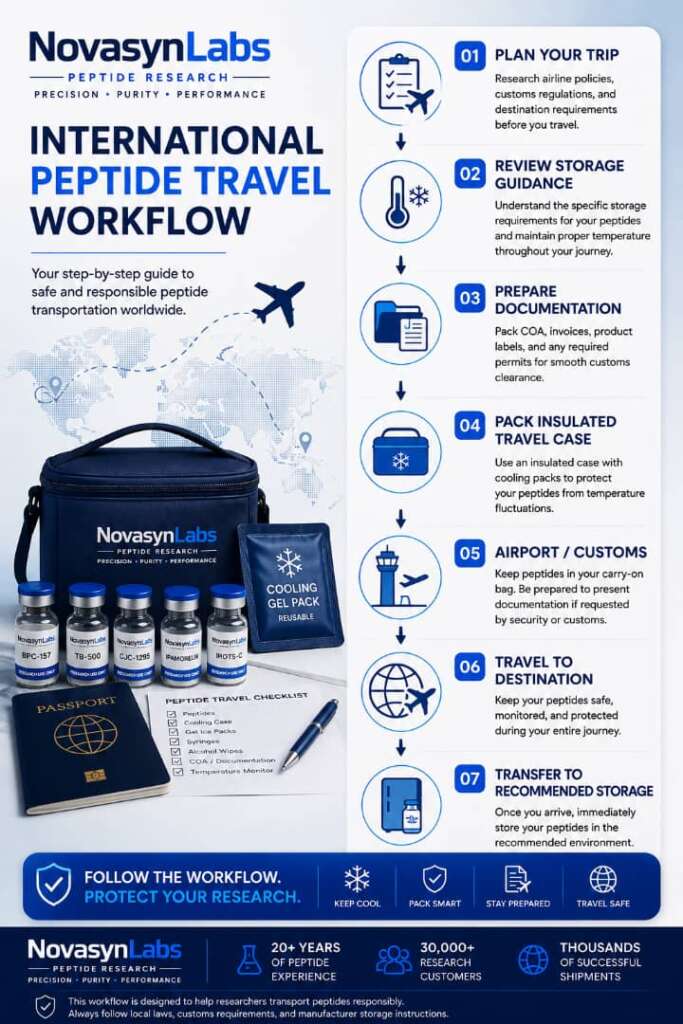
In many situations, researchers travel with peptides between laboratories, universities, conferences, or research facilities. However, the appropriate way to transport them depends on factors such as:
- The specific peptide formulation.
- Airline policies.
- Destination country requirements.
- Customs regulations.
- Product documentation.
- Packaging.
When flying, many experienced travelers prefer to keep research materials in their carry-on luggage rather than checked baggage. Carry-on storage generally allows better oversight of the materials and avoids the more variable conditions that checked luggage may experience during handling and transit.
It’s also advisable to keep accompanying documentation—such as Certificates of Analysis (COAs), batch information, and invoices—readily accessible if needed during routine customs or security screening.
Important: Regulations regarding the transportation of research materials can vary between countries and airlines. Always review the policies of your airline and the customs requirements of your destination before traveling.
Key Takeaways So Far
- Plan your peptide transport before your trip.
- Understand whether you’re traveling with lyophilized or reconstituted peptides.
- Protect samples from excessive heat, freezing, moisture, and direct sunlight.
- Keep documentation organized and accessible.
- Carry-on luggage often provides greater control over storage conditions than checked baggage, subject to applicable airline rules.
- Consistent temperatures are generally preferable to repeated warming and cooling cycles.
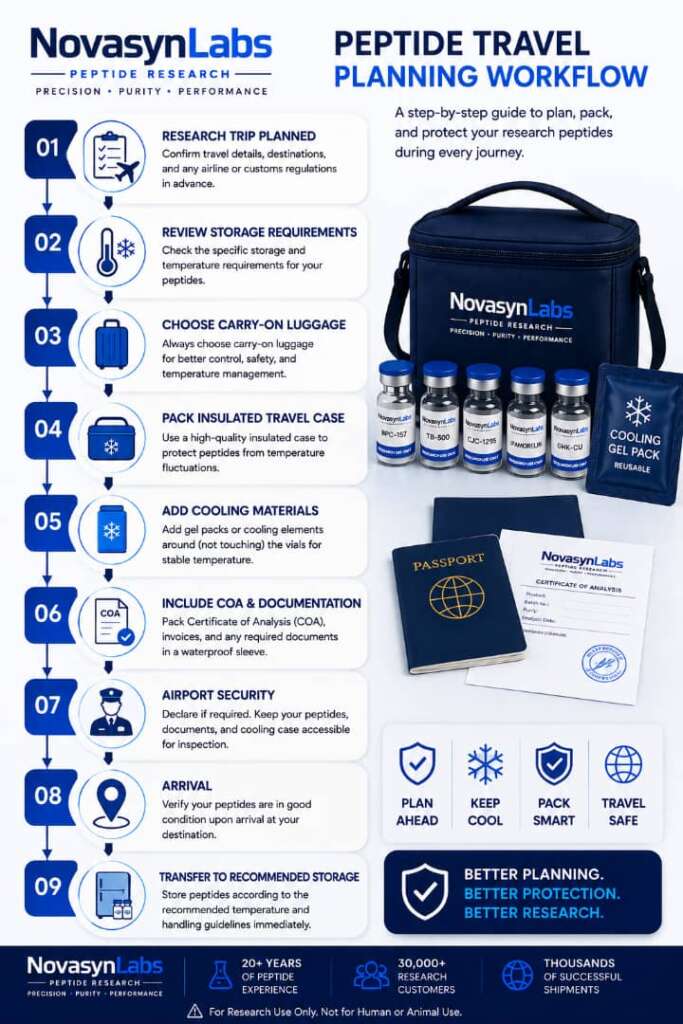
Carry-On vs Checked Luggage: Which Is Better?
One of the most frequently asked questions we receive from researchers is:
Should I pack peptides in my carry-on or checked baggage?
Based on our experience supporting 30,000+ research customers over the past 20 years, we generally recommend keeping research peptides in your carry-on luggage whenever practical and permitted by airline and destination requirements.
Carry-on baggage typically allows you to maintain better oversight of your materials throughout your journey. In contrast, checked luggage may be exposed to greater temperature fluctuations, rough handling, delays, or temporary separation from the traveler.
Always review the policies of your airline and the customs requirements of your destination before traveling.
Carry-On vs Checked Luggage Comparison
| Feature | Carry-On Luggage | Checked Luggage |
| Better control over storage | ✅ Yes | ❌ Limited |
| Easy access during delays | ✅ Yes | ❌ No |
| Lower risk of rough handling | ✅ Generally | ❌ Higher |
| Easier to monitor temperature | ✅ Yes | ❌ No |
| Reduced chance of lost baggage | ✅ Yes | ❌ No |
| Suitable for insulated travel cases | ✅ Yes | ✅ Yes (subject to airline rules) |
| Recommended by NovaSyn Labs | ⭐ Preferred | Only if necessary |
Travel Tip: If you are carrying cooling accessories such as gel packs, verify your airline’s and airport security’s current rules before departure.
Recommended Storage Temperatures During Travel
Storage recommendations vary depending on the specific peptide, formulation, and manufacturer. Always follow the product-specific instructions provided with your materials.
The table below summarizes commonly accepted storage practices used in research settings.
| Peptide State | Typical Storage Guidance |
| Unopened lyophilized peptides | Store in a cool, dry environment. Many manufacturers recommend refrigeration (approximately 2-8°C) for longer-term storage. Some products may tolerate short periods at room temperature during transit. |
| Reconstituted peptides | Commonly stored refrigerated at 2-8°C unless otherwise specified by the manufacturer. |
| During travel | Minimize exposure to excessive heat and avoid freezing unless otherwise specifically recommended for that product. |
| Long-term laboratory storage | Follow the manufacturer’s storage guidance for the specific peptide. |
Avoid Common Temperature Extremes
Researchers should avoid situations such as:
- Leaving peptides inside a parked vehicle on a warm day.
- Placing vials directly against frozen ice packs.
- Storing products next to hotel freezer vents.
- Repeated warming and cooling cycles.
- Direct sunlight during outdoor travel.
Maintaining a stable temperature is generally preferable to frequent temperature changes.
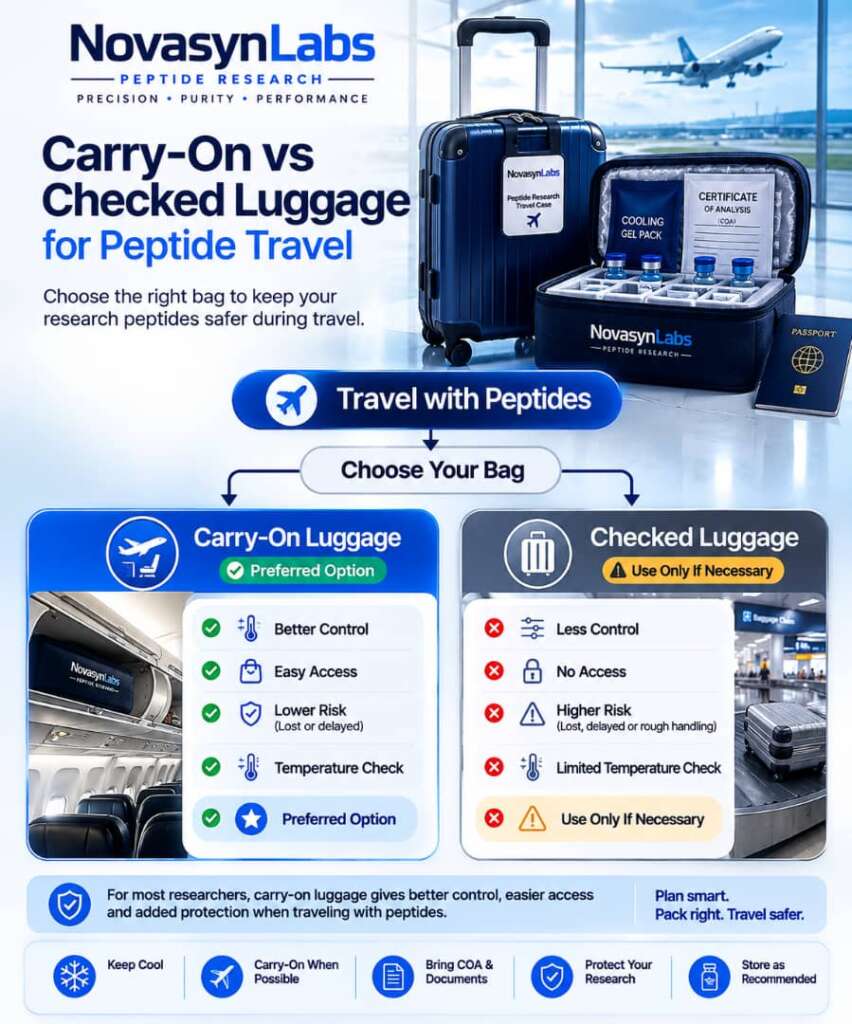
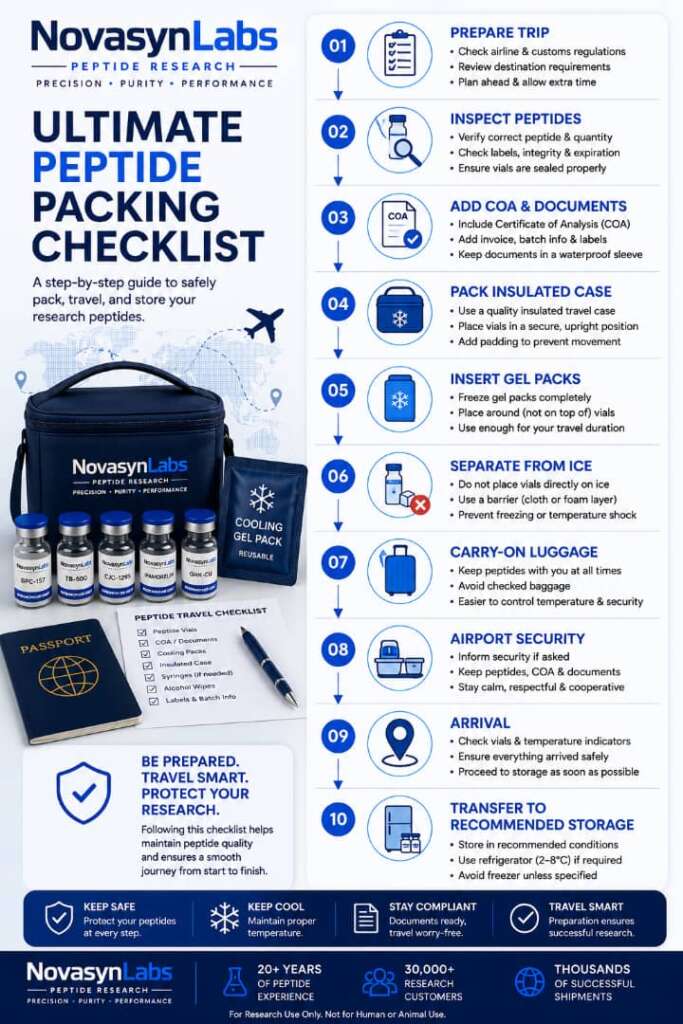
How to Pack Peptides for Travel
Proper preparation before leaving home is one of the most effective ways to help reduce avoidable risks during transportation.
Step 1: Verify Your Materials
Before packing, confirm that you have:
- Correct peptide vials
- Labels intact
- Batch information
- Certificate of Analysis (COA), if applicable
- Any required documentation
- Appropriate storage instructions
Double-check expiration dates and inspect vials for any signs of damage before departure.
Step 2: Choose an Insulated Travel Case
A quality insulated travel case helps reduce rapid temperature changes during transport.
Look for features such as:
- Thick insulated lining
- Protective interior padding
- Waterproof outer shell
- Secure zipper closure
- Compact size for carry-on luggage
- Space for gel packs and documentation
For multi-day travel, consider a larger insulated cooler designed for medical or laboratory transport.
Step 3: Add Cooling Materials
Cooling accessories help maintain a more stable environment during travel.
Common options include:
- Reusable gel ice packs
- Medical cooling wallets
- Portable insulated coolers
- Temperature-monitoring devices
Avoid placing peptide vials in direct contact with frozen cooling packs. Use a fabric divider or foam insert to help prevent localized freezing.
Step 4: Organize Documentation
When traveling internationally, keeping documentation organized can simplify routine customs or security screening.
Depending on your circumstances, useful documents may include:
- Certificate of Analysis (COA)
- Batch information
- Product labels
- Invoice or order confirmation
- Supplier contact details
Store paperwork in a waterproof document sleeve inside your carry-on bag.
Step 5: Monitor Temperature During Long Trips
For extended journeys, consider using a compact temperature monitor.
Benefits include:
- Monitoring storage conditions throughout travel.
- Identifying prolonged heat exposure.
- Recording temperatures for research documentation.
- Providing additional confidence during long-distance transport.
Best Cooling Products for Traveling with Peptides
Different trips require different cooling solutions.
| Cooling Method | Best For | Advantages | Considerations |
| Medical Cooling Wallet | Fights and day trips | Lightweight, reusable, compact | Cooling duration varies by product |
| Reusable Gel Ice Packs | Short and medium trips | Widely available, affordable | Avoid direct contact with vials |
| Insulated Travel Case | Most travel situations | Helps reduce temperature changes | Cooling source may still be needed |
| Portable Medical Cooler | Long-distance travel | Larger capacity, extended cooling | Bulkier to carry |
| Temperature Monitor | Multi-day travel | Tracks storage conditions | Requires battery or charging |
The Ultimate Peptide Travel Packing Checklist
Use this checklist before every trip.
| Item | Packed |
| Research peptide vials | ☐ |
| Insulated travel case | ☐ |
| Reusable gel ice packs | ☐ |
| Medical cooling wallet | ☐ |
| Certificate of Analysis (COA) | ☐ |
| Batch documentation | ☐ |
| Product labels | ☐ |
| Alcohol wipes (if appropriate) | ☐ |
| Syringes and related supplies (where appropriate and permitted) | ☐ |
| Temperature monitor | ☐ |
| Waterproof document sleeve | ☐ |
| Permanent marker for labeling | ☐ |
| Emergency contact information | ☐ |
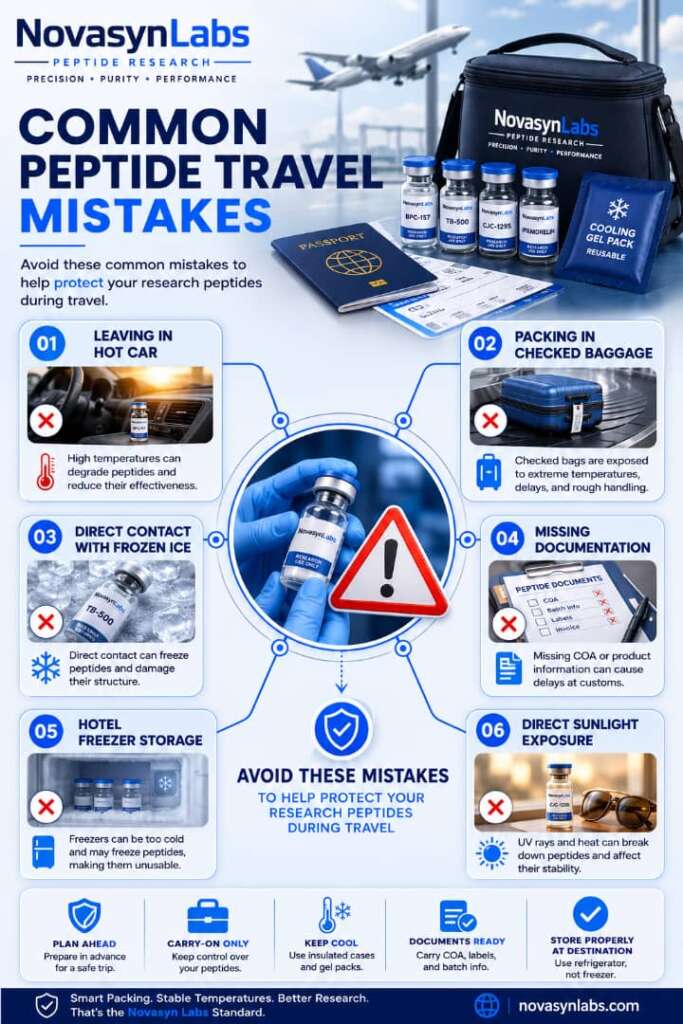
Common Packing Mistakes to Avoid
Even experienced travelers can overlook simple details. Based on our experience supporting peptide shipments worldwide, these are among the most common mistakes.
| Mistake | Why It Matters | Better Approach |
| Leaving peptides in a hot car | High temperatures may affect stability | Keep products with you whenever possible |
| Packing in checked baggage | Less control over conditions | Use carry-on when practical |
| Placing vials directly on frozen ice | May expose products to freezing | Use an insulated divider |
| Forgetting documentation | Can complicate inspections | Keep COAs and product information accessible |
| Hotel freezer storage | Risk of accidental freezing | Use the refrigerator unless otherwise instructed |
| Direct sunlight | Increased heat exposure | Store in a shaded insulated case |
Expert Insight from NovaSyn Labs
Over the past 20 years, NovaSyn Labs has supported 30,000+ research customers across the United States and Europe. One of the consistent lessons from our shipping and logistics experience is that planning ahead makes a significant difference.
Researchers who prepare insulated storage, organize documentation, and move products into their recommended storage conditions promptly after arrival are generally better positioned to reduce avoidable transportation risks than those who rely on last-minute arrangements
Should You Reconstitute Peptides Before Traveling?
One of the most common questions researchers ask is whether peptides should be reconstituted before a trip or kept in their lyophilized (freeze-dried) form until they reach the destination.
There is no single answer that applies to every peptide. The appropriate approach depends on the specific product, formulation, travel duration, and the manufacturer’s storage recommendations.
In general, unopened lyophilized peptides are often more convenient for transport because they are dry, easier to package, and typically less sensitive to handling than liquid preparations. When feasible and consistent with the manufacturer’s instructions, many researchers prefer to wait until they arrive at their destination before reconstituting.
Lyophilized vs Reconstituted During Travel
| Factor | Lyophilized Peptides | Reconstituted Peptides |
| Travel Convenience | Excellent | Moderate |
| Moisture Exposure | Minimal while sealed | Higher |
| Temperature Sensitivity | Generally lower | Often higher |
| Long Flights | Commonly preferred | Requires closer temperature management |
| Storage After Arrival | Follow manufacturer guidance | Usually refrigerate according to product instructions |
Tip: Before traveling, review the storage recommendations supplied with your specific peptide and avoid unnecessary handling during transit.
Traveling with Popular Research Peptides
The following overview summarizes general travel considerations. It is not a substitute for the storage guidance provided by the manufacturer of a specific product.
Semaglutide
Semaglutide has become one of the world’s most widely discussed peptide products. If transporting a refrigerated formulation, maintain the storage conditions recommended by the manufacturer and avoid unnecessary heat exposure. Plan ahead for flights, hotel stays, and extended travel.
Tirzepatide
For researchers transporting Tirzepatide, an insulated travel case and cooling materials can help maintain a more stable environment during transit. Avoid leaving products in vehicles or direct sunlight.
Retatrutide
As interest in Retatrutide research continues to grow, careful transportation planning is equally important. Keep products properly labeled, carry supporting documentation where appropriate, and transfer them to the recommended storage environment as soon as possible after arrival.
BPC-157
Many researchers choose to transport unopened lyophilized BPC-157 vials when traveling between laboratories. Keep the vials protected from excessive heat, moisture, and physical damage during transit.
TB-500
TB-500 should be transported in accordance with the manufacturer’s storage recommendations. Using an insulated protective case can help reduce exposure to rapid temperature changes.
CJC-1295
CJC-1295 should remain securely packaged during travel. Avoid repeated warming and cooling cycles whenever possible.
Ipamorelin
Carry Ipamorelin in a protective insulated container and avoid prolonged exposure to elevated temperatures or direct sunlight.
Tesamorelin
Before departure, verify the storage guidance provided with the product. If refrigeration is recommended, plan your travel so that appropriate cooling is maintained.
MOTS-c
MOTS-c should be transported carefully using protective packaging that helps minimize environmental stress during travel.
SS-31
Researchers traveling with SS-31 should organize documentation before departure and maintain recommended storage conditions throughout transportation.
GHK-Cu
Whether traveling locally or internationally, protect GHK-Cu from unnecessary heat and moisture and move it into the recommended storage environment promptly after arrival.
International Travel with Peptides
Travel requirements differ between countries, airlines, and research institutions. Before departure, check the latest guidance from your airline and the relevant customs authorities.
European Union (EU)
When traveling within the EU:
- Review airline baggage policies.
- Keep product labels intact.
- Carry documentation such as Certificates of Analysis (COAs) where appropriate.
- Use an insulated travel case if temperature-sensitive storage is recommended.
United States
For domestic travel within the United States:
- Review airline and airport security requirements.
- Keep products organized and clearly labeled.
- Plan ahead for connecting flights or travel delays.
United Kingdom
Researchers traveling within or to the UK should ensure they have any documentation required for their specific circumstances and follow airline guidance for carrying research materials.
Canada
Canadian travel may involve varying weather conditions depending on the season. Consider additional insulation during periods of extreme heat or cold and review airline requirements before departure.
Australia
Australia has strict border and customs requirements. Review current import and biosecurity guidance well before traveling and ensure all documentation is complete.
Hotel Storage Tips
After arriving at your destination, proper storage remains important.
Recommended Practices
- Place products into the recommended storage environment as soon as possible.
- Confirm that the hotel refrigerator is operating correctly.
- Keep peptides away from freezer vents unless freezing is specifically recommended by the manufacturer.
- Store products in a protective container rather than loose inside the refrigerator.
- Minimize unnecessary opening of the travel case.
Avoid
- Window ledges exposed to sunlight.
- Bathroom cabinets with high humidity.
- Parked vehicles.
- Direct contact with ice.
- Hotel mini-fridge freezer compartments unless specifically instructed.
Road Trip Travel Tips
Road travel presents different challenges than air travel.
During long drives:
- Keep peptides inside the passenger compartment rather than the trunk if temperatures are extreme.
- Use an insulated travel cooler.
- Refresh cooling materials during extended stops if needed.
- Never leave the travel case inside a parked vehicle on hot days.
- Plan overnight refrigeration in advance.
Case Study 1: International Shipment Delay Preserved by Proper Packaging
Background
An anonymous European research laboratory ordered multiple lyophilized peptide vials from NovaSyn Labs during a period of increased customs inspections.
Situation
The shipment experienced an unexpected 72-hour delay while awaiting routine customs clearance.
The peptides had been packed inside an insulated shipping container with temperature-control materials designed to help reduce environmental exposure during transit.
Outcome
- Packaging remained intact upon arrival.
- No visible signs of moisture or vial damage were reported.
- Certificates of Analysis, batch information, and shipping records helped simplify customs processing.
- The laboratory transferred the materials into the recommended storage environment immediately after delivery.
Lesson Learned
While delays cannot always be avoided, appropriate insulated packaging, organized documentation, and prompt storage after arrival can help reduce avoidable transportation risks.
Case Study 2: Researcher Traveling Across Europe
Background
An anonymous researcher needed to transport unopened lyophilized peptide vials between two research facilities within Europe.
Situation
Before departure, the researcher packed the sealed vials inside a compact insulated travel pouch and carried the accompanying documentation throughout the journey. The products remained unopened until arrival at the destination laboratory.
Outcome
- Vials arrived without visible physical damage.
- Documentation helped streamline routine customs discussions.
- The travel pouch reduced exposure to heat during transit.
- Products were placed into the recommended storage environment immediately after arrival.
Lesson Learned
Planning transportation in advance, using insulated protection, carrying appropriate documentation, and promptly storing materials after arrival are practical steps that support good handling practices.
Frequently Asked Questions
Can you fly with peptides?
In many situations, yes, provided you comply with applicable airline, airport, and destination-country requirements. Always verify current policies before traveling.
Should peptides go in carry-on luggage?
Many researchers prefer carry-on luggage because it allows better oversight of their materials during travel, subject to airline rules.
Can peptides stay at room temperature during travel?
This depends on the specific peptide and its formulation. Always follow the storage recommendations supplied by the manufacturer.
What is the best way to keep peptides cool while traveling?
Many researchers use insulated travel cases with reusable gel packs or medical cooling wallets to help maintain a stable temperature.
Can peptides freeze?
Some formulations may be adversely affected by freezing. Follow the product-specific storage guidance and avoid placing vials directly against frozen cooling packs unless instructed otherwise.
Should I bring documentation?
Keeping product labels, Certificates of Analysis (COAs), and batch information organized may be helpful during transportation and routine customs screening.
Final Travel Checklist
Before leaving home, confirm that you have:
| Checklist Item | Complete |
| Research peptides | ☐ |
| Insulated travel case | ☐ |
| Cooling materials | ☐ |
| Product labels | ☐ |
| COA and batch information | ☐ |
| Travel documentation | ☐ |
| Temperature monitor (optional) | ☐ |
| Destination storage arranged | ☐ |
| Airline policies reviewed | ☐ |
| Customs requirements checked | ☐ |
Final Thoughts
Traveling with peptides requires thoughtful preparation, particularly when temperature-sensitive materials are involved. Choosing appropriate insulated packaging, organizing documentation, planning for airport procedures, and moving products into their recommended storage conditions promptly after arrival are practical measures that can help support proper handling.
At NovaSyn Labs, our team has spent more than 20 years supplying research peptides and serving over 30,000 research customers across the United States and Europe. Through thousands of successful international shipments, we’ve seen how careful planning, quality packaging, and attention to storage guidance contribute to reliable transportation of research materials.
Whether you’re traveling between laboratories, attending a scientific conference, or coordinating international research, preparation remains one of the most effective ways to help protect your peptide samples throughout the journey.
External References

