


No products in the cart.
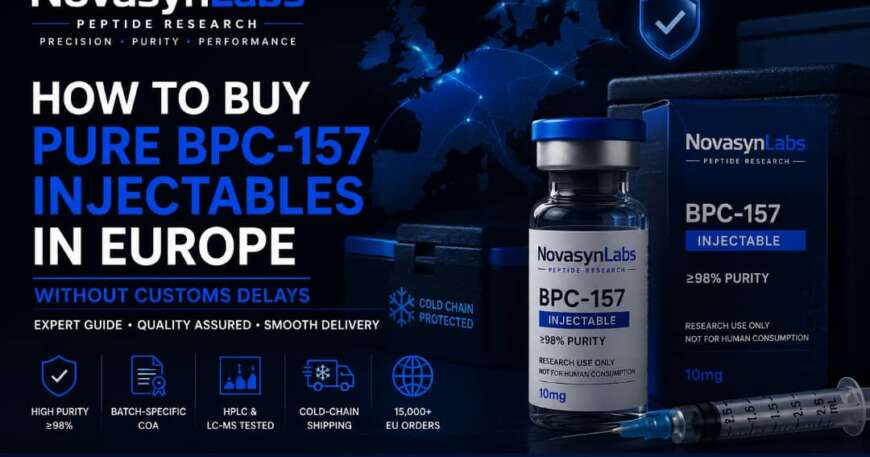
How to Buy Pure BPC-157 Injectables in Europe Without Customs Delays (2026 Complete Guide)
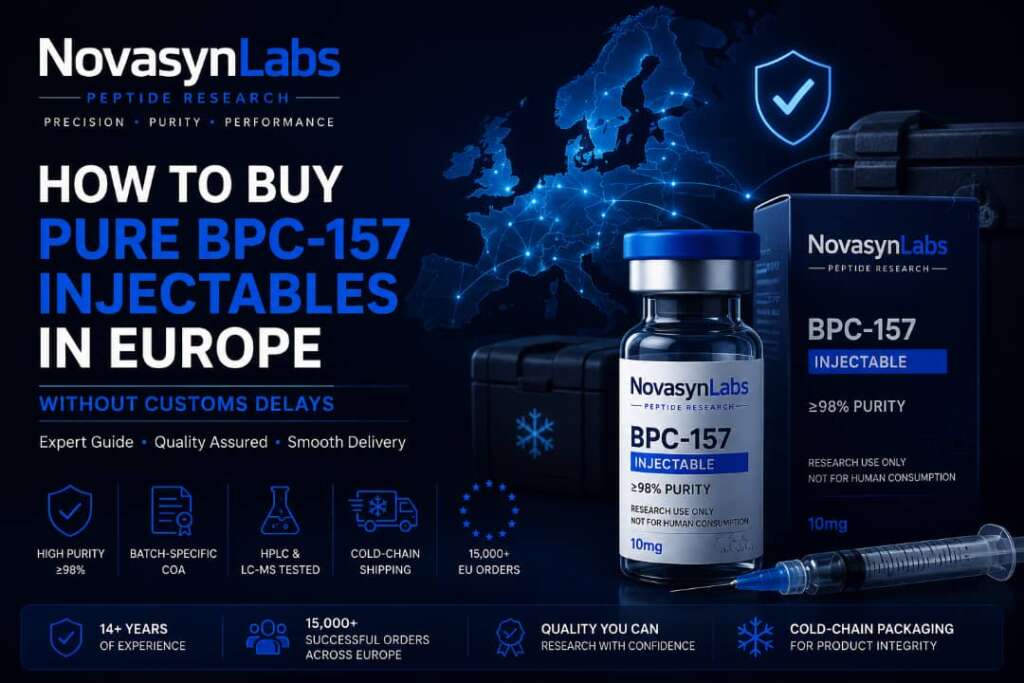
Table of Contents
Introduction
Learn How to Buy Pure BPC-157 injectables in Europe Without Customs Delays. Finding a reliable supplier for pure BPC-157 injectables in Europe without customs delays can be challenging. While many suppliers advertise “high purity” products and fast shipping, buyers often discover that product quality, shipping documentation, and customs preparation vary significantly from one supplier to another.
For research laboratories and institutions, customs delays can interrupt project timelines, while inconsistent documentation or poor-quality materials may create unnecessary administrative work. Understanding how to evaluate suppliers before placing an order can help reduce these risks.
At NovasynLabs, we’ve spent more than 14 years supplying research peptides to laboratories and research organizations across Europe. During that time, we’ve successfully fulfilled over 15,000 orders, shipping regularly to countries including Germany, France, Italy, Spain, the Netherlands, Belgium, Sweden, Moldova, Bulgaria, Belarus, Malta, and Austria. This experience has provided valuable insight into the documentation, quality-control standards, and shipping practices that support smoother international deliveries.
In this guide, you’ll learn:
- How to identify high-purity BPC-157 injectables
- Which laboratory quality tests matter most
- Why Certificates of Analysis (COAs) are essential
- Common causes of customs delays in Europe
- Documentation that may help support customs clearance
- Best practices for selecting a trusted research peptide supplier
- How proper cold-chain shipping helps maintain product integrity during transit
Whether you’re placing your first order or reviewing your current supplier, this guide explains the key factors that experienced laboratories evaluate before purchasing research peptides.
«Important: BPC-157 products discussed in this article are intended for laboratory research use only and are not for human consumption. Researchers should always comply with applicable laws, institutional policies, and local import requirements.»
What Is BPC-157?
BPC-157 is a synthetic research peptide that has attracted significant scientific interest because of its unique biological properties and its potential role in experimental studies involving tissue biology, angiogenesis, and cellular signaling pathways.
Originally derived from a naturally occurring gastric protein sequence, BPC-157 has become one of the most widely studied peptides in preclinical research. Laboratories around the world continue to investigate its behavior in controlled experimental settings, contributing to a growing body of published scientific literature.
As interest in peptide research has expanded across Europe, demand for high-purity BPC-157 injectables has also increased. This has resulted in a wider range of suppliers entering the market, making it more important than ever for buyers to evaluate product quality, analytical testing, and supplier documentation before purchasing.
Why Purity Matters
Not all BPC-157 products are manufactured or tested to the same standard.
Even when suppliers advertise similar purity percentages, the reliability of those claims depends on whether they are supported by analytical testing and batch-specific documentation.
Experienced laboratories generally look for suppliers that provide:
- Batch-specific Certificates of Analysis (COAs)
- High-Performance Liquid Chromatography (HPLC) results
- Liquid Chromatography–Mass Spectrometry (LC-MS) verification
- Third-party analytical testing where available
- Batch numbers for traceability
- Consistent manufacturing and documentation practices
These quality-control measures help researchers verify that the material they receive matches the supplier’s published specifications.
Why Customs Delays Happen When Buying BPC-157 Injectables in Europe
One of the biggest concerns for laboratories ordering research peptides internationally is customs clearance.
Many buyers assume customs delays are caused solely by the products themselves. In reality, delays are often related to shipping documentation rather than the contents of the package.
Over many years of supplying research peptides throughout Europe, we’ve found that most customs holds result from incomplete paperwork, inconsistent documentation, or destination-specific import requirements rather than the shipment itself.
Common Causes of Customs Delays
| Cause | Potential Impact | Best Practice |
| Incomplete commercial invoice | Customs may request additional information | Include complete shipment details |
| Product description is too vague | Manual customs review | Use accurate research product descriptions |
| Incorrect declared customs value | Additional verification | Declare accurate shipment values |
| Missing Certificate of Analysis (When appropriate) | Documentation requests | Include batch-specific COA where applicable |
| Missing consignee information | Delivery delays | Verify recipient details before dispatch |
| Destination-specific import requirements | Additional paperwork | Review country-specific requirements before shipping |
| Random customs inspection | Processing delay | Inspections cannot always be avoided |
It’s important to understand that no supplier can guarantee customs clearance. Customs authorities may inspect shipments at their discretion.
However, complete and accurate documentation can help reduce delays caused by missing or inconsistent paperwork.
Documentation That May Support Smoother Customs Processing
International shipments often move more efficiently when essential shipping documents are prepared accurately before dispatch.
Depending on the destination country and shipment, commonly requested documentation may include:
- Commercial invoice with complete product details
- Accurate product descriptions
- Declared customs value
- Harmonized System (HS) code where appropriate
- Complete shipper and consignee information
- Packing list (when applicable)
- Batch-specific Certificate of Analysis (COA)
- Additional documentation requested by the destination country or carrier
Although customs inspections remain possible, well-prepared documentation helps reduce requests for clarification and supports a smoother import process.
Case Study: Customs Delay Caused by Incomplete Documentation
Research Organization: Independent biotechnology laboratory in Europe
Situation
An independent biotechnology laboratory ordered research peptides from an overseas supplier. The shipment reached the destination country within the expected transit time but remained in customs for several additional days.
What Happened
The supplier’s commercial invoice described the shipment only as “laboratory chemicals.”
Because the description lacked sufficient detail, customs authorities requested additional documentation before continuing the clearance process.
The supplier later submitted:
- A revised commercial invoice
- Clearer product descriptions
- Accurate declared value
- Supporting shipment documentation
Outcome
Following receipt of the revised paperwork, customs completed the review and released the shipment.
Lesson Learned
While customs inspections cannot be eliminated, clear commercial invoices, consistent product descriptions, and complete shipping documentation can help reduce avoidable customs delays.
How to Buy Pure BPC-157 Injectables in Europe Without Customs Delays
Choosing the right supplier involves much more than comparing prices.
Experienced laboratories typically evaluate four key areas before placing an order:
- Product quality
- Analytical testing
- Documentation standards
- International shipping experience
How to Evaluate a BPC-157 Supplier Before You Buy
Not all research peptide suppliers operate to the same quality standards. While many advertise “high purity” products, the real difference often lies in their quality-control procedures, analytical testing, shipping experience, and documentation.
For laboratories purchasing pure BPC-157 injectables in Europe, evaluating a supplier before placing an order can reduce the risk of receiving inconsistent materials or experiencing avoidable customs delays.
Below are some of the most important factors experienced research organizations consider.
1. Verify That Every Batch Includes a Certificate of Analysis (COA)
A Certificate of Analysis (COA) provides batch-specific analytical information about a product. Rather than relying solely on marketing claims, researchers should review documentation that corresponds to the actual batch being supplied.
A COA may include information such as:
- Batch number
- Product identification
- Analytical purity
- Test methods performed
- Manufacturing date (where applicable)
- Laboratory results
- Authorized quality review
Suppliers that provide batch-specific COAs demonstrate greater transparency and make it easier for laboratories to maintain accurate procurement records.
At NovasynLabs, every batch of BPC-157 is accompanied by a Certificate of Analysis with each order to support laboratory documentation and quality verification.
2. Confirm HPLC and LC-MS Testing
Analytical testing plays an important role in verifying peptide identity and purity.
Two commonly used laboratory techniques include:
High-Performance Liquid Chromatography (HPLC)
HPLC is widely used to evaluate peptide purity by separating compounds within a sample.
Researchers often use HPLC results to determine whether the reported purity aligns with supplier specifications.
Liquid Chromatography-Mass Spectrometry (LC-MS)
LC-MS combines chromatographic separation with molecular mass analysis, helping verify peptide identity and detect impurities that may not be apparent through other testing methods.
When used together, HPLC and LC-MS provide complementary analytical information that supports confidence in product quality.
At NovasynLabs, every production batch undergoes HPLC analysis, LC-MS verification, and third-party analytical review before being released for shipment.
3. Look for Third-Party Verification
Independent analytical verification provides an additional level of confidence because testing is performed by laboratories separate from the manufacturer.
Although not every supplier offers third-party verification, laboratories often consider it an important indicator of transparency and quality assurance.
Benefits include:
- Independent confirmation of analytical results
- Increased confidence in reported purity
- Improved documentation for procurement records
- Greater batch-to-batch consistency
4. Review the Supplier’s Shipping Experience
Shipping research peptides internationally requires more than simply choosing an express courier.
Experienced suppliers understand:
- Customs documentation requirements
- Country-specific shipping procedures
- Carrier performance
- Packaging methods
- Transit risk management
A supplier with years of European shipping experience is generally better prepared to support smooth international deliveries than one with limited logistics experience.
Over the past 14 years, NovasynLabs has successfully completed more than 15,000 European orders, regularly shipping to:
- Germany
- France
- Italy
- Spain
- Netherlands
- Belgium
- Sweden
- Austria
- Moldova
- Bulgaria
- Belarus
- Malta
This experience has helped refine documentation standards, packaging methods, and shipping procedures for research customers throughout Europe.
Supplier Evaluation Checklist
Before placing an order, consider asking the following questions.
| Evaluation Criteria | Why It Matters |
| Batch-specific COA available? | Supports quality verification |
| HPLC testing performed? | Confirms reported purity |
| LC-MS verification available? | Confirms peptide identity |
| Third-party testing? | Independent analytical review |
| Batch-numbers provided? | Product traceability |
| European shipping experience? | Better logistics knowledge |
| Cold-chain packaging? | Helps protect temperature-sensitive materials |
| Responsive customer support? | Faster issue resolution |
| Clear customs documentation? | Helps reduce paperwork-related delays |
| Shipment tracking? | Improves delivery visibility |
The more boxes a supplier can confidently check, the easier it becomes for laboratories to evaluate overall reliability.
How NovasynLabs Protects Product Quality During Shipping
Maintaining product integrity doesn’t end after laboratory testing. Shipping conditions also play an important role in preserving temperature-sensitive research materials.
At NovasynLabs, every shipment is prepared using packaging selected for the product type, destination, seasonal conditions, and anticipated transit time.
Temperature-Controlled Packaging
Typical packaging practices include:
- Tamper-evident sealed peptide vials
- Protective impact-resistant cushioning
- Bubble wrap for additional protection
- Insulated thermal mailers
- Foam-lined shipping containers
- Moisture-resistant packaging materials
- Cold packs or phase-change gel packs when appropriate
- Discreet outer packaging without unnecessary product identification
Orders are packed immediately before dispatch to minimize unnecessary exposure to ambient temperatures.
Shipping Carriers
Depending on destination and service availability, shipments may be sent using established international carriers including:
- DHL Express
- FedEx
- UPS
- EMS
- National postal partners for final-mile delivery
Carrier selection considers factors such as:
- Delivery speed
- Tracking reliability
- Customs efficiency
- Destination country
- Seasonal logistics conditions
Typical European Delivery Times
Delivery estimates vary depending on customs clearance, holidays, weather, and carrier operations.
| Destination | Estimated Transit Time |
| Germany | 3-7 business days |
| France | 3-7 business days |
| Netherlands | 3-6 business days |
| Belgium | 3-6 business days |
| Italy | 4-8 business days |
| Spain | 4-8 business days |
| Austria | 3-7 business days |
| Poland | 4-8 business days |
| Sweden | 4-8 business days |
| Denmark | 3-6 business days |
| Finland | 5-9 business days |
| Ireland | 4-8 business days |
Delivery estimates are provided for general guidance and are not guaranteed.
How We Help Minimize Transit-Related Quality Risks
To support product integrity throughout transit, NovasynLabs follows several quality-focused shipping practices:
- Prompt dispatch after order preparation
- Insulated packaging selected for the season and destination
- Reliable carriers with shipment tracking
- Secure vial packaging to reduce movement and breakage
- Commercial invoices prepared with accurate product details
- Batch-specific COAs included when appropriate
- Continuous review of carrier performance and shipping routes
- Guidance for prompt refrigeration upon delivery according to product storage recommendations
These practices are intended to help preserve product quality during transportation while supporting efficient shipping and customs processing.
7 Common Mistakes European Buyers Make When Purchasing BPC-157 Injectables
Choosing a supplier based solely on price can create unnecessary challenges for research laboratories. Experienced procurement teams often evaluate documentation, quality-control procedures, and logistics capabilities before making a purchasing decision.
Below are some of the most common mistakes buyers make—and how they can be avoided.
1. Buying Based Only on Price
Lower pricing may be appealing, but it should never be the only factor when selecting a supplier.
A significantly lower price may indicate differences in:
- Quality-control procedures
- Analytical testing
- Documentation
- Packaging standards
- Customer support
Instead of comparing price alone, laboratories should consider the overall value provided through reliable documentation, consistent quality, and responsive service.
2. Ignoring Batch Testing
Some buyers purchase products without reviewing whether analytical testing has been performed on the specific batch they will receive.
Batch-specific testing helps demonstrate consistency and supports laboratory record-keeping.
Look for suppliers that perform:
- HPLC analysis
- LC-MS verification
- Third-party testing where available
- Batch-specific Certificates of Analysis
3. Accepting “Pharmaceutical Grade” Claims Without Evidence
The phrase “pharmaceutical grade” is frequently used in marketing, but meaningful quality claims should be supported by documentation rather than promotional language.
Before purchasing, consider asking for:
- Batch-specific COAs
- HPLC chromatograms
- LC-MS results
- Batch numbers
- Quality-control documentation
Transparent suppliers should be able to provide supporting information for their products.
4. Choosing Suppliers Without European Shipping Experience
Shipping internationally involves much more than preparing a package.
Suppliers with established European shipping experience are often more familiar with:
- Customs documentation
- Country-specific shipping requirements
- Carrier performance
- Packaging practices
- Import procedures
Experience cannot eliminate customs inspections, but it can help reduce avoidable delays caused by incomplete documentation.
5. Overlooking Cold-Chain Packaging
Temperature-sensitive research materials should be packaged appropriately for transit conditions.
Quality packaging may include:
- Thermal insulation
- Protective cushioning
- Tamper-evident vials
- Cold packs when appropriate
- Moisture-resistant materials
Proper packaging helps support product integrity throughout transportation.
6. Ignoring Supplier Support
Reliable customer support becomes particularly valuable if customs requests additional documentation or shipping updates.
Before ordering, consider whether the supplier provides:
- Prompt communication
- Tracking assistance
- Documentation support
- Clear responses to technical questions
7. Failing to Review Customs Documentation
Incomplete paperwork is one of the most common reasons shipments experience customs delays.
Buyers should confirm that suppliers prepare accurate shipping documents, including:
- Commercial invoices
- Product descriptions
- Declared values
- HS codes where appropriate
- Complete consignee information
- Supporting documentation requested by the destination country
Trusted Supplier vs High-Risk Supplier
| Trusted Research Supplier | High-Risk Supplier |
| Batch-specific COA provided | No COA availabe |
| HPLC and LC-MS | Limited or no analytical data |
| Third-party verification | No independent verification |
| 14+ years of European shipping experience | Limited international experience |
| Clear customs documentation | Generic or incomplete paperwork |
| Cold-chain packaging when appropriate | Standard packaging only |
| Responsive customer support | Slow or limited communication |
| Batch traceability | Batch information unavailable |
| Transparent quality-control procedures | Minimal quality information |
Case Study 2: Laboratory Changed Suppliers After Quality Documentation Concerns
Research Organization: Academic research laboratory
Situation
An academic laboratory sourced research peptides from several vendors for ongoing projects.
During routine quality-control reviews, researchers observed that one supplier could not consistently provide complete analytical documentation for every production batch.
What Happened
The laboratory requested:
- Batch-specific Certificates of Analysis
- Analytical testing records
- Batch traceability documentation
The supplier was unable to provide consistent records for each lot supplied.
Outcome
After evaluating alternative suppliers, the laboratory selected one that routinely supplied batch-specific COAs, standardized documentation, and detailed analytical records.
The updated procurement process simplified internal documentation and improved consistency across multiple orders.
Lesson Learned
Many laboratories evaluate suppliers based not only on product pricing but also on documentation quality, analytical transparency, and batch consistency.
Case Study 3: Smooth Customs Clearance Through Complete Documentation
Research Organization: Private research laboratory
Situation
A private research laboratory regularly imported research materials into Europe and wanted to reduce delays associated with customs processing.
Shipping Preparation
Each shipment included:
- Detailed commercial invoice
- Accurate product descriptions
- Correct declared customs value
- Batch-specific Certificate of Analysis
- Complete shipper information
- Complete consignee information
Outcome
Across multiple shipments, customs processing was generally straightforward, with no requests for additional documentation beyond routine procedures.
Although customs inspections remained possible, the laboratory experienced fewer administrative delays caused by incomplete paperwork.
Lesson Learned
Well-prepared shipping documentation cannot guarantee customs clearance, but it can reduce delays related to missing or inconsistent information.
Frequently Asked Questions
How can I verify the purity of BPC-157?
Review the supplier’s batch-specific Certificate of Analysis and confirm that analytical testing, such as HPLC and LC-MS, has been performed. When available, third-party verification provides an additional level of confidence.
What purity should I look for?
Many research suppliers offer BPC-157 with purity specifications of 98% or higher. Buyers should confirm that the reported purity is supported by analytical documentation.
Can customs inspect research peptide shipments?
Yes. Customs authorities may inspect shipments at their discretion. Complete and accurate documentation may help reduce delays related to missing paperwork, but inspections cannot be guaranteed or avoided.
What documentation should accompany an international shipment?
Depending on the destination and shipment, documentation may include:
- Commercial invoice
- Product description
- Declared customs value
- HS code where appropriate
- Packing list
- Batch-specific COA
- Any additional documents required by the destination country
Which shipping carriers are commonly used?
International research shipments are commonly handled by providers such as DHL Express, FedEx, UPS, EMS, and national postal partners for final-mile delivery, depending on destination and service availability.
How should BPC-157 be stored after delivery?
Researchers should follow the storage recommendations provided for the specific product and refrigerate materials promptly after delivery when appropriate to help maintain product integrity.
Why is supplier experience important?
Suppliers with extensive experience shipping to Europe are often more familiar with customs documentation, packaging practices, carrier selection, and logistics procedures, which can contribute to a smoother purchasing experience.
Final Thoughts
Buying pure BPC-157 injectables in Europe without customs delays involves more than selecting the lowest-priced supplier. Product quality, analytical testing, shipping expertise, and documentation all play important roles in supporting a reliable purchasing process.
Before placing an order, laboratories should verify that the supplier provides:
- Batch-specific Certificates of Analysis
- HPLC and LC-MS analytical testing
- Third-party verification where available
- Reliable cold-chain packaging
- Complete customs documentation
- European shipping experience
- Responsive customer support
- Consistent batch traceability
At NovasynLabs, our focus is on supporting the research community through transparent quality-control procedures, batch-specific documentation, and carefully managed international shipping. With more than 14 years of experience and over 15,000 successful orders delivered across Europe, we continue to prioritize product quality, documentation standards, and dependable logistics for research customers.
Research Use Only: Products discussed in this article are intended solely for laboratory research purposes and are not for human consumption.
Continue Reading
To learn more about research peptides and laboratory best practices, explore our related guides:
- Research Peptide Quality Control: HPLC, LC-MS & COAs Explained
- How to Store Research Peptides Correctly
- GHK-Cu Research Guide
These resources provide additional information on peptide quality, storage, supplier evaluation, and research-focused procurement practices to help laboratories make well-informed purchasing decisions.
External References


Comment
What Role Do Growth Factors Play In Tissue Repair Studies? (2026 Deep Dive)
[…] BPC-157 […]