


No products in the cart.
Where Do Researchers Buy Peptides in the USA? Quality Checklist & Expert Tips
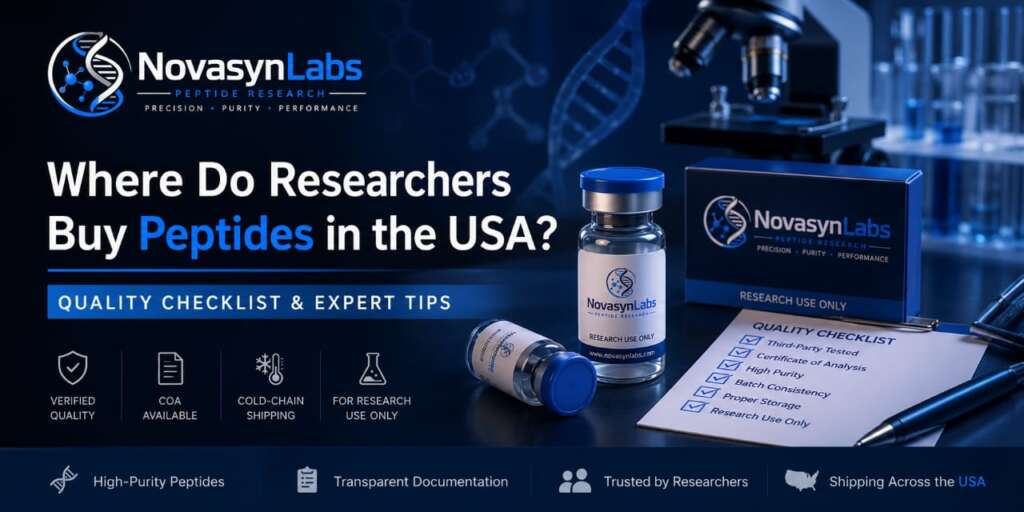
Table of Contents
Where Do Researchers Buy Peptides in the USA? Quality Checklist & Expert Tips
The United States is home to many universities, biotechnology companies, pharmaceutical organizations, and contract research laboratories that use research peptides in a wide variety of scientific studies. As peptide research continues to grow, researchers are increasingly looking beyond price when selecting a supplier. Instead, they often prioritize analytical documentation, product quality, batch consistency, and reliable customer support.
If you’re wondering where researchers buy peptides in the USA, the answer is not simply “the cheapest supplier” or “the first website that appears in search results.” Experienced laboratories typically evaluate suppliers using a structured quality checklist that helps ensure every batch meets their documentation and procurement requirements.
Whether your laboratory is sourcing Semaglutide, Tirzepatide, Retatrutide, Cagrilintide, BPC-157, TB-500, GHK-Cu, MOTS-c, or Epitalon, choosing a supplier with transparent quality standards can simplify inventory management, improve traceability, and support consistent laboratory workflows.
At NovaSyn Labs, we have supplied research peptides for more than 18 years, serving over 10,000 research customers across the United States while also supporting researchers in Europe and other regions. Throughout those years, we’ve observed that laboratories with well-defined procurement procedures often place greater emphasis on analytical documentation and supplier consistency than on price alone.
In this guide, we’ll explain the quality checklist and expert tips researchers commonly use when evaluating peptide suppliers in the USA, helping you understand what to look for before placing an order.
Research Use Only: The products discussed in this article are supplied for laboratory research purposes only and are not intended for human use.
Quick Answer
Where Do Researchers Buy Peptides in the USA?
Researchers typically purchase peptides from suppliers that can provide documented analytical quality and reliable laboratory support.
Before ordering, experienced laboratories often verify:
- Batch-specific Certificate of Analysis (COA)
- Independent HPLC purity testing
- LC-MS identity verification
- Manufacturing quality standards
- Batch consistency
- Cold-chain shipping
- Proper storage guidance
- Clear product labeling
- Responsive customer support
- Supplier experience and documentation
Rather than selecting a supplier based only on price, many laboratories compare these factors to support reproducible research and efficient procurement.
Why Supplier Selection Matters
Research peptides are frequently incorporated into carefully controlled laboratory studies where consistency and documentation are essential.
Even when experimental protocols remain unchanged, differences in sourcing can introduce unnecessary administrative or quality-control challenges.
A well-documented supplier can help laboratories:
- Improve inventory traceability
- Maintain organized procurement records
- Simplify internal quality assurance
- Support standardized laboratory workflows
- Reduce administrative complexity across long-term projects
For laboratories conducting studies over several months, maintaining consistent sourcing can be an important part of project planning.
Why the USA Is a Leading Market for Research Peptides
The United States remains one of the world’s largest centers for peptide research.
Researchers across academic institutions, biotechnology companies, pharmaceutical organizations, and contract research laboratories continue to investigate peptides involved in:
- GLP-1 receptor biology
- Metabolic research
- Cellular signaling
- Tissue repair
- Mitochondrial function
- Cosmetic peptide research
- Healthy aging research
- Experimental pharmacology
As research expands, demand for well-documented, high-quality research peptides has continued to increase.
This makes supplier evaluation more important than ever.
NovaSyn Labs’ Experience Supporting Researchers
For more than 18 years, NovaSyn Labs has supported laboratories by supplying research peptides to over 10,000 research customers throughout the USA, in addition to serving researchers across Europe and other continents.
Our catalog includes some of today’s most widely studied research peptides, including:
- Semaglutide
- Tirzepatide
- Retatrutide
- Cagrilintide
- BPC-157
- TB-500
- GHK-Cu
- MOTS-c
- SS-31
- Epitalon
Every batch is supported by documented quality measures that include:
- ≥98% purity (where applicable)
- Third-party HPLC purity testing
- LC-MS identity verification
- Batch-specific Certificate of Analysis (COA)
- Manufacturing quality standards
- Cold-chain shipping
- Quality-controlled packaging
These practices help laboratories begin their projects with well-characterized research materials and supporting documentation.
The Researcher’s Quality Checklist
When experienced laboratories evaluate peptide suppliers, they often use a structured checklist rather than focusing on a single factor.
The ten areas covered in this guide include:
- Supplier reputation and experience
- Analytical testing (HPLC & LC-MS)
- Certificate of Analysis (COA)
- Peptide purity
- Manufacturing standards
- Cold-chain shipping
- Storage after delivery
- Batch consistency
- Customer support
- Red flags to avoid
Each of these topics contributes to informed supplier selection and supports laboratory quality assurance.
Why Buying Based Only on Price Can Be Costly
One of the most common mistakes researchers make is selecting a supplier solely because they advertise the lowest price.
While cost is an important consideration, it should not replace quality evaluation.
A lower-priced product may not include:
- Independent analytical testing
- Batch-specific COAs
- LC-MS verification
- Manufacturing documentation
- Appropriate packaging
- Reliable customer support
- Clear storage recommendations
Researchers should compare overall value rather than price alone.
Comparison Table: Trusted Supplier vs Unknown Supplier
| Quality Factor | Trusted Supplier | Unknown Supplier |
| Certificate of Analysis | ✔Batch-specific | Often unavailable |
| Third-party HPLC Testing | ✔ | May not be disclosed |
| LC-MS Verification | ✔ | Often unavailable |
| Manufacturing Standards | ✔ | Documented Limited information |
| Batch Identification | ✔ | Sometimes missing |
| Cold-Chain Shipping | ✔ Available | May not be specified |
| Storage Guidance | ✔ Included | Often missing |
| Customer Support | ✔ Responsive | Difficult to verify |
| Supplier Experience | ✔ Established | Unknown |
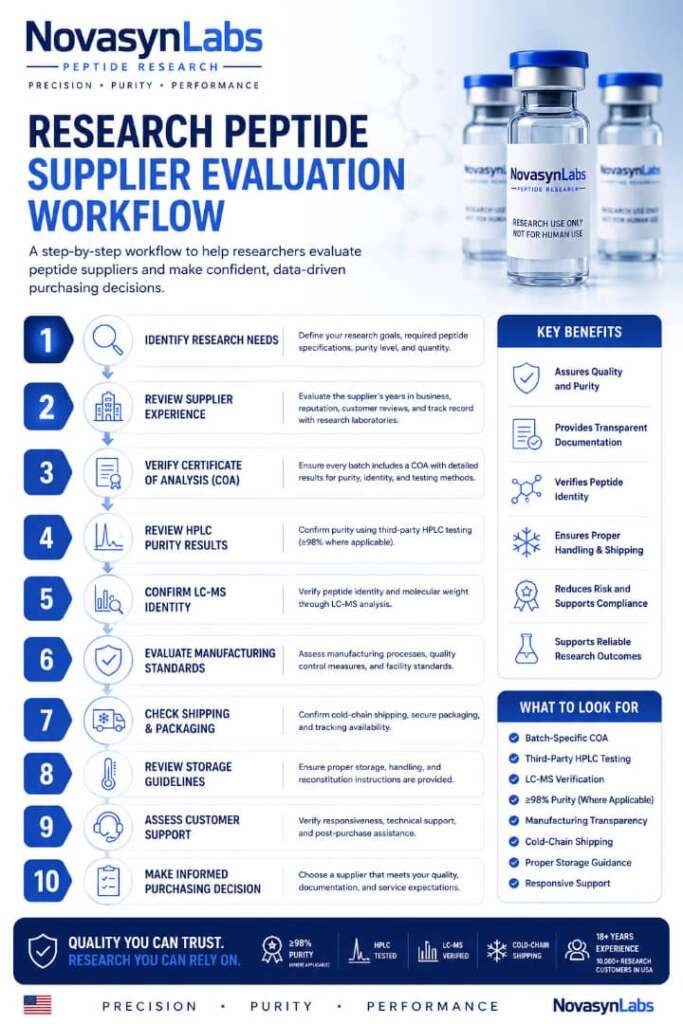
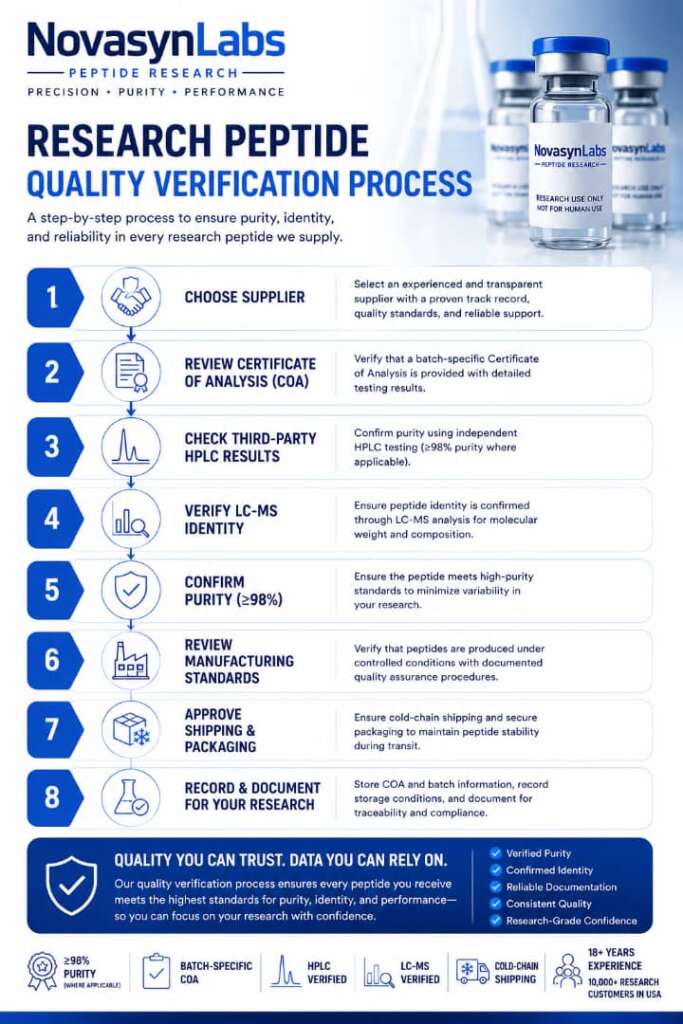
The First Five Quality Checks Every Researcher Should Make Before Buying Peptides in the USA
Selecting a research peptide supplier involves much more than comparing prices or product catalogs. Experienced laboratories often follow a structured evaluation process that helps ensure the materials they purchase are supported by appropriate analytical documentation, consistent manufacturing practices, and reliable logistics.
In this section, we’ll examine the first five quality checks that can help researchers identify trustworthy suppliers and make informed procurement decisions.
1. Evaluate the Supplier’s Experience and Reputation
One of the first questions researchers should ask is:
“Can this supplier consistently support long-term laboratory research?”
An experienced supplier is generally more likely to have established quality-control systems, standardized documentation, and customer support processes that simplify laboratory procurement.
Instead of focusing only on marketing claims, researchers often look for objective indicators such as:
- Years supplying research peptides
- Transparent company information
- Technical product documentation
- Batch identification
- Customer support availability
- Educational resources
- Quality-control procedures
At NovaSyn Labs, we’ve supported research laboratories for more than 18 years, supplying research peptides to over 10,000 research customers throughout the United States while also serving researchers across Europe and other regions.
Over time, we’ve found that laboratories conducting multi-month research projects frequently value supplier consistency just as highly as product specifications.
Supplier Evaluation Checklist
| Question | Why It Matters |
| How long has the supplier operated? | Indicates long-term reliability |
| Are Certificates of Analysis available? | Supports documentation requirements |
| Is customer support accessible? | Simplifies procurement questions |
| Are lot numbers clearly identified? | Supports traceability |
| Does the supplier publish quality standards? | Demonstrates transparency |
Expert Tip
Researchers should evaluate suppliers using measurable quality indicators rather than promotional language alone.
2. Confirm HPLC Purity Testing
One of the most important quality indicators when purchasing research peptides is analytical purity.
High-Performance Liquid Chromatography (HPLC) is commonly used to evaluate peptide purity by separating components within a sample and estimating the proportion of the desired peptide relative to impurities.
Many laboratories review HPLC reports before beginning research because they provide valuable information for internal quality documentation.
At NovaSyn Labs, every batch is supported by third-party HPLC purity testing, helping laboratories review analytical documentation before initiating experiments.
Why HPLC Matters
HPLC testing helps researchers:
- Review analytical purity
- Compare batches
- Support procurement documentation
- Maintain quality records
- Improve purchasing confidence
HPLC Verification Table
| Without HPLC | With Third-Party HPLC |
| Limited analytical information | Independent purity documentation |
| Difficult batch comparison | Easier batch evaluation |
| Less procurement transparency | Greater documentation confidence |
| Reduced traceability | Improved laboratory records |
3. Verify LC-MS Identity Confirmation
Purity and identity are not the same.
A peptide may demonstrate high purity while laboratories still require confirmation that the molecular identity matches the expected product.
Liquid Chromatography-Mass Spectrometry (LC-MS) provides molecular identity verification by analyzing the mass of the peptide.
This additional analytical step helps laboratories confirm that documentation aligns with the intended research material.
NovaSyn Labs provides LC-MS verification alongside other analytical documentation to support laboratory quality assurance procedures.
Why Researchers Value LC-MS
LC-MS verification helps laboratories:
- Confirm peptide identity
- Support quality documentation
- Compare analytical records
- Strengthen procurement confidence
- Maintain standardized project documentation
Comparison
| HPLC | LC-MS |
| Evaluates purity | Confirms molecular identity |
| Measures impurities | Verifies peptide composition |
| Supports quality assessment | Supports identity confirmation |
4. Review the Certificate of Analysis (COA)
The Certificate of Analysis (COA) is one of the most frequently requested documents during laboratory procurement.
Rather than serving as a simple product insert, the COA provides analytical information specific to an individual batch.
Many laboratories archive COAs with project documentation to improve traceability and simplify future quality reviews.
A Typical COA May Include
- Product name
- Batch number
- Lot number
- Purity results
- Analytical testing methods
- LC-MS verification
- Manufacturing date
- Storage recommendations
Why COAs Matter
Laboratories often use COAs to:
- Verify incoming shipments
- Record batch numbers
- Support procurement approval
- Improve traceability
- Archive project documentation
Expert Tip
Researchers should review the COA before beginning laboratory work rather than waiting until project documentation is finalized.
5. Confirm Peptide Purity
Purity remains one of the most discussed characteristics when evaluating research peptides.
While purity alone does not describe every aspect of product quality, it is frequently reviewed alongside analytical documentation, identity confirmation, manufacturing standards, and storage practices.
NovaSyn Labs supplies research peptides with ≥98% purity (where applicable), supported by independent analytical documentation.
Why Purity Is Important
Higher analytical purity can help laboratories:
- Reduce unnecessary variables
- Standardize procurement
- Improve documentation
- Support quality assurance
- Compare batches more effectively
Researchers should remember that purity should always be interpreted alongside HPLC reports, LC-MS verification, and Certificates of Analysis rather than as a standalone specification.
Comparison Table: High-Purity vs Poorly Documented Peptides
| High Purity, Documented Peptides | Poorly Documented Peptides |
| ≥98% purity (where applicable) | Purity often unclear |
| Third-party HPLC testing | Limited or no testing information |
| LC-MS identity verification | Identity may not be documented |
| Batch-specific COA | COA may be unavailable |
| Lot identification | Batch details may be missing |
| Better documentation for laboratory records | Reduced procurement transparency |
6. Review Manufacturing Standards
Analytical testing is valuable, but it represents only one part of peptide quality.
Researchers should also understand how products are manufactured and whether quality-control procedures are followed throughout production.
Manufacturing standards influence:
- Batch consistency
- Product traceability
- Documentation quality
- Packaging consistency
- Inventory management
- Long-term procurement reliability
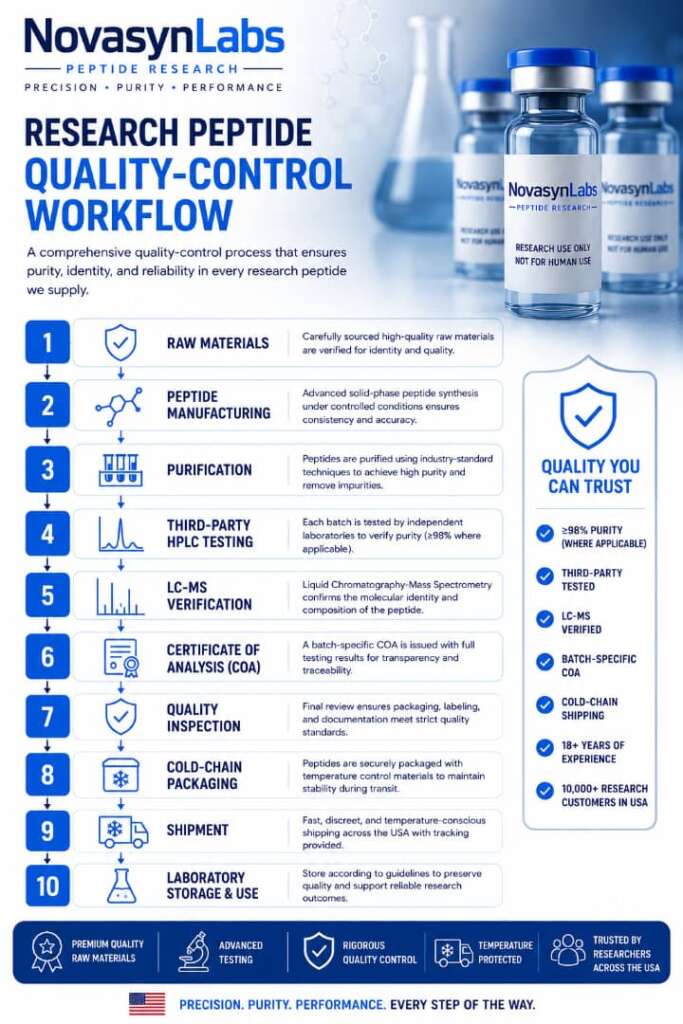
At NovaSyn Labs, every production batch undergoes multiple quality-control stages before release.
These include:
- Raw material verification
- Controlled peptide synthesis
- Purification
- Third-party HPLC testing
- LC-MS identity verification
- Certificate of Analysis generation
- Quality inspection
- Cold-chain packaging
This structured workflow helps ensure every shipment is accompanied by consistent laboratory documentation.
Manufacturing Quality Checklist
| Question | Why It Matters |
| Are manufacturing standards documented? | Improves transparency |
| Is every batch tested? | Supports consistency |
| Is a COA supplied? | Simplifies laboratory documentation |
| Is LC-MS performed? | Confirms peptide identity |
| Are batches traceable? | Improves quality assurance |
Expert Tip
Researchers should view manufacturing quality as a complete system rather than focusing on purity alone.
7. Why Cold-Chain Shipping Matters
Research peptides are carefully manufactured and tested, but transportation conditions also play an important role in preserving product quality before arrival.
For this reason, many laboratories evaluate shipping procedures before selecting a supplier.
Cold-chain shipping helps maintain appropriate environmental conditions during transit and supports laboratory storage practices upon delivery.
At NovaSyn Labs, research peptides are packaged using quality-controlled cold-chain shipping procedures designed for laboratory distribution.
Researchers Often Verify
- Insulated packaging
- Temperature-conscious shipping
- Secure vial protection
- Shipment tracking
- Proper labeling
- Storage instructions
Comparison Table
| Cold-Chain Shipping | Standard Shipping |
| Temperature-conscious packaging | Environmental exposure may vary |
| Better protection during transit | Less controlled conditions |
| Improved shipment presentation | Packaging quality may vary |
| Supports laboratory storage procedures | Storage guidance may be limited |
Storage After Delivery
Receiving a shipment is only the beginning.
Proper storage after delivery helps laboratories maintain organized inventory and consistent handling procedures.
Researchers should:
- Inspect shipments immediately
- Review the Certificate of Analysis
- Record lot numbers
- Store lyophilized peptides according to laboratory SOPs
- Limit unnecessary handling
- Prepare aliquots when appropriate
- Document storage locations
- Maintain inventory records
These practices improve traceability throughout long-term projects.
Common Storage Mistakes
Avoid:
- Leaving shipments unopened for extended periods
- Ignoring storage recommendations
- Failing to document batch numbers
- Repeated freeze-thaw cycles
- Improper inventory labeling
- Mixing batches without documentation
8. Why Batch Consistency Is Critical
Many laboratory projects continue for weeks or even months.
During these studies, researchers frequently rely on consistent sourcing and documentation to simplify procurement and internal quality assurance.
Batch consistency helps laboratories:
- Compare experiments over time
- Improve inventory management
- Simplify audits
- Maintain standardized documentation
- Reduce administrative complexity
Batch Consistency Checklist
Researchers often record:
- Lot number
- Batch number
- Date received
- Storage location
- COA reference
- Experimental use
- Remaining inventory
Maintaining these records supports laboratory organization throughout the project.
Anonymous Laboratory Case Study #1
Standardizing Supplier Documentation for a Multi-Center Research Project
Laboratory Background
A university-affiliated molecular biology laboratory was preparing a collaborative research project involving three independent research groups.
Because multiple investigators would handle identical peptide batches over several months, procurement personnel established strict documentation requirements before placing any orders.
Why They Selected NovaSyn Labs
The laboratory prioritized:
- Batch-specific Certificates of Analysis
- Clearly identified lot numbers
- Laboratory-ready product labeling
- Consistent documentation
- Protective packaging suitable for laboratory storage
Rather than purchasing from multiple suppliers, the laboratory chose a single documented supplier to maintain standardized procurement records throughout the study.
Research Timeline
Week 1
- Supplier evaluation
- Documentation review
- Procurement approval
↓
Week 2
- Shipment received
- COA verification
- Inventory registration
↓
Weeks 3–18
- Routine laboratory research
- Batch tracking
- Storage monitoring
↓
Weeks 19–20
- Documentation archive
- Internal quality review
Laboratory Workflow
Supplier Documentation Review
↓
Shipment Inspection
↓
COA Verification
↓
Inventory Registration
↓
Controlled Storage
↓
Batch Tracking
↓
Laboratory Research
↓
Documentation Archive
Lessons Learned
The laboratory concluded that:
- Standardized documentation simplified coordination across research teams.
- Recording batch numbers improved traceability.
- Consistent procurement reduced administrative complexity.
- Organized inventory supported internal quality assurance.
- Early documentation review simplified future audits.
Common Mistakes Researchers Make When Buying Peptides in the USA
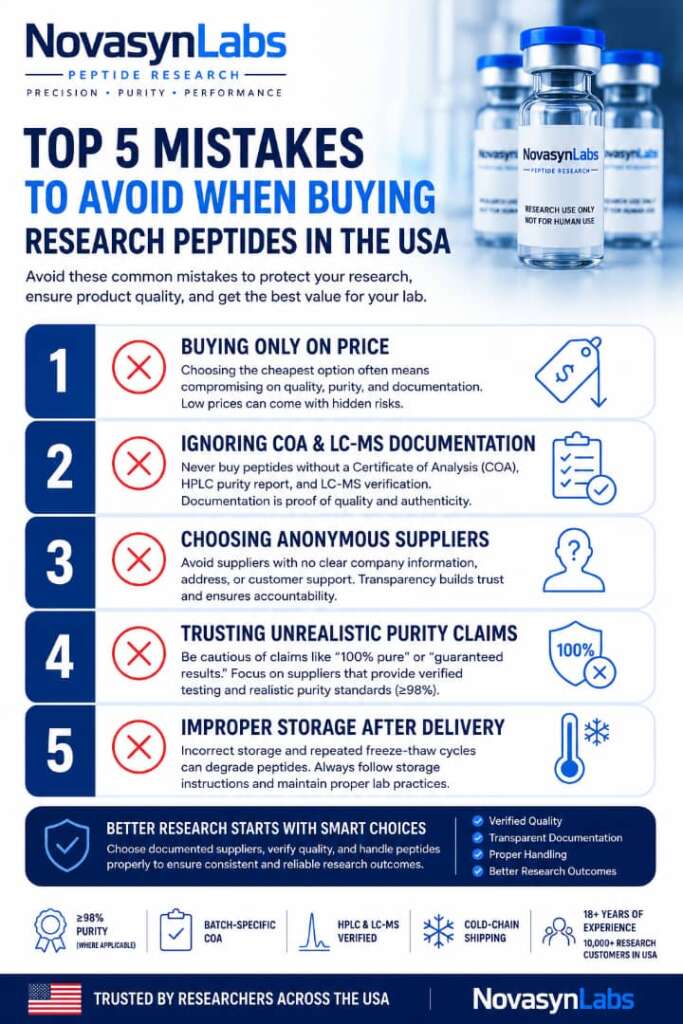
Even experienced laboratories can make procurement decisions that create unnecessary administrative challenges. Over the past 18+ years, after serving more than 10,000 research customers across the USA, we’ve observed that the same purchasing mistakes appear repeatedly.
Avoiding these issues helps improve documentation, inventory management, and laboratory workflow consistency.
Mistake 1: Choosing the Cheapest Supplier Instead of the Most Documented Supplier
One of the biggest procurement mistakes is evaluating suppliers based only on price.
Lower pricing often comes with trade-offs, including:
- Missing Certificates of Analysis
- No LC-MS verification
- Limited batch documentation
- Unknown manufacturing practices
- Poor customer support
- Inconsistent packaging
Professional laboratories typically evaluate documentation before comparing prices.
Why Documentation Matters More Than Price
The purchase price is only one part of the total research cost.
Unexpected issues such as missing documentation, inconsistent labeling, or unclear batch identification can create additional administrative work and delays.
Researchers often save time by selecting suppliers that provide complete documentation from the beginning.
Table: Low-Cost Supplier vs Documented Supplier
| Feature | Low-Cost Supplier | Documented Supplier |
| COA | Sometimes unavailable | Included with each batch |
| LC-MS Verification | Often unavailable | Available |
| Batch Numbers | Inconsistent | Clearly documented |
| Cold-Chain Shipping | Variable | Available when required |
| Customer Support | Limited | Responsive support |
| Inventory Traceability | Difficult | Straightforward |
Mistake 2: Ignoring Analytical Testing
A supplier may advertise high purity without providing supporting analytical documentation.
Before ordering, researchers should confirm:
- Certificate of Analysis (COA)
- HPLC purity report
- LC-MS verification (where available)
- Batch identification
- Manufacturing information
Supporting documentation helps laboratories maintain organized procurement records.
Mistake 3: Purchasing from Anonymous Suppliers
A trustworthy supplier should provide clear business information.
Look for:
- Company name
- Contact details
- Customer support
- Quality documentation
- Published policies
- Professional website
If a supplier hides basic information, it may be difficult to resolve issues after purchase.
Mistake 4: Believing Unrealistic Purity Claims
Statements such as:
- “100% Pure”
- “Perfect Quality”
- “Best Peptides on Earth”
- “Guaranteed Results”
are marketing claims that should be viewed critically.
Professional suppliers generally support quality claims with analytical documentation rather than absolute promises.
What to Look For Instead
Researchers should look for suppliers that provide:
- Documented purity (for example, ≥98% where applicable)
- Batch-specific Certificates of Analysis
- LC-MS or other analytical verification when available
- Transparent quality information
- Consistent labeling
Mistake 5: Improper Storage After Delivery
Even well-documented research peptides should be handled according to appropriate laboratory procedures after receipt.
Good practice includes:
- Inspecting the shipment upon arrival
- Reviewing the accompanying documentation
- Recording batch numbers
- Following the supplier’s storage recommendations
- Minimizing unnecessary handling
Proper inventory practices help support consistency throughout a research project.
Research Procurement Tip
When comparing peptide suppliers in the USA, ask yourself these questions before placing an order:
- Is a batch-specific COA provided?
- Is analytical testing documented?
- Are products clearly labeled?
- Are storage recommendations included?
- Is customer support easy to contact?
- Does the supplier explain shipping procedures?
- Can lot numbers be recorded for traceability?
- Does the supplier have an established track record serving research laboratories?
Answering these questions can make supplier selection more systematic and reduce administrative complexity throughout a research project.
How to Evaluate a Research Peptide Supplier in the USA
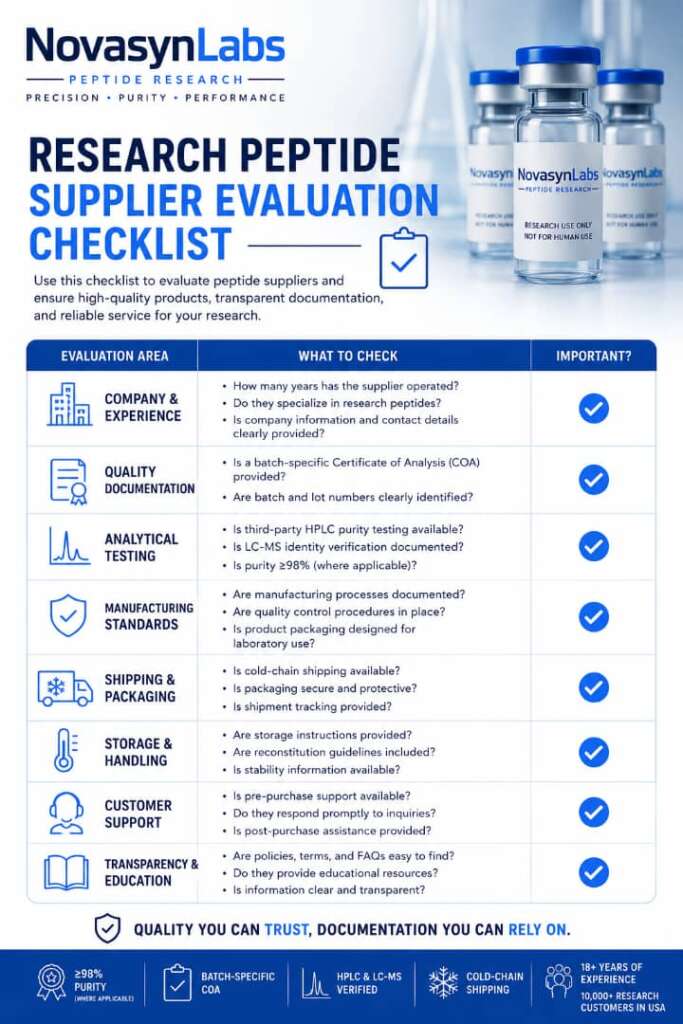
After narrowing down potential suppliers, researchers often perform a more detailed evaluation before placing an order. Rather than relying on advertising claims, experienced laboratories compare documentation, analytical testing, shipping practices, and supplier transparency.
A structured evaluation process can help support consistent procurement decisions and improve laboratory recordkeeping.
The Researcher’s Supplier Evaluation Checklist
Before purchasing research peptides in the USA, consider the following questions:
Company & Experience
- How long has the supplier served the research community?
- Do they clearly identify their company and contact information?
- Do they specialize in research peptides?
- Is educational content available to help researchers understand their products?
Quality Documentation
- Is a batch-specific Certificate of Analysis (COA) provided?
- Is third-party HPLC testing available?
- Is LC-MS identity verification documented?
- Are batch and lot numbers clearly identified?
Product Quality
- Is the stated purity supported by analytical testing?
- Are manufacturing standards explained?
- Is packaging designed for laboratory use?
- Are storage recommendations included?
Shipping
- Is cold-chain shipping available when appropriate?
- Is shipment tracking provided?
- Are products packaged to protect them during transit?
Customer Support
- Can technical questions be answered before ordering?
- Is post-purchase support available?
- Does the supplier respond promptly to inquiries?
Complete Supplier Evaluation Table
| Evaluation Area | Questions to Ask |
| Company Experience | How many years has the supplier operated? |
| Customer Base | Do they regularly serve research laboratories? |
| COA | Is every batch supplied with documentation? |
| HPLC Testing | Is purity independently verified? |
| LC-MS | Is peptide identity confirmed? |
| Batch Tracking | Are lot numbers clearly recorded? |
| Manufacturing | Are quality standards documented? |
| Shipping | Is cold-chain shipping available? |
| Storage Guidance | Are handling instructions provided? |
| Customer Support | Can researchers obtain assistance when needed? |
Trusted Supplier vs Unknown Supplier
| Feature | Trusted Supplier | Unknown Supplier |
| Years of Experience | Extensive | Unknown |
| COA | Included | May be unavailable |
| Third-Party HPLC | Available | Often not disclosed |
| LC-MS Verification | Available | Rarely documented |
| Batch Numbers | Clearly identified | May be inconsistent |
| Manufacturing Standards | Transparent | Limited information |
| Cold-Chain Shipping | Available | May not be specified |
| Storage Instructions | Included | Sometimes missing |
| Customer Support | Responsive | Difficult to verify |
Anonymous Laboratory Case Study #1
Standardizing Supplier Documentation for a Multi-Center Research Project
Laboratory Background
A university-affiliated molecular biology laboratory was preparing a collaborative research project involving three research groups. Since multiple investigators would use the same peptide batches over several months, procurement staff established standardized purchasing requirements before placing any orders.
Why They Selected NovaSyn Labs
During supplier evaluation, the laboratory prioritized documentation quality over price alone.
The team selected NovaSyn Labs because the supplier provided:
- Batch-specific Certificates of Analysis (COAs)
- Clearly identified batch and lot numbers
- Laboratory-ready product labeling
- Documentation compatible with internal quality procedures
- Packaging designed to protect lyophilized research materials during shipment
Using a single documented supplier helped reduce administrative variability throughout the project.
Research Objective
The laboratory aimed to evaluate peptide handling procedures across multiple laboratories while maintaining standardized procurement records and consistent material traceability.
The project focused on improving documentation quality and inventory management rather than comparing biological outcomes.
Project Timeline
| Timeline | Activity |
| Week 1 | Supplier evaluation, documentation review, procurement approval |
| Week 2 | Shipment received, COA verification, inventory registration |
| Weeks 3-18 | Routine laboratory research, batch tracking, storage monitoring |
| Weeks 19-20 | Documentation archive and internal quality review |
Laboratory Workflow
Supplier Evaluation
↓
Documentation Review
↓
Procurement Approval
↓
Shipment Received
↓
COA Verification
↓
Inventory Registration
↓
Controlled Storage
↓
Routine Laboratory Research
↓
Documentation Archive
Lessons Learned
At the conclusion of the project, the laboratory found that:
- Standardized supplier documentation simplified coordination between multiple research teams.
- Recording batch and lot numbers improved traceability throughout the study.
- Maintaining consistent procurement practices reduced administrative complexity.
- Organized inventory records supported internal quality assurance procedures.
- Reviewing documentation before experimentation made future audits more efficient.
Expert Procurement Tips
Researchers evaluating peptide suppliers in the USA often benefit from a consistent review process:
- Compare documentation before comparing prices.
- Verify that each batch includes a COA.
- Confirm that HPLC and LC-MS testing are available where applicable.
- Review shipping and storage recommendations before ordering.
- Record batch and lot numbers in laboratory records.
- Use a standardized checklist for every purchase to support consistency across projects.
Shipping Expectations Across the USA
Reliable shipping is an important part of laboratory procurement.
Researchers should know what to expect before placing an order.
A professional supplier should provide:
- Secure protective packaging
- Clearly labeled products
- Batch identification
- Certificate of Analysis (COA)
- Storage recommendations
- Shipment tracking (where available)
- Customer support for shipping questions
For temperature-sensitive products, researchers should also confirm whether cold-chain shipping procedures are used.
Shipping Inspection Checklist
Immediately after delivery, laboratories should:
✓ Inspect external packaging
✓ Verify product labels
✓ Confirm batch and lot numbers
✓ Review the COA
✓ Record the delivery date
✓ Store products according to supplier recommendations
✓ Update laboratory inventory records
Following a standardized receiving procedure improves traceability and supports future quality reviews.
Anonymous Laboratory Case Study #2
Improving Storage Documentation and Inventory Management
Laboratory Background
A private contract research laboratory routinely evaluated peptide handling procedures during internal assay development.
As research activity increased, laboratory management sought to improve inventory organization and standardize storage practices across several ongoing projects.
Why They Selected NovaSyn Labs
The laboratory compared multiple suppliers before selecting NovaSyn Labs because they valued:
- Comprehensive analytical documentation
- Batch-specific Certificates of Analysis
- Clearly labeled research materials
- Consistent packaging suitable for laboratory storage
- Documentation that integrated with existing laboratory quality systems
Rather than focusing only on purchase price, the laboratory emphasized documentation quality and long-term consistency.
Research Objective
The project aimed to establish standardized procedures for:
- Receiving shipments
- Inventory registration
- Storage documentation
- Batch tracking
- Laboratory recordkeeping
The emphasis was on improving workflow consistency rather than evaluating biological outcomes.
Project Timeline
| Timeline | Activity |
| Day 1 | Shipment received and packaging inspected |
| Day 2 | Documentation review and COA verification |
| Week 1 | Inventory registration and storage assignment |
| Weeks 2-14 | Routine laboratory handling, aliquot preparation, inventory monitoring |
| Project Completion | Documentation archive and internal workflow evaluation |
Laboratory Workflow
Shipment Received
↓
Packaging Inspection
↓
COA Verification
↓
Inventory Registration
↓
Controlled Storage
↓
Aliquot Preparation
↓
Laboratory Research
↓
Inventory Monitoring
↓
Documentation Archive
Lessons Learned
Following the project, the laboratory reported that:
- Standardized receiving procedures improved inventory accuracy.
- Aliquot preparation reduced repeated handling.
- Recording storage temperatures improved traceability.
- Organized batch documentation simplified internal quality reviews.
- Working with a supplier providing consistent documentation supported standardized laboratory workflows across multiple projects.
Questions Every Researcher Should Ask Before Ordering
Before purchasing research peptides in the USA, researchers should ask:
- Is every batch supplied with a Certificate of Analysis?
- Is third-party HPLC testing available?
- Is LC-MS identity verification documented?
- Are batch and lot numbers clearly identified?
- What shipping procedures are used?
- Are storage recommendations provided?
- Is customer support available before and after purchase?
- Are manufacturing quality standards explained?
- How long has the supplier served the research community?
- Does the supplier provide educational resources?
Frequently Asked Questions
Where do researchers buy peptides in the USA?
Researchers often purchase peptides from suppliers that provide transparent analytical documentation, including batch-specific Certificates of Analysis, HPLC purity testing, LC-MS identity verification, and clear storage recommendations. Many laboratories also evaluate supplier experience, manufacturing standards, and customer support before placing an order.
How do I know if a peptide supplier is trustworthy?
Look for suppliers that openly provide:
- Batch-specific COAs
- Independent analytical testing
- Clear batch identification
- Manufacturing information
- Storage guidance
- Responsive customer support
- A demonstrated history of serving research laboratories
Why is a Certificate of Analysis important?
A COA provides batch-specific analytical information that helps laboratories verify incoming materials, maintain inventory records, and support internal quality assurance procedures.
What is the difference between HPLC and LC-MS?
HPLC (High-Performance Liquid Chromatography) is commonly used to evaluate peptide purity.
LC-MS (Liquid Chromatography-Mass Spectrometry) is used to verify molecular identity.
Together, these analytical methods provide complementary quality information.
Why does batch consistency matter?
Maintaining consistent batches throughout a research project supports:
- Better documentation
- Easier inventory management
- Improved traceability
- Simplified internal audits
- Standardized laboratory workflows
Why is cold-chain shipping important?
Appropriate shipping procedures help protect research materials during transit and support proper handling upon arrival. Researchers should always follow the supplier’s storage recommendations after receiving a shipment.
Research Peptide Buyer’s Checklist
Before placing an order, confirm that your supplier provides:
☑ Batch-specific Certificate of Analysis
☑ Third-party HPLC purity testing
☑ LC-MS identity verification
☑ ≥98% purity specifications (where applicable)
☑ Manufacturing quality standards
☑ Cold-chain shipping (where appropriate)
☑ Secure packaging
☑ Batch and lot identification
☑ Storage recommendations
☑ Responsive customer support
☑ Educational resources
☑ Transparent documentation
Related Articles
To continue learning about research peptide quality and laboratory best practices, explore these guides:
- Peptide Storage Guide
- Semaglutide Research Guide
- Retatrutide Research Guide
- BPC-157 Research Guide
- GLP-1 vs Other Peptides
- How Peptide Purity Is Maintained During Storage
Conclusion
Researchers purchasing peptides in the USA benefit from taking a systematic approach to supplier evaluation. Rather than focusing solely on price, experienced laboratories often compare documentation quality, analytical testing, manufacturing standards, shipping practices, storage guidance, and supplier transparency.
For more than 18 years, NovaSyn Labs has supported over 10,000 research customers across the United States, as well as researchers in Europe and other regions. Our commitment to third-party HPLC testing, LC-MS identity verification, batch-specific Certificates of Analysis, ≥98% purity specifications (where applicable), quality-controlled packaging, and cold-chain shipping reflects our focus on supporting laboratory research with transparent documentation and dependable service.
Whether your laboratory is sourcing Semaglutide, Tirzepatide, Retatrutide, Cagrilintide, BPC-157, TB-500, GHK-Cu, MOTS-c, SS-31, or Epitalon, evaluating suppliers against the quality checklist outlined in this guide can help support informed procurement decisions and consistent laboratory workflows.
External References

