


No products in the cart.
How Are Research Peptides Made? Complete Guide to Peptide Manufacturing & Quality Control
How Are Research Peptides Made?
Research peptides have become indispensable tools across modern scientific disciplines, supporting investigations in molecular biology, cell signaling, immunology, endocrinology, metabolism, neuroscience, and many other laboratory fields. Yet despite their widespread use, one question continues to surface among both new and experienced researchers:
How are research peptides made?
The answer involves far more than simply combining amino acids. Producing a high-quality research peptide requires carefully selected raw materials, advanced synthesis technologies, multiple purification stages, rigorous analytical testing, and controlled storage conditions. Every stage contributes to ensuring that researchers receive materials with verified identity, consistent purity, and reliable documentation.
At NovaSyn Labs, we’ve been supplying research peptides for more than 24 years. During that time, we’ve witnessed remarkable advances in peptide manufacturing technology. Today, we manufacture selected peptides ourselves while also working with carefully qualified laboratory partners in China that meet our quality expectations. This combined manufacturing approach enables us to offer a broad product portfolio while maintaining a strong focus on documentation, consistency, and quality assurance.
Rather than relying on a single quality indicator, our evaluation process incorporates multiple analytical testing methods to verify each batch before release. Our products typically meet a 98% or higher purity standard, and each qualifying batch is supported by detailed documentation to help researchers maintain accurate laboratory records.
This guide explains every stage of the manufacturing process—from raw amino acids to the finished lyophilized vial—while also exploring why purification, testing, and documentation are just as important as peptide synthesis itself.
Note: The information in this article is provided for educational purposes regarding research peptide manufacturing and laboratory quality practices. Research peptides are intended for laboratory research use and should be handled according to applicable regulations and laboratory protocols.
What Are Research Peptides?
Research peptides are short chains of amino acids produced under controlled laboratory conditions for scientific investigation. Their relatively small size allows researchers to study highly specific biological interactions, making peptides valuable tools in a wide range of experimental settings.
Unlike naturally occurring proteins—which may contain hundreds or even thousands of amino acids—research peptides are typically much shorter. This enables manufacturers to synthesize them with high precision while allowing researchers to investigate specific biological pathways in controlled laboratory environments.
Today’s research peptides support investigations involving:
- Growth hormone signaling
- Cellular communication
- Mitochondrial biology
- Immune system research
- Tissue and connective tissue research
- Longevity and healthy aging pathways
- Metabolic signaling
- Cosmetic peptide research
Because these molecules often participate in highly specific biochemical interactions, even small manufacturing inconsistencies can influence laboratory reproducibility. This is one reason why reputable manufacturers invest heavily in quality assurance and analytical verification.
Why Understanding How Research Peptides Are Made Matters
Many researchers focus primarily on a peptide’s name or reported purity percentage. While purity is undoubtedly important, it represents only one aspect of overall product quality.
Understanding how research peptides are manufactured helps laboratories make more informed sourcing decisions by highlighting the importance of manufacturing practices, documentation, analytical testing, and storage conditions.
For example, two suppliers may both advertise a peptide as 98% pure, yet differences in manufacturing procedures, documentation, storage, or analytical verification can affect confidence in product consistency and traceability.
At NovaSyn Labs, we’ve learned over more than two decades that researchers increasingly value comprehensive quality documentation alongside analytical testing. This trend reflects the growing importance of reproducibility and record management in scientific research.
Instead of evaluating peptides based on purity alone, many laboratories also consider:
- Manufacturing consistency
- Batch traceability
- Certificate of Analysis (COA) availability
- Analytical testing methods
- Packaging quality
- Storage recommendations
- Supplier experience
- Customer support
Together, these factors contribute to a more complete picture of product quality.
Table: Factors That Influence Research Peptide Quality
| Quality Factor | Why It Matters |
| Raw material quality | Supports accurate peptide synthesis and consistency. |
| Manufacturing method | Influences production efficiency and overall process control. |
| Purification | Removes unwanted synthesis by-products and impurities. |
| Analytical testing | Helps verify peptide identity and purity before release. |
| Batch documentation | Supports traceability and laboratory record-keeping. |
| Certificate of Analysis (COA) | Provides documented analytical results for individual batches. |
| Storage Conditions | Helps maintain peptide stability during storage and transportation. |
| Supplier experience | May reflect established quality systems and manufacturing oversight. |
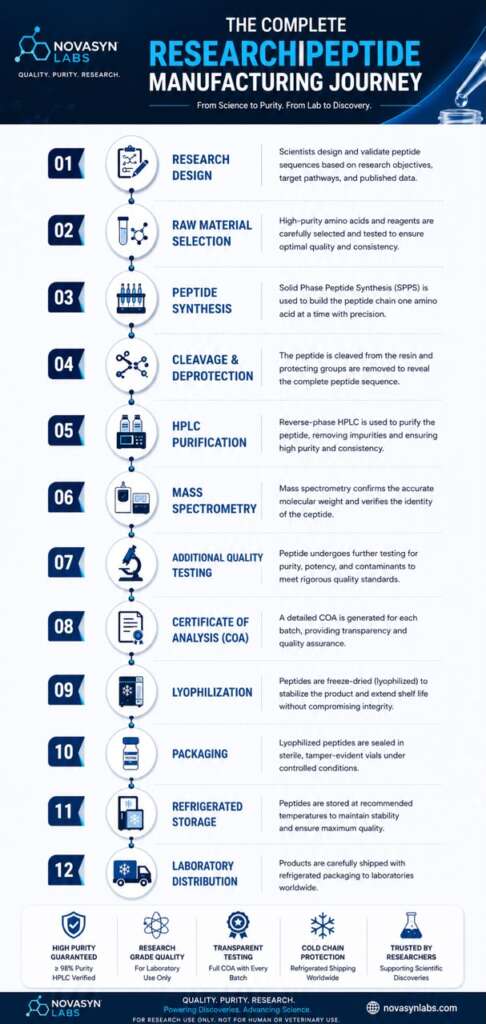
The Journey from Amino Acids to Finished Research Peptides
Every research peptide begins with a carefully designed amino acid sequence.
Scientists first determine the exact order of amino acids required for the intended research application. That sequence becomes the manufacturing blueprint used during synthesis.
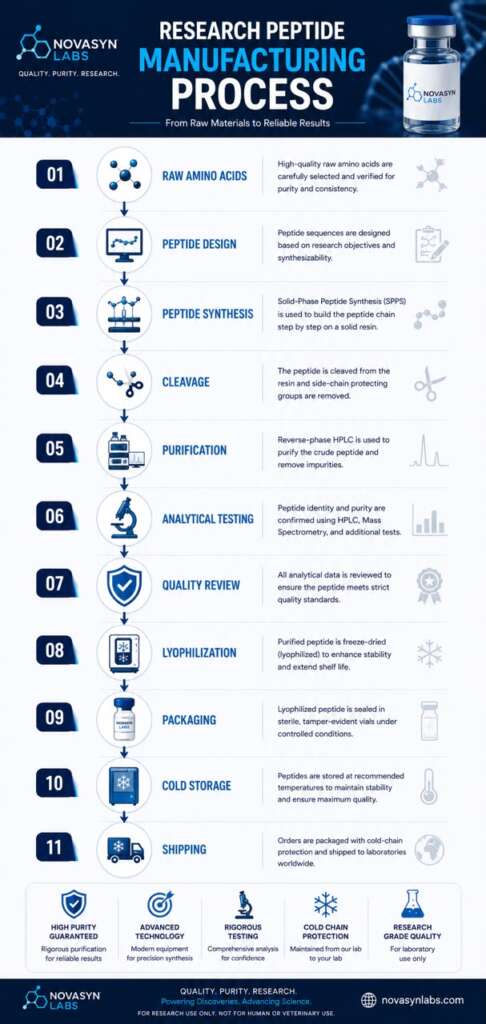
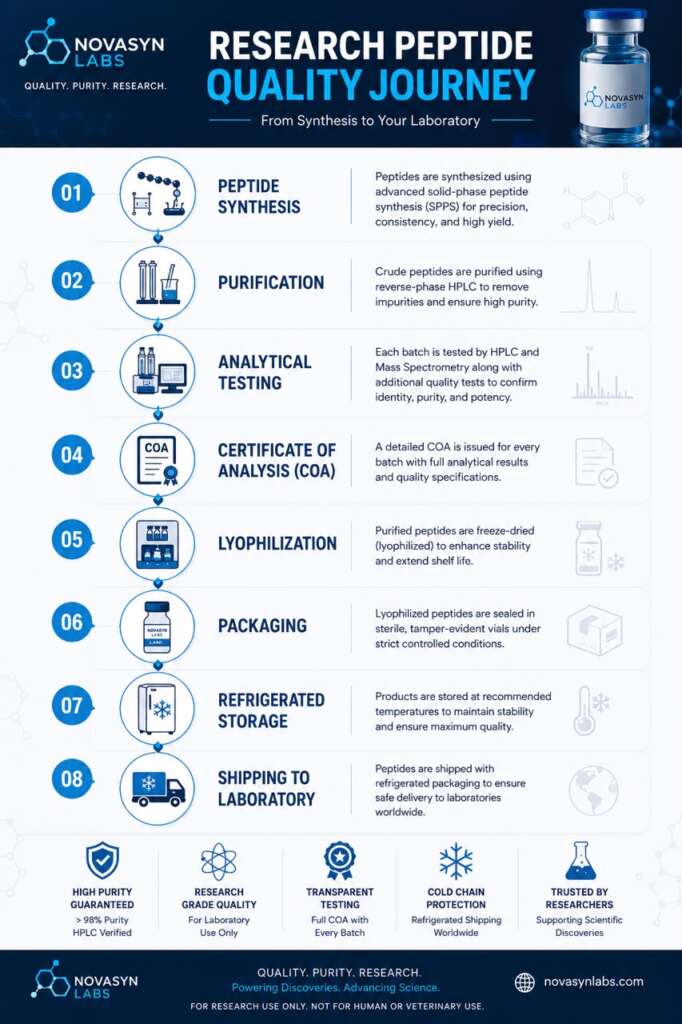
Although the overall concept sounds straightforward, peptide manufacturing actually involves numerous carefully controlled stages:
- Selecting pharmaceutical-grade amino acids
- Building the peptide chain one amino acid at a time
- Removing protective chemical groups
- Purifying the finished peptide
- Performing multiple analytical quality tests
- Freeze-drying (lyophilization)
- Packaging and documenting the finished product
- Refrigerated storage before shipment
Each stage has its own quality-control procedures designed to support consistency and traceability.
What Is the First Step in Manufacturing Research Peptides?
Every successful peptide begins long before synthesis starts.
The process starts with selecting high-quality amino acid building blocks. Amino acids are the individual molecular units that are chemically linked together to create a peptide chain. The exact order of these amino acids determines the peptide’s structure.
Modern manufacturing facilities evaluate raw materials against predefined quality specifications before production begins. This helps reduce variability and supports consistent manufacturing from one batch to the next.
The selected amino acids are then prepared for synthesis using specialized protective chemical groups. These protective groups prevent unwanted chemical reactions while allowing manufacturers to add one amino acid at a time in the correct sequence.
Although this preparation stage often receives little attention outside manufacturing laboratories, it plays an essential role in producing accurately assembled peptide chains.
Peptide Synthesis – Building Research Peptides One Amino Acid at a Time
After the raw amino acids have been carefully selected and prepared, the manufacturing process moves into its most technically demanding stage: peptide synthesis.
This is where individual amino acids are chemically joined together in a precise order to create the desired peptide. Unlike assembling random building blocks, every amino acid must be added in the correct sequence. Even a single error during synthesis can result in a different molecule than intended, which is why manufacturers rely on controlled processes and multiple quality checks throughout production.
Today, peptide manufacturers use advanced synthesis techniques that have been refined over decades of scientific research. At NovaSyn Labs, we manufacture selected peptides ourselves and also work with qualified laboratory partners that utilize a combination of peptide synthesis methods, depending on the characteristics of the peptide being produced.
What Is Peptide Synthesis?
Peptide synthesis is the controlled chemical process of linking amino acids together using peptide bonds.
Each amino acid contains functional chemical groups that allow it to bond with the next amino acid in the sequence. During manufacturing, protective chemical groups temporarily block unwanted reactions so that only the correct bond forms at each step.
The process continues one amino acid at a time until the complete peptide sequence has been assembled.
Although the concept sounds straightforward, manufacturing longer peptides can require dozens of carefully controlled reaction cycles, each of which must be optimized to maintain efficiency and minimize unwanted by-products.
The Two Main Methods Used to Manufacture Research Peptides
Modern manufacturers generally rely on two established approaches:
- Solid-Phase Peptide Synthesis (SPPS)
- Liquid-Phase Peptide Synthesis (LPPS)
Rather than viewing one as universally superior, manufacturers choose the method that best fits the peptide’s complexity, production scale, and quality objectives.
Solid-Phase Peptide Synthesis (SPPS)
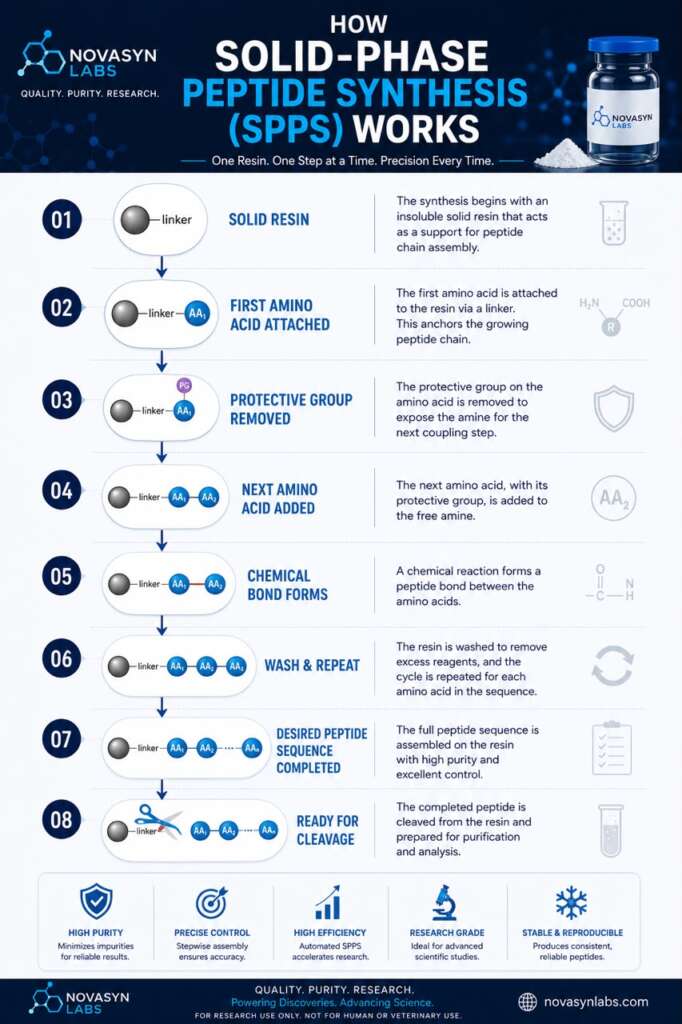
The most widely used manufacturing technique today is Solid-Phase Peptide Synthesis, commonly abbreviated as SPPS.
Developed by Nobel Prize-winning chemist Robert Bruce Merrifield, SPPS transformed peptide manufacturing by allowing amino acids to be added sequentially while the growing peptide remains attached to a solid resin.
This approach significantly simplified purification between reaction cycles and improved manufacturing efficiency for many research peptides.
During SPPS:
- The first amino acid is attached to a solid resin.
- A protective group is removed.
- The next amino acid is chemically attached.
- Excess reagents are washed away.
- The cycle repeats until the desired sequence is complete.
Because the peptide remains anchored to the resin throughout much of the process, manufacturers can more easily remove unwanted chemicals after each reaction step.
This controlled workflow has made SPPS the preferred manufacturing method for many laboratory research peptides.
Liquid-Phase Peptide Synthesis (LPPS)
Although SPPS is widely used, Liquid-Phase Peptide Synthesis (LPPS) continues to play an important role for certain peptides and manufacturing strategies.
Unlike SPPS, LPPS takes place entirely in solution rather than on a solid support.
This method may be selected for particular peptide sequences, specialized production requirements, or specific manufacturing workflows where solution-based chemistry offers practical advantages.
LPPS generally involves:
- Building shorter peptide fragments
- Purifying intermediate products
- Joining fragments together
- Completing the final peptide sequence
Because purification often occurs between synthesis stages, LPPS can require more processing steps than SPPS. However, it remains a valuable manufacturing approach for selected applications.
At NovaSyn Labs, our manufacturing network utilizes a combination of synthesis methods depending on the peptide being produced, helping ensure that the chosen process aligns with quality expectations and production requirements.
Why Manufacturers Use Protective Groups
One of the biggest challenges during peptide synthesis is preventing amino acids from reacting in unintended ways.
Every amino acid contains reactive chemical groups. Without temporary protection, amino acids could bond incorrectly, creating unwanted molecules instead of the desired peptide.
To address this, manufacturers use protective groups.
These protective groups temporarily block reactive sites while allowing only the intended chemical reaction to occur. Once each amino acid has been successfully added, the protective group is removed before the next amino acid is introduced.
This repeated cycle of:
- Deprotection
- Coupling
- Washing
continues until the full peptide chain has been assembled.
Although researchers rarely see these intermediate stages, they are fundamental to producing peptides with consistent identity.
Why Precision Matters During Synthesis
Peptide manufacturing is not simply about completing a sequence—it is about completing the correct sequence.
Each reaction cycle must be carefully controlled because incomplete reactions may produce truncated peptides or other synthesis by-products.
To help reduce variability, manufacturers monitor factors such as:
- Reaction time
- Temperature
- Solvent quality
- Reagent concentration
- Coupling efficiency
- Equipment calibration
Careful control of these variables supports consistent manufacturing from one production batch to another.
Table: SPPS vs LPPS
| Feature | Solid-Phase Peptide Synthesis (SPPS) | Liquid-Phase Peptide Synthesis (LPPS) |
| Reaction location | On a solid resin | In solution |
| Typical use | Many laboratory research peptides | Selected peptides and specialized manufacturing workflows |
| Washing between steps | Generally straightforward | Often more involved |
| Manufacturing flexibility | High for sequential chain assembly | Useful for certain peptide fragments and production strategies |
| Common role | Widely used in modern peptide manufacturing | Complementary approach for specific applications |
What Happens After Synthesis Is Complete?
Once the peptide chain has been successfully assembled, the manufacturing process is not yet finished.
The completed peptide must first be separated from the solid resin (when SPPS has been used), protective groups must be removed, and any remaining synthesis by-products need to be eliminated before the material can move to purification.
Only after these steps can manufacturers begin refining the peptide to help achieve the desired purity and prepare it for analytical testing.
The purification stage is where techniques such as High-Performance Liquid Chromatography (HPLC) become essential for separating the target peptide from impurities generated during synthesis.
Purification, Analytical Testing, and Quality Verification
Successfully assembling a peptide sequence is a major milestone, but it does not produce a finished research product on its own.
Following synthesis, the peptide still contains residual reagents, protective groups, and synthesis by-products that must be removed before it is suitable for laboratory distribution. This is where purification and analytical testing become essential components of the manufacturing process.
In many ways, these stages determine whether a peptide meets the quality expectations of researchers. A carefully synthesized peptide that has not undergone appropriate purification and verification may not provide the same level of confidence as one that has been thoroughly analyzed and documented.
At NovaSyn Labs, product evaluation is based on a combination of analytical testing methods, rather than relying on a single measurement. Our research peptides are typically produced to a 98% or higher purity standard, and each qualifying batch is supported by documentation designed to help laboratories maintain traceability and quality records.
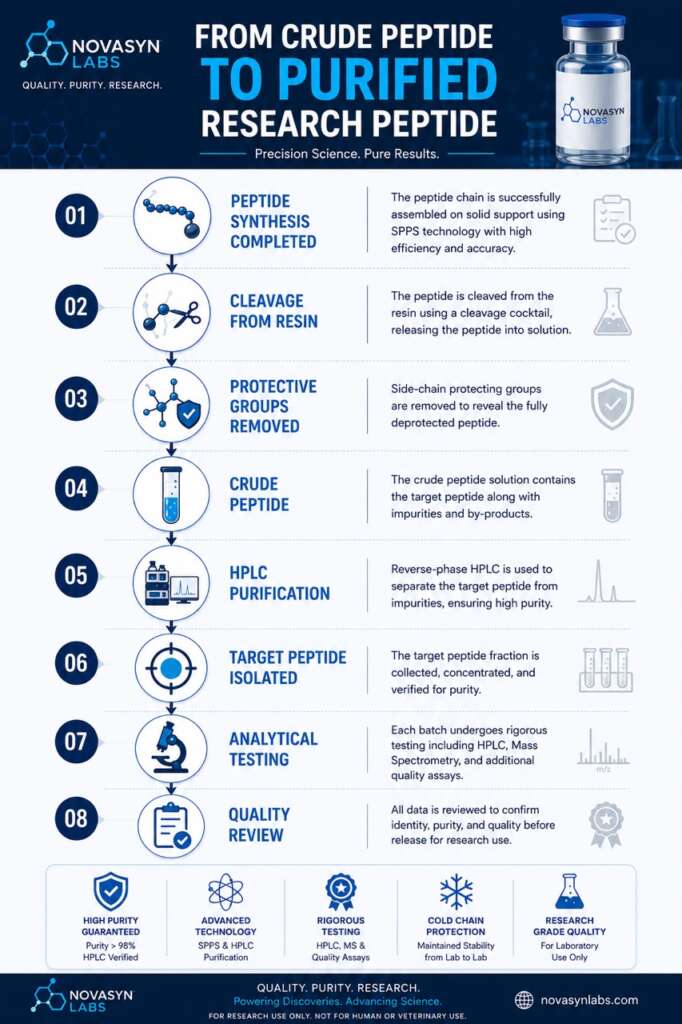
Step 1: Cleavage and Deprotection
For peptides manufactured using Solid-Phase Peptide Synthesis (SPPS), the completed peptide chain remains attached to a solid resin after synthesis.
Before purification can begin, two important tasks must be completed:
- The peptide is separated (or cleaved) from the resin.
- The temporary protective groups used during synthesis are removed (deprotection).
These protective groups were essential during manufacturing because they prevented unwanted chemical reactions while each amino acid was added to the growing peptide chain.
Once synthesis is complete, however, these groups are no longer needed and must be removed to reveal the finished peptide molecule.
After cleavage and deprotection, the result is often referred to as a crude peptide.
What Is a Crude Peptide?
A crude peptide is an intermediate product that contains the desired peptide alongside other materials generated during manufacturing.
Depending on the peptide sequence and synthesis conditions, a crude sample may contain:
- Incomplete peptide fragments
- Side reaction products
- Residual reagents
- Protective group remnants
- Trace manufacturing impurities
While the target peptide is present, these additional materials must be removed before the product proceeds to quality testing and final packaging.
This is why purification is considered one of the most important stages in research peptide manufacturing.
Why Purification Is Essential
Every chemical manufacturing process naturally produces some unwanted by-products.
Purification helps separate the desired peptide from these unwanted components, improving the overall quality of the finished material.
Without effective purification:
- Analytical testing becomes more difficult.
- Product consistency may be reduced.
- Documentation may not accurately reflect the intended material.
- Laboratories may have less confidence in batch reproducibility.
Although researchers often focus on purity percentages, purification itself is the process that helps manufacturers achieve those quality targets.
High-Performance Liquid Chromatography (HPLC)
One of the most widely used purification techniques in peptide manufacturing is High-Performance Liquid Chromatography (HPLC).
HPLC separates molecules according to their physical and chemical properties.
As the crude peptide mixture passes through a chromatography column, different compounds travel at different speeds.
This allows manufacturers to isolate the desired peptide while separating many unwanted synthesis by-products.
The purified peptide collected from the column can then undergo additional analytical testing before being released.
Because of its effectiveness and reproducibility, HPLC is considered one of the industry’s standard tools for peptide purification and quality assessment.
Beyond Purity: Why Analytical Testing Matters
Purity alone does not provide a complete picture of peptide quality.
Researchers often benefit from additional analytical information that helps confirm a peptide’s identity and supports laboratory documentation.
For this reason, manufacturers frequently perform multiple quality-control procedures before releasing a batch.
At NovaSyn Labs, we evaluate research peptides using a combination of analytical testing methods to help verify quality before distribution.
Rather than depending on a single test result, multiple analytical techniques can provide complementary information about a peptide.
Common Analytical Testing Methods
Depending on the peptide and manufacturing requirements, testing may include:
High-Performance Liquid Chromatography (HPLC)
Used to evaluate peptide purity by separating different molecular components within the sample.
Mass Spectrometry (MS)
Mass spectrometry helps verify the molecular weight of a peptide.
By comparing the measured molecular weight with the expected value, manufacturers can confirm that the synthesized peptide matches the intended molecular structure.
Additional Quality-Control Procedures
Depending on manufacturing requirements, laboratories may also perform other analytical evaluations as part of their overall quality assurance program.
These additional procedures can provide further information about batch quality and support comprehensive documentation.
Table: Common Analytical Tests Used in Research Peptide Manufacturing
| Test | Purpose | Why It Matters |
| High-Performance Liquid Chromatography (HPLC) | Evaluates peptide purity | Helps identify impurities and estimate purity levels. |
| Mass Spectrometry (MS) | Confirms molecular weight | Supports verification of the peptide’s expected identity. |
| Additional analytical procedures | Provides supplementary quality information | Contributes to overall batch evaluation and documentation. |
Understanding 98%+ Purity
Many research peptide suppliers report purity values such as 95%, 98%, or 99%.
These percentages describe the proportion of the analyzed sample that corresponds to the desired peptide under the testing method used.
At NovaSyn Labs, our research peptides are generally produced to a 98% or higher purity standard, reflecting our commitment to quality-focused manufacturing and analytical verification.
However, it is important to understand that purity should not be evaluated in isolation.
Experienced researchers often consider additional factors, including:
- Batch consistency
- Manufacturing controls
- Quality documentation
- Analytical testing
- Storage conditions
- Supplier reliability
Taken together, these elements provide a more complete assessment of product quality than purity alone.
Table: Purity vs Overall Product Quality
| Purity Alone | Overall Product Quality |
| Indicates the proportion of the target peptide detected during analysis. | Includes purity, analytical testing, documentation, consistency, storage, and traceability. |
| Represents one quality metric. | Reflects the complete manufacturing and quality assurance process. |
| Useful for comparison | More informative for laboratories seeking reliable, well-documented materials. |
How NovaSyn Labs Approaches Quality Verification
Over more than 24 years of supplying research peptides, we’ve seen that many laboratories value comprehensive documentation just as highly as analytical testing.
Our quality approach emphasizes:
- Multiple analytical testing methods
- Typical purity standards of 98% or higher
- Batch identification
- Certificate of Analysis (COA) availability
- Consistent documentation
- Quality-focused manufacturing practices
- Ongoing customer support
These measures help researchers maintain organized laboratory records while supporting traceability between peptide batches.
Lyophilization, Packaging, Storage, and Real Laboratory Experiences
By the time a research peptide has successfully passed purification and analytical testing, it has already undergone numerous carefully controlled manufacturing steps. However, the manufacturing journey is still not complete.
Before a peptide is ready to reach a research laboratory, it must be stabilized, packaged, documented, and stored under appropriate conditions. These final steps are often overlooked, yet they play an important role in helping maintain product quality from manufacturing through delivery.
At NovaSyn Labs, quality extends beyond synthesis and testing. Proper handling after production—including lyophilization, refrigerated storage, and comprehensive documentation—helps support the consistency researchers expect when sourcing laboratory materials.
Why Are Research Peptides Lyophilized?
One of the final manufacturing stages is lyophilization, more commonly known as freeze-drying.
Instead of storing peptides as liquid solutions, manufacturers often convert them into a dry powder by removing water under carefully controlled conditions.
This process helps improve stability during storage and transportation while reducing the rate of chemical degradation that can occur in solution.
The result is the familiar white powder found inside many research peptide vials.
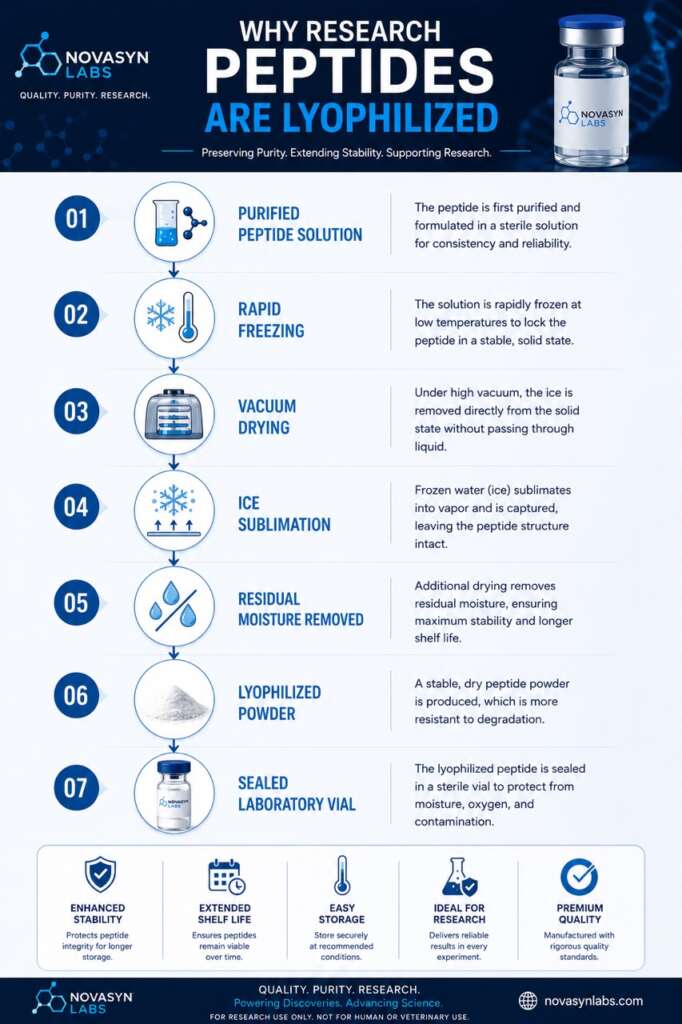
How Lyophilization Works
Although highly technical, the basic process follows three stages:
Step 1 – Freezing
The purified peptide solution is rapidly frozen.
Freezing locks the peptide molecules into place while preparing the material for moisture removal.
Step 2 – Primary Drying
The pressure is reduced inside a specialized freeze dryer.
Instead of melting into liquid water, the ice transitions directly into vapor through a process known as sublimation.
This removes most of the water while minimizing stress on the peptide.
Step 3 – Secondary Drying
Any remaining bound moisture is removed under carefully controlled conditions.
The finished peptide is then sealed inside sterile laboratory vials to help preserve its stability during storage.
Why Manufacturers Freeze-Dry Peptides
Lyophilization offers several practical advantages for research materials.
These include:
- Improved stability during storage
- Reduced moisture exposure
- Easier transportation
- Longer shelf life under recommended storage conditions
- More convenient long-term inventory management
Because of these benefits, lyophilization has become a standard practice in modern research peptide manufacturing.
Packaging: Protecting Research Peptides After Manufacturing
Once lyophilization is complete, peptides move into the packaging stage.
Although packaging may appear simple, it serves several important functions.
Proper packaging helps:
- Protect peptides during transportation
- Reduce environmental exposure
- Preserve documentation
- Maintain batch identification
- Support laboratory inventory management
Manufacturers typically use specialized laboratory vials designed to protect the peptide throughout storage and shipping.
Each batch is carefully identified to support traceability from production through laboratory use.
Why Batch Documentation Matters
For many research laboratories, documentation is just as valuable as the peptide itself.
Accurate records allow laboratories to:
- Identify individual production batches
- Track inventory
- Maintain procurement records
- Support internal quality assurance
- Reference analytical documentation during future projects
At NovaSyn Labs, Certificates of Analysis (COAs) and batch documentation form an important part of our quality-focused approach.
These records help laboratories organize materials and maintain traceability between research projects.
Case Study #1
Standardized Documentation Simplified Laboratory Record Management
University-Affiliated Research Laboratory (United States)
One university-affiliated research laboratory reported that sourcing peptides from a supplier providing comprehensive documentation—including Certificates of Analysis (COAs), batch numbers, and analytical test results—made procurement and inventory management more efficient.
According to the laboratory, standardized documentation simplified internal record-keeping and reduced the time required to verify incoming materials before beginning experimental work.
The researchers also noted that consistent documentation proved valuable during quality assurance reviews by making it easier to maintain traceability between experimental batches.
Although this experience focuses on laboratory administration rather than research outcomes, it highlights the practical value of organized documentation throughout the procurement process.
Case Study #2
Supplier Transition Improved Batch Traceability
Independent Research Group (Europe)
An independent research group conducting preclinical studies transitioned from a previous peptide supplier to one providing detailed analytical reports, clearly labeled packaging, and consistent lot identification.
Following the transition, the laboratory reported that standardized documentation made it easier to organize inventory and reference specific peptide batches throughout ongoing projects.
Researchers also appreciated receiving the same documentation format with every shipment, supporting internal reproducibility practices and more efficient record management.
This experience demonstrates how consistency in documentation can contribute to smoother laboratory operations without making claims about experimental performance.
Why Refrigerated Storage Is Important
Even after manufacturing is complete, storage conditions remain an important consideration.
Environmental factors such as heat, prolonged moisture exposure, and repeated temperature fluctuations may affect peptide stability over time.
For this reason, many research peptides are stored under recommended refrigerated conditions until they are prepared for shipment.
At NovaSyn Labs, refrigerated storage forms part of our post-manufacturing handling process, helping maintain product quality before distribution.
Researchers should always follow the storage recommendations provided with each product and refer to the accompanying documentation for guidance.
Common Misconceptions About Research Peptide Manufacturing
As peptide research has become more widely discussed, several misconceptions have emerged. Understanding the manufacturing process helps separate common myths from established laboratory practices.
| Myth | Reality |
| Research peptides are extracted from humans. | Most research peptides are produced through controlled chemical synthesis or other established manufacturing methods, not extracted from human tissue. |
| Every manufacturer follows the same quality standards. | Manufacturing practices, testing protocols, documentation, and quality systems can vary between suppliers. |
| A higher purity percentage tells the whole story. | Purity is important, but researchers also consider analytical testing, batch documentation, consistency, storage practices, and supplier reliability. |
| Every peptide is manufactured using the same process. | Different peptides may require different synthesis strategies, purification methods, and production workflows. |
These distinctions reinforce why understanding how research peptides are made is valuable when evaluating suppliers and interpreting quality documentation.
What Sets NovaSyn Labs Apart?
Selecting a research peptide supplier involves more than comparing product prices or advertised purity values. Researchers often look for suppliers that demonstrate consistency, transparency, and a commitment to quality throughout the manufacturing process.
At NovaSyn Labs, our approach has been shaped by more than 24 years of supplying research peptides. During that time, we’ve expanded our product portfolio while maintaining an emphasis on quality-focused manufacturing, documentation, and customer support.
Our approach includes:
- Manufacturing selected research peptides while partnering with qualified laboratories in China for others.
- Utilizing a combination of established peptide synthesis methods based on the product being manufactured.
- Applying multiple analytical testing methods as part of our quality evaluation process.
- Supplying products that typically meet a 98% or higher purity standard.
- Providing Certificates of Analysis (COAs) where applicable.
- Maintaining batch documentation to support laboratory traceability.
- Offering responsive customer support to assist researchers with product-related questions.
Rather than focusing on a single quality metric, we believe researchers benefit from evaluating the complete picture, including manufacturing practices, testing, documentation, and storage.
Research Peptide Categories
Modern peptide manufacturing supports a diverse range of research fields. At NovaSyn Labs, our product catalog includes peptides used in laboratory investigations across several scientific areas.
| Research Category | Example Peptides | Common Research Focus |
| Growth Hormone Secretagogues | CJC-1295, Ipamorelin | Growth hormoe signaling |
| Cosmetic Peptides | GHK-Cu | Skin and connective tissue research |
| Longevity Peptides | Epitalon | Cellular aging pathways |
| Immune Research Peptides | Thymosin Alpha-1, KPV | Immune system research |
| Mitochondrial Research Peptides | SS-31, MOTS-c | Mitochondrial function and cellular energy |
*Examples refer to areas of scientific research and are not statements about therapeutic use.
Frequently Asked Questions
1. How are research peptides made?
Research peptides are manufactured by chemically linking amino acids in a specific sequence. The finished peptide is then purified, analytically tested, freeze-dried (lyophilized), packaged, and stored under recommended conditions before distribution.
2. What is Solid-Phase Peptide Synthesis (SPPS)?
SPPS is a manufacturing technique in which a peptide is built one amino acid at a time while attached to a solid resin. It is widely used because it simplifies many manufacturing steps and supports efficient peptide production.
3. Are research peptides extracted from humans?
No. Most research peptides are produced through controlled chemical synthesis or other established laboratory manufacturing methods rather than being extracted from human tissue.
4. Why is HPLC used in peptide manufacturing?
High-Performance Liquid Chromatography (HPLC) is commonly used to separate the desired peptide from impurities generated during synthesis and to help evaluate peptide purity.
5. Why is mass spectrometry important?
Mass spectrometry helps verify that the peptide’s molecular weight matches the expected value, supporting confirmation of the peptide’s identity.
6. Why are research peptides freeze-dried?
Lyophilization removes water from purified peptides, improving stability during storage and transportation while producing the dry powder commonly found in research peptide vials.
7. Does 98% purity mean every product is identical?
Not necessarily. Purity is an important quality metric, but researchers also evaluate analytical testing, manufacturing consistency, documentation, storage practices, and batch traceability.
8. Why are Certificates of Analysis (COAs) important?
A Certificate of Analysis provides documented analytical information for a production batch, helping laboratories verify quality records and maintain traceability.
9. How should research peptides be stored?
Storage recommendations vary by product. Many lyophilized research peptides are stored under recommended refrigerated conditions until use. Researchers should always follow the storage instructions provided with the product.
10. Why does supplier experience mattWhat Are Research Peptides? Complete Guide to Types, Manufacturing, Quality Testing & Laboratory Research (2026)What Is Peptide Reconstitution? Complete Guide to Laboratory Preparation, Storage & Best Practices (2026)Complete Guide to TB-500 Research (2026): Origins, Quality, Storage & Experimental Aplicationser?
Experienced suppliers often have established manufacturing relationships, documented quality systems, and consistent procedures that support reliable product documentation and customer service.
Key Takeaways
- Research peptides are manufactured using carefully controlled chemical synthesis techniques.
- Modern production commonly includes both SPPS and LPPS, depending on the peptide.
- Purification and analytical testing are essential steps before a peptide is released.
- HPLC and mass spectrometry are widely used quality-control tools.
- Lyophilization helps improve stability during storage and transportation.
- Documentation, including COAs and batch records, supports laboratory traceability.
- Purity is important, but it should be considered alongside manufacturing consistency, testing, and storage practices.
- Working with experienced suppliers can help laboratories obtain well-documented research materials.
Conclusion
The question “How are research peptides made?” extends far beyond the chemistry of joining amino acids together. Manufacturing a research peptide involves a sequence of carefully managed stages, each contributing to the overall quality of the finished material.
From raw material selection and peptide synthesis to purification, analytical testing, lyophilization, packaging, and storage, every step is designed to support consistency and provide researchers with well-documented laboratory materials.
At NovaSyn Labs, our 24+ years of experience have reinforced the importance of combining established manufacturing practices with transparent documentation and responsive customer support. By manufacturing selected peptides, partnering with qualified laboratories, applying multiple analytical testing methods, and emphasizing batch traceability, we aim to help researchers source products with confidence.
As peptide science continues to evolve, understanding how research peptides are manufactured enables researchers to make more informed sourcing decisions and appreciate the quality systems behind the products they use in the laboratory.
References
- National Center for Biotechnology Information (NCBI)
- PubMed
- National Institute of Health (NIH)
- International Union of Pure and Applied Chemistry (IUPAC)

