



No products in the cart.
How Is Peptide Purity Maintained During Storage? The Complete Research Guide to Preserving Stability and Quality
How Is Peptide Purity Maintained During Storage?
Quick Answer
Peptide purity is maintained during storage by minimizing exposure to heat, moisture, oxygen, light, and repeated freeze-thaw cycles while using appropriate storage temperatures, chemically inert containers, validated laboratory practices, and analytical quality control methods such as HPLC, LC-MS, and MALDI-TOF. Proper handling helps preserve peptide integrity, improve experimental reproducibility, and reduce degradation throughout the storage period.
Table of Contents
Introduction
Peptides have become indispensable tools across biotechnology, pharmaceutical development, molecular biology, and academic research. Whether studying receptor signaling, metabolic pathways, regenerative biology, or analytical chemistry, researchers rely on peptide samples with consistently high purity to generate reliable and reproducible experimental data.
However, peptide purity does not end with manufacturing. Even peptides synthesized to exceptionally high purity may gradually degrade if stored or handled improperly. Exposure to moisture, elevated temperatures, oxygen, ultraviolet light, unsuitable containers, or repeated freeze-thaw cycles can compromise molecular integrity over time.
Understanding how peptide purity is maintained during storage is therefore a fundamental aspect of laboratory best practice. Correct storage conditions help reduce degradation, preserve structural stability, and support consistent research outcomes across short-term and long-term studies.
At NovaSynLabs, we believe peptide quality extends beyond manufacturing. Proper packaging, cold-chain handling, analytical verification, and evidence-based storage recommendations all contribute to maintaining peptide integrity throughout the product lifecycle.
What Does Peptide Purity Mean?
Peptide purity refers to the proportion of the desired peptide sequence relative to impurities or degradation products within a sample. High-purity peptides contain a greater percentage of the intended molecular structure with fewer unwanted by-products.
Impurities may originate from synthesis, purification, transportation, or degradation during storage. As peptides are exposed to unfavorable environmental conditions, chemical changes can gradually reduce the percentage of intact peptide molecules.
Maintaining purity therefore involves protecting peptides from conditions that promote chemical or physical degradation after production.
Common Sources of Purity Loss
| Source | Potential Effect |
| Moisture | Hydrolysis |
| Oxygen | Oxidation |
| Heat | Accelerated degradation |
| UV Light | Photochemical reactions |
| Freeze-Thaw Cycling | Aggregation |
| Improper pH | Structural instability |
| Poor Containers | Adsorption and contamination |
Why Maintaining Peptide Purity Matters
Peptide degradation can introduce variability into laboratory experiments, making it difficult to determine whether observed results arise from biological mechanisms or compromised sample quality.
Maintaining purity helps researchers:
- Improve experimental reproducibility
- Reduce variability between studies
- Protect analytical accuracy
- Extend sample usability
- Improve long-term stability
- Reduce unnecessary sample waste
- Increase confidence in laboratory findings
For research organizations working across multiple experimental phases, preserving peptide integrity can contribute to greater consistency between analytical batches.
The Science Behind Peptide Degradation
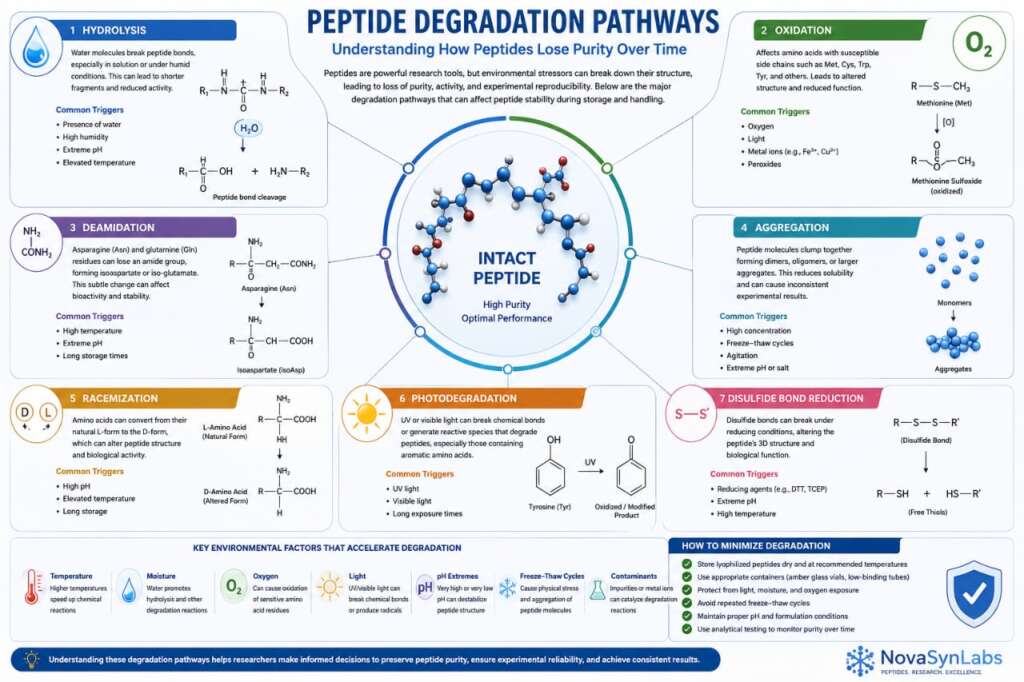
Although peptides are chemically stable under appropriate storage conditions, they remain susceptible to several degradation pathways.
Understanding these mechanisms enables researchers to implement storage strategies that minimize purity loss.
Hydrolysis
Hydrolysis occurs when water molecules break peptide bonds.
This process becomes more likely when peptides remain dissolved for extended periods or are exposed to humid environments.
Hydrolysis may lead to:
- Reduced molecular integrity
- Lower analytical purity
- Decreased experimental consistency
Oxidation
Certain amino acids—including methionine, cysteine, tryptophan, and tyrosine—are more susceptible to oxidation.
Oxidative reactions may occur through exposure to oxygen, light, or reactive contaminants.
Possible consequences include:
- Structural modification
- Reduced stability
- Changes in analytical profiles
Aggregation
Aggregation occurs when peptide molecules interact with one another to form larger molecular complexes.
Repeated freeze-thaw cycles increase this risk.
Aggregated peptides may display:
- Reduced solubility
- Lower biological consistency
- Increased analytical variability
Deamidation
Certain amino acid residues may slowly undergo deamidation under unsuitable storage conditions.
Although often gradual, this reaction can alter peptide structure over time.
Educational Diagram
Major Peptide Degradation Pathways
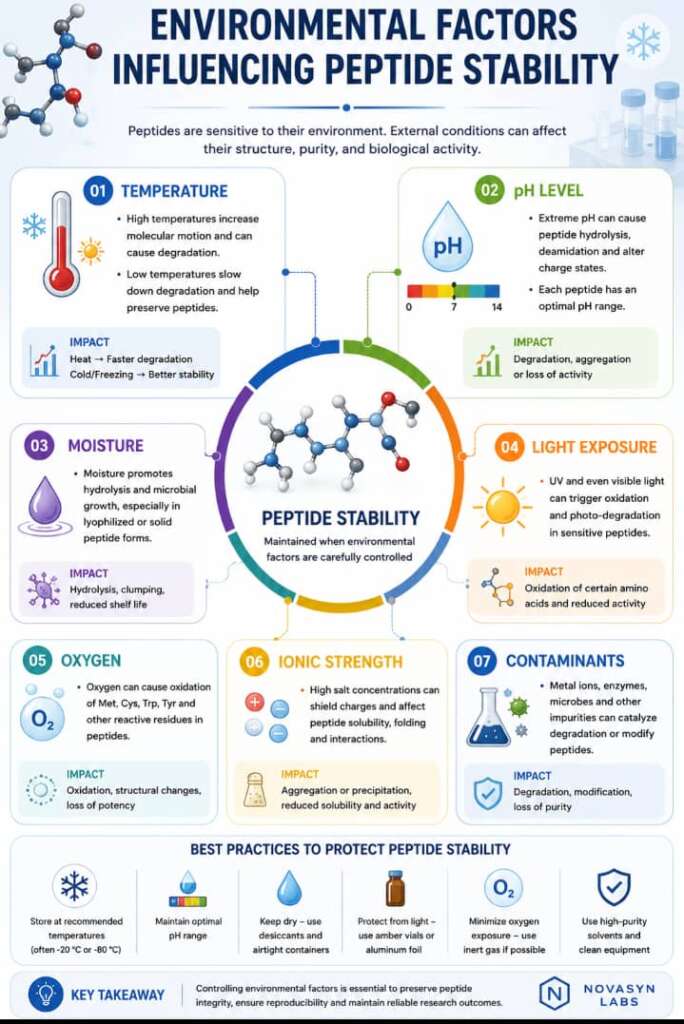
Environmental Factors That Affect Peptide Stability
Temperature
Temperature is one of the most influential variables affecting peptide stability.
Higher temperatures accelerate many chemical reactions responsible for degradation.
Lower temperatures generally slow these reactions considerably.
Moisture
Lyophilized peptides remain considerably more stable because very little water is present.
Moisture exposure may accelerate hydrolysis and other degradation pathways.
Researchers should minimize unnecessary opening of peptide containers and ensure storage environments remain dry.
Light
Photosensitive peptides may gradually degrade when exposed to ultraviolet or visible light.
Amber glass vials provide additional protection for light-sensitive compounds.
Oxygen
Oxidation risk increases with prolonged oxygen exposure.
Proper sealing and minimizing unnecessary handling help reduce oxidative degradation.
pH
Following reconstitution, solution pH may significantly influence stability.
The optimal pH depends on the peptide sequence and solvent system used.
Table
Environmental Risk Factors
| Factor | Risk Level | Recommended Prevention |
| Heat | High | Refrigerate or freeze appropriately |
| Moisture | High | Store lyophilized samples dry |
| Oxygen | Moderate | Keep containers tightly sealed |
| UV Light | Moderate | Use amber storage vials |
| Freeze-Thaw Cycles | High | Prepare aliquots |
| Contamination | Moderate | Follow aseptic laboratory practices |
Environmental Factors Influencing Peptide Stability
Recommended Storage Temperatures
Storage recommendations vary depending on whether peptides remain lyophilized or have been reconstituted.
Lyophilized Peptides
| Storage Duration | Temperature |
| Up to several weeks | 2–8°C |
| Several months | –20°C |
| Six to twenty-four months or longer | -80°C when available |
Lyophilized peptides are generally much more stable than peptides stored in solution because removing water significantly slows many degradation reactions.
Reconstituted Peptides
| Storage Duration | Temperature |
| Hours to several days | 2–8°C |
| Long-term storage | –20°C or preferably –80°C |
The exact stability after reconstitution depends on factors such as:
- Peptide sequence
- Solvent used
- Concentration
- Solution pH
- Oxygen exposure
- Light exposure
NovaSynLabs Research Tip
Whenever practical, prepare small aliquots immediately after reconstitution rather than repeatedly thawing and refreezing the same sample. This simple laboratory practice helps reduce aggregation, minimizes degradation risk, and supports greater experimental reproducibility.
Key Takeaways
- Peptide purity depends on both manufacturing quality and proper storage practices.
- Heat, moisture, oxygen, light, and repeated freeze-thaw cycles are major causes of degradation.
- Lyophilized peptides generally provide greater long-term stability than reconstituted solutions.
- Appropriate storage temperatures and chemically inert containers play an essential role in preserving peptide integrity.
- Understanding degradation mechanisms enables researchers to make informed storage decisions that improve experimental consistency.
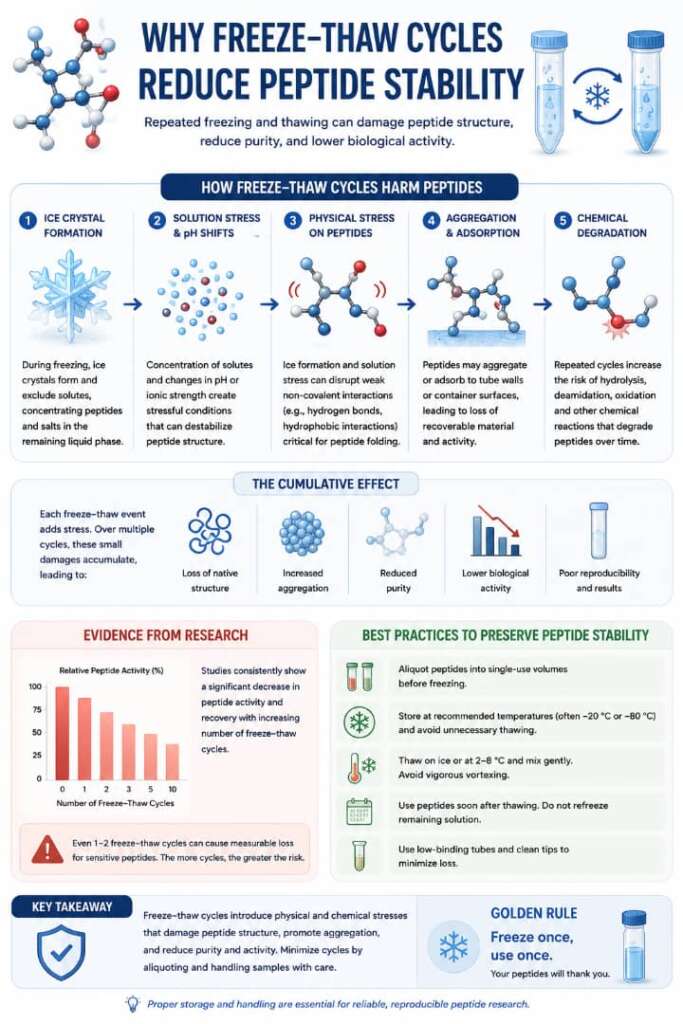
Preventing Damage from Freeze–Thaw Cycles
Repeated freeze–thaw cycles are among the most common causes of peptide instability in research laboratories. Every thaw exposes the peptide solution to changes in temperature, dissolved oxygen, and molecular movement, all of which can increase the likelihood of degradation.
Potential consequences include:
- Aggregation of peptide molecules
- Oxidation of susceptible amino acid residues
- Reduced solubility
- Lower analytical purity
- Increased variability between experiments
- Reduced reproducibility
Although not every peptide responds identically, minimizing unnecessary freeze–thaw events is widely regarded as a best practice.
NovaSynLabs Professional Recommendation
Instead of repeatedly thawing a single vial, prepare several small aliquots immediately after reconstitution. Each aliquot can then be thawed only once when needed, reducing unnecessary stress on the sample.
Storage Containers Matter More Than Many Researchers Realize
The choice of storage container can significantly influence peptide stability, especially for dilute peptide solutions.
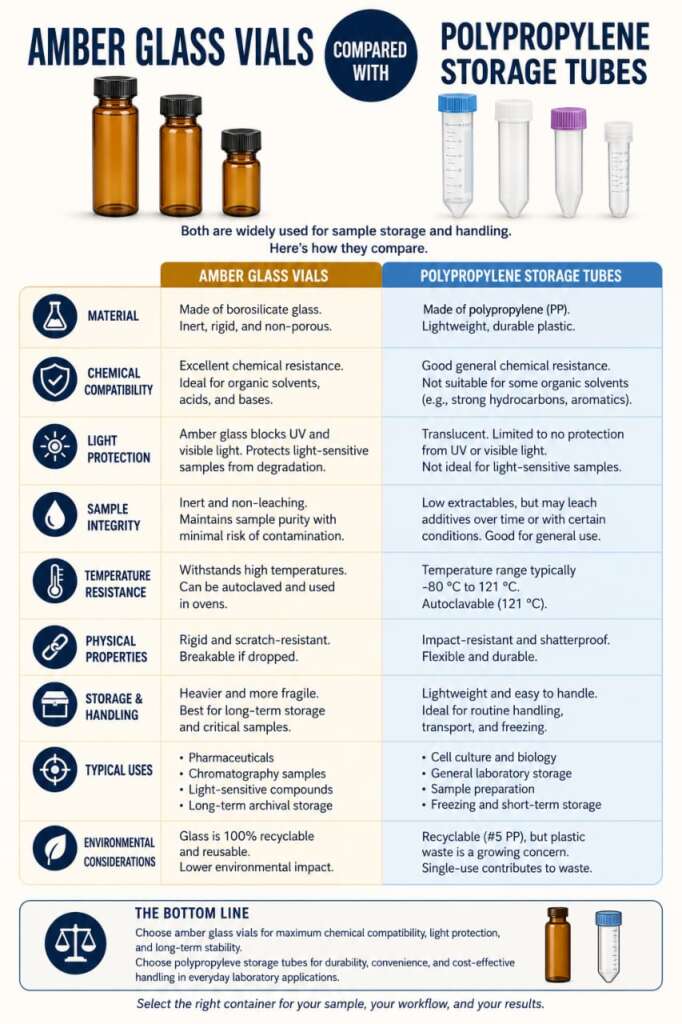
Amber Glass Vials
Amber glass vials are often preferred for long-term storage of lyophilized peptides and light-sensitive compounds.
Advantages
- Chemically inert
- Excellent barrier against moisture
- Excellent oxygen barrier
- Protects photosensitive peptides
- Minimal interaction with peptide samples
Polypropylene Tubes
Polypropylene laboratory tubes remain a practical choice for routine handling and aliquoting.
Modern low protein-binding polypropylene tubes reduce peptide adsorption while offering durability during daily laboratory work.
Advantages
- Lightweight
- Durable
- Convenient for aliquoting
- Widely available
- Low protein-binding options
Comparison Table
| Feature | Amber Glass Vials | Polypropylene Tubes |
| Long-term Storage | Excellent | Good |
| Light Protetion | Excellent | Limited |
| Chemical Resistance | Excellent | Very Good |
| Moisture Barrier | Excellent | Good |
| Daily Laboratory Use | Moderate | Excellent |
| Low Protein Binding | Excellent | Available with specialized grades |
Best Practices After Reconstitution
Once peptides are dissolved, they generally become more susceptible to degradation than when stored in their lyophilized state.
Researchers should therefore pay close attention to handling procedures immediately after reconstitution.
Recommended practices include:
- Prepare only the amount required.
- Aliquot immediately.
- Minimize oxygen exposure.
- Protect from unnecessary light.
- Maintain recommended storage temperatures.
- Label each aliquot clearly.
- Avoid repeated warming.
- Use sterile laboratory technique.
Laboratory Handling Checklist
| Best Practice | Importance |
| Wear clean laboratory gloves | High |
| Use sterile pipette tips | High |
| Label aliquots | High |
| Limit room-temperature exposure | High |
| Avoid repeated thawing | High |
| Keep containers tightly sealed | High |
| Store in appropriate freezer | High |
Educational Example 1
Proper Storage
A research laboratory receives a high-purity lyophilized peptide intended for a multi-month receptor binding study.
Immediately after receipt, the laboratory:
- Stores the vial at –20°C.
- Protects it from light.
- Reconstitutes only the amount needed.
- Creates multiple aliquots.
- Returns unused aliquots promptly to frozen storage.
Result:
Throughout the study, analytical testing demonstrates consistent purity profiles and excellent experimental reproducibility.
Educational Example 2
Improper Storage
Another laboratory repeatedly removes the same peptide vial from the freezer, allows it to thaw completely, and returns the remaining solution after each experiment.
After numerous freeze–thaw cycles, researchers observe:
- Increased aggregation
- Reduced solubility
- Greater variability in analytical testing
- Less consistent experimental performance
Although the peptide sequence itself remains unchanged, repeated handling contributes to gradual degradation.
How Analytical Testing Helps Verify Peptide Purity
Maintaining purity requires more than proper storage. Analytical testing provides objective evidence that peptide identity and quality remain within expected specifications.
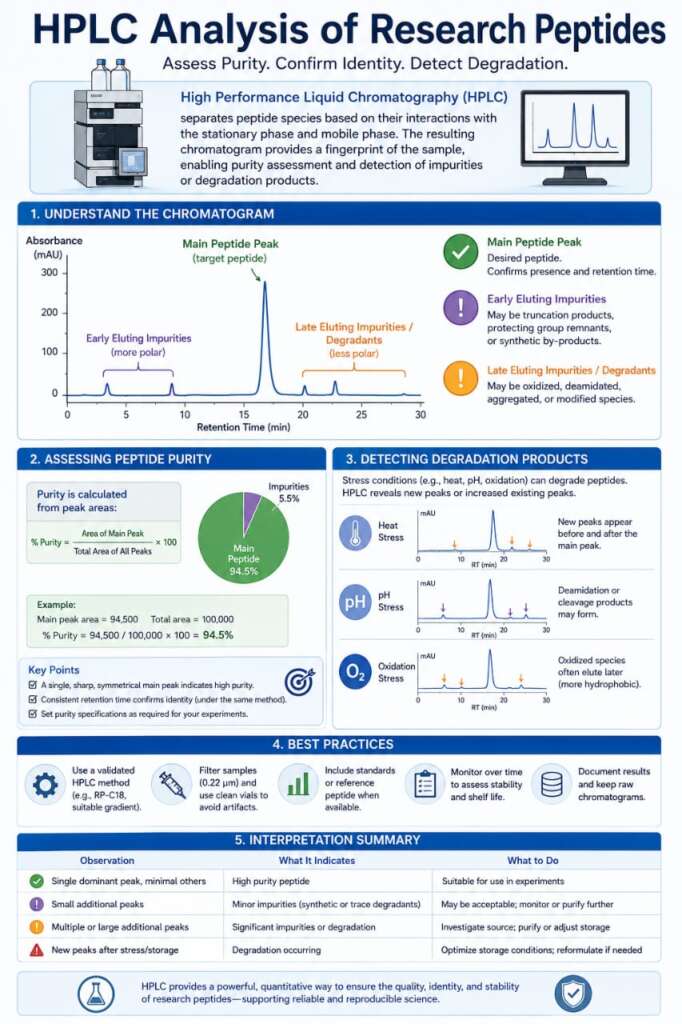
High-Performance Liquid Chromatography (HPLC)
HPLC separates peptide molecules from impurities based on their chemical properties.
Researchers commonly use HPLC to:
- Verify purity
- Detect degradation products
- Compare production batches
- Monitor stability studies
Liquid Chromatography–Mass Spectrometry (LC-MS)
LC-MS combines chromatographic separation with mass analysis.
This technique provides highly accurate confirmation of:
- Molecular weight
- Peptide identity
- Sample composition
- Potential degradation products
MALDI-TOF Mass Spectrometry
Matrix-Assisted Laser Desorption/Ionization Time-of-Flight (MALDI-TOF) offers rapid molecular characterization of peptides.
Researchers frequently use MALDI-TOF to:
- Confirm peptide identity
- Verify molecular mass
- Support quality assurance
Stability Testing
Stability studies evaluate how peptide samples perform under different storage conditions over time.
Typical assessments examine:
- Temperature effects
- Moisture exposure
- Freeze–thaw tolerance
- Light sensitivity
- Long-term storage performance
NovaSynLabs Quality Approach
At NovaSynLabs, maintaining peptide quality extends beyond synthesis.
Our educational recommendations emphasize:
- Careful manufacturing standards
- Protective packaging
- Cold-chain handling
- Batch verification
- HPLC purity testing
- LC-MS confirmation
- MALDI-TOF identity verification
- Stability-focused storage guidance
These practices are intended to help support reliable research outcomes and consistent laboratory performance.
Research Peptides Frequently Discussed in Scientific Literature
Examples include:
- Retatrutide
- Cagrilintide
- BPC-157
- TB-500
- CJC-1295
- Ipamorelin
- GHK-Cu
- MOTS-c
- SS-31
- Tesamorelin
- Semax
- Selank
- Epitalon
- Kisspeptin-10
- PT-141
- Thymosin Alpha-1
- AOD-9604
- GLP-1 analog research peptides
- IGF-1 LR3
- PEG-MGF
Each peptide has unique stability characteristics, reinforcing the importance of following storage recommendations specific to the peptide and research protocol.
«Research Use Notice: The information in this guide is intended for educational purposes and laboratory research use only. Storage requirements may vary depending on the peptide sequence, formulation, and experimental design.»
Common Mistakes That Can Reduce Peptide Purity
Even peptides manufactured to high purity can lose stability if they are not stored or handled correctly. Avoiding common mistakes is one of the simplest ways to help preserve peptide quality over time.
| Mistake | Potential Impact | Recommended Practice |
| Repeated freeze-thaw cycles | Aggregation and oxidation | Prepare single-use aliquots immediately after reconstitution |
| Leaving peptides at room temperature for extended periods | Accelerated degradation | Return samples to recommended storage promptly |
| Using inappropriate storage containers | Adsorption or contamination | Use amber glass vials for long-term storage and quality polypropylene tubes for routine handling |
| Frequent exposure to moisture | Increased hydrolysis risk | Keep lyophilized peptides dry and tightly sealed |
| Exposure to direct light | Photodegradation of light-sensitive peptides | Store in amber containers or dark environments |
| Poor labeling | Sample mix-ups and inconsistent data | Clearly label peptide name, concentration, solvent, date, and storage temperature |
| Improper aseptic technique | Contamination | Use sterile laboratory practices throughout handling |
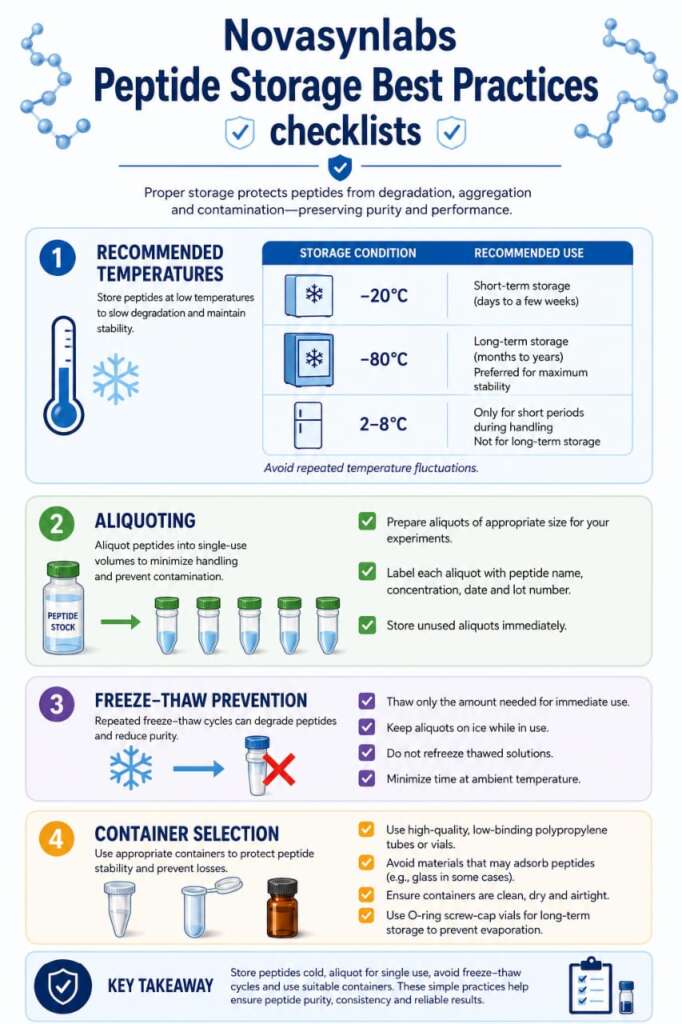
NovaSynLabs Best Practice Checklist
Researchers can help maintain peptide purity by following a consistent storage workflow.
✅ Store lyophilized peptides dry until needed.
✅ Store at the recommended temperature according to the expected storage duration.
✅ Minimize exposure to moisture, oxygen, and light.
✅ Reconstitute only when necessary.
✅ Prepare aliquots immediately after reconstitution.
✅ Avoid repeated freeze–thaw cycles.
✅ Use chemically inert storage containers.
✅ Maintain accurate laboratory documentation.
✅ Verify peptide identity and purity using appropriate analytical methods.
Frequently Asked Questions
1. How is peptide purity maintained during storage?
Peptide purity is maintained by controlling temperature, minimizing moisture, limiting oxygen and light exposure, avoiding repeated freeze–thaw cycles, selecting appropriate storage containers, and confirming quality through analytical testing such as HPLC and LC-MS.
2. Why are lyophilized peptides generally more stable?
Lyophilization removes water, slowing hydrolysis and many other degradation pathways. This generally makes lyophilized peptides more stable than peptides stored in solution.
3. Why should repeated freeze–thaw cycles be avoided?
Repeated freeze–thaw cycles may contribute to aggregation, oxidation, structural changes, and reduced experimental reproducibility. Preparing aliquots helps reduce these risks.
4. What temperature is recommended for long-term peptide storage?
For many lyophilized peptides, –80°C is preferred for long-term storage when available. Many laboratories also store peptides at –20°C for medium-term use. Storage requirements may vary depending on the peptide and study design.
5. Does light affect peptide stability?
Yes. Some peptides are photosensitive and may gradually degrade when exposed to prolonged light. Amber glass containers help reduce light exposure.
6. Which container is best for storing peptides?
Amber glass vials are commonly preferred for long-term storage, particularly for lyophilized or light-sensitive peptides. Low protein-binding polypropylene tubes are often suitable for routine laboratory handling and aliquoting.
7. How do researchers verify peptide purity?
Researchers commonly use analytical methods including HPLC, LC-MS, MALDI-TOF mass spectrometry, peptide identity verification, and stability studies.
8. Does reconstitution reduce peptide stability?
Generally, peptides become more susceptible to degradation after reconstitution because water enables additional chemical reactions. Proper storage and handling become even more important once peptides are in solution.
9. Which environmental factors most affect peptide stability?
Temperature, moisture, oxygen, ultraviolet light, solution pH, contamination, and repeated freeze–thaw cycles are among the most important factors influencing peptide stability.
10. Are all peptides stored the same way?
No. Storage recommendations vary depending on the peptide sequence, formulation, solvent, concentration, and intended research application. Researchers should follow product-specific guidance whenever available.
Summary Table
Factors That Help Maintain Peptide Purity
| Factor | Recommendation |
| Temperature | Store at 2–8°C, –20°C, or –80°C depending on storage duration and peptide form |
| Moisture | Keep lyophilized peptides dry |
| Oxygen | Minimize unnecessary exposure |
| Light | Protect photosensitive peptides using amber containers |
| Freeze-Thaw | Use aliquots to avoid repeated cycles |
| Containers | Amber glass for long-term storage; quality polypropylene tubes for routine use |
| Handling | Follow aseptic laboratory techniques |
| Quality control | Verify purity using validated analytical methods |
Conclusion
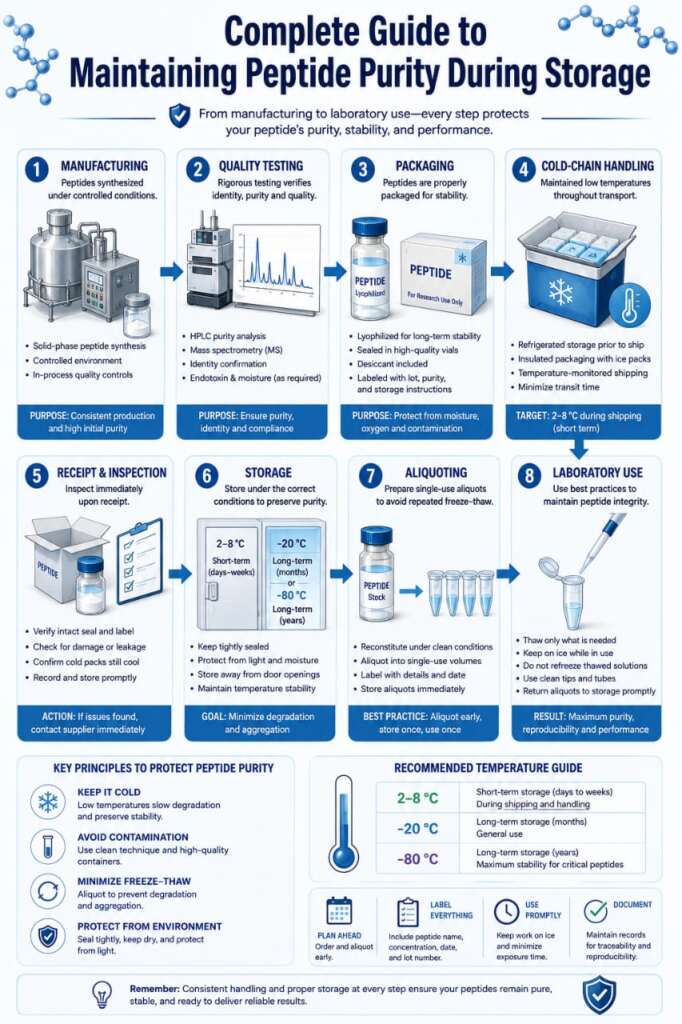
Maintaining peptide purity during storage requires more than selecting an appropriate freezer temperature. Every stage—from packaging and transportation to storage, reconstitution, handling, and analytical verification—can influence peptide stability and overall research quality.
Environmental factors such as heat, moisture, oxygen, light, and repeated freeze–thaw cycles are among the most common contributors to degradation. By understanding these risks and implementing evidence-based storage practices, researchers can help preserve peptide integrity and support more reliable experimental outcomes.
At NovaSynLabs, we emphasize that peptide quality extends beyond synthesis. Educational guidance on proper storage, careful handling, protective packaging, cold-chain awareness, and analytical verification can all contribute to maintaining high standards for research-use materials.
Whether working with BPC-157, TB-500, CJC-1295, GHK-Cu, Retatrutide, or other research peptides, following appropriate storage recommendations helps reduce variability and improve confidence in laboratory findings.
Related Articles
References
- National Center of Biotechnology Information (NCBI)
- PubMed
- National Institutes of Health (NIH)
- International Union of Pure and Applied Chemistry (IUPAC)
Research Use Disclaimer
For Research Use Only: The information presented in this article is intended solely for educational and scientific research purposes. It is not intended as medical advice, nor should it be interpreted as guidance for diagnosing, treating, curing, or preventing any disease. Storage recommendations may vary depending on peptide sequence, formulation, and specific laboratory protocols. Researchers should always follow validated procedures and product-specific documentation.


Comment
How To Travel With Peptides: The Ultimate 2026 Guide To Packing, Cooling & Flying Safely
[…] Proper Peptide Storage Matters During […]