


Description
KLOW Peptide Blend 80mg — Research-Grade GHK-Cu, BPC-157, TB-500 & KPV
Overview
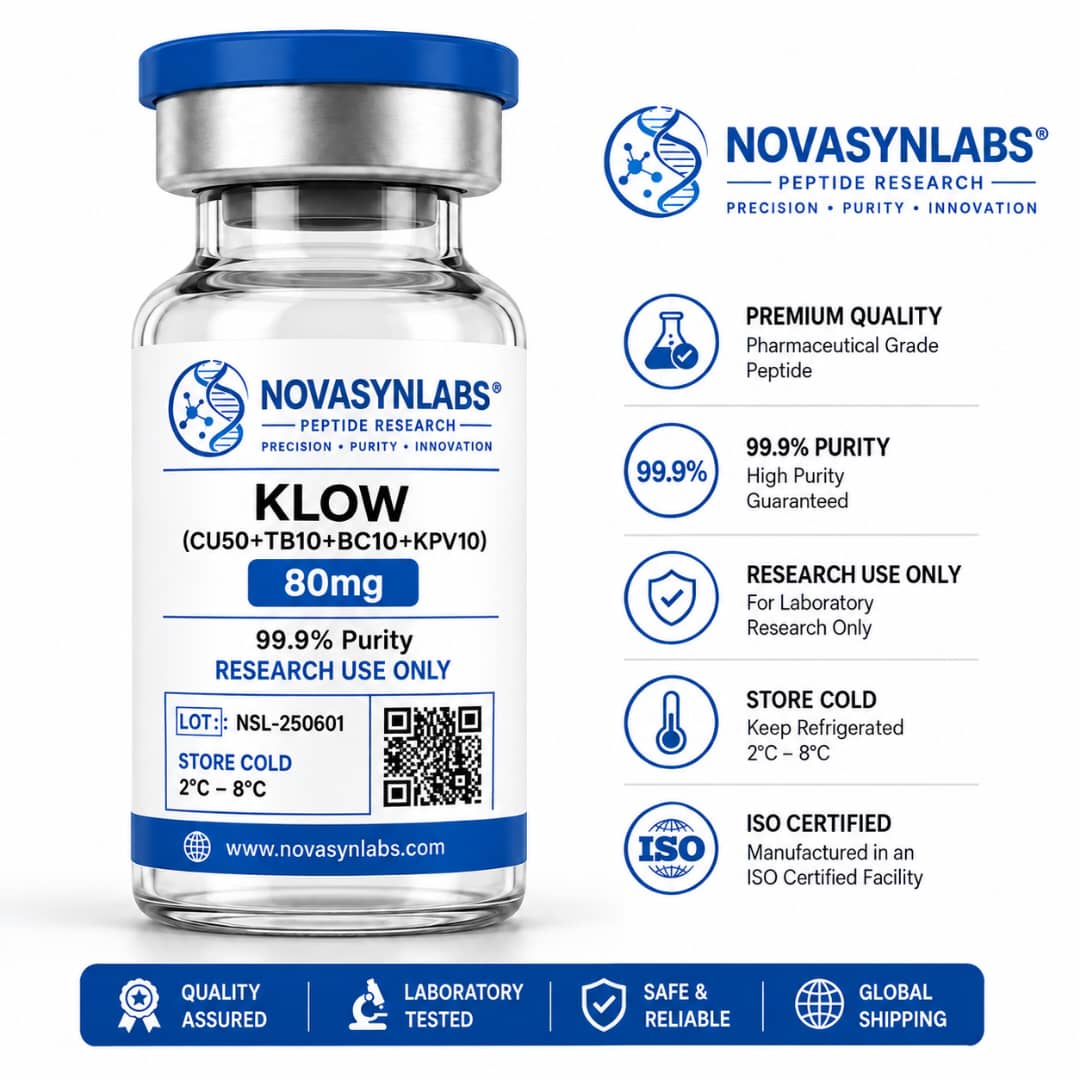
KLOW is a multi-peptide research formulation combining four distinct research compounds: GHK-Cu, BPC-157, TB-500, and KPV.
The commonly referenced 80mg KLOW formulation contains 50mg GHK-Cu, 10mg BPC-157, 10mg TB-500, and 10mg KPV. The components remain separate molecules within the co-formulated preparation rather than forming a new single chemical entity.
NovasynLabs KLOW 80mg is intended for laboratory research and analytical applications involving peptide biology, tissue-related signaling, inflammatory pathways, extracellular-matrix biology, and structure-function research.
KLOW Composition
The standard 80mg research formulation is:
Component| Quantity
GHK-Cu| 50mg
BPC-157| 10mg
TB-500| 10mg
KPV| 10mg
Total| 80mg
GHK-Cu represents the largest component of the formulation, accounting for approximately 62.5% of the total peptide material.
Because KLOW is a vendor-defined research blend rather than a standardized pharmaceutical formulation, researchers should always verify the exact composition against the batch-specific product documentation and COA.
GHK-Cu Research
GHK-Cu is a copper-binding tripeptide that has been studied extensively in cellular and tissue biology. Research has examined its relationship with extracellular-matrix components, collagen-related processes, gene expression, cellular signaling, and tissue remodeling.
The presence of GHK-Cu makes KLOW relevant to laboratory research involving extracellular-matrix biology and copper-peptide interactions.
BPC-157 Research
BPC-157 is a synthetic pentadecapeptide investigated primarily in preclinical research. Published studies have examined its interaction with vascular signaling, tissue biology, gastrointestinal models, and connective-tissue processes.
Within KLOW, BPC-157 provides a distinct research component for laboratories investigating peptide-mediated cellular and tissue responses.
TB-500 Research
TB-500 is commonly associated with research involving thymosin-beta-4-related pathways. Thymosin beta-4 research has investigated cell migration, actin dynamics, angiogenesis, wound-related processes, and tissue remodeling.
Researchers should distinguish between studies conducted with full-length thymosin beta-4 and studies using specific TB-500 fragments or formulations.
KPV Research
KPV is a short tripeptide corresponding to the C-terminal portion of alpha-melanocyte-stimulating hormone. Experimental research has examined KPV in relation to inflammatory signaling and cellular pathways, including NF-kB-associated mechanisms.
The addition of KPV differentiates KLOW from GLOW and creates a four-component formulation.
KLOW Versus GLOW
GLOW is commonly described as a three-component blend containing GHK-Cu, BPC-157, and TB-500, totaling 70mg.
KLOW adds KPV to this combination, resulting in an 80mg total formulation.
Therefore:
GLOW: GHK-Cu 50mg + BPC-157 10mg + TB-500 10mg
KLOW: GHK-Cu 50mg + BPC-157 10mg + TB-500 10mg + KPV 10mg
The distinction is important for researchers documenting experimental materials.
Research Applications
KLOW may be relevant to laboratory research involving:
– Peptide structure and function
– Extracellular-matrix biology
– Cellular signaling
– Tissue biology
– Inflammatory signaling
– Peptide combinations
– Copper-peptide research
– Cell migration
– Connective-tissue research
– Structure-activity studies
Importantly, these areas represent research interests associated with the individual components. There is not equivalent clinical evidence establishing that the four-component KLOW formulation produces a combined effect.
Analytical Quality
Multi-component peptide blends require careful analytical characterization because several distinct molecules are present in the same material.
Laboratories may use chromatographic and mass-spectrometric methods to evaluate component identity and purity. HPLC can provide chromatographic information, while LC-MS or related mass spectrometry methods can support molecular identification.
Batch-specific documentation should be reviewed before experimental use.
Why Choose NovasynLabs KLOW 80mg?
NovasynLabs focuses on research-oriented peptide materials with an emphasis on product identification, analytical documentation, batch consistency, and laboratory suitability.
The KLOW 80mg presentation provides researchers with a combined research formulation containing four distinct peptide components in a defined mass ratio.
Researchers should review the applicable COA and product documentation for the specific lot before incorporating the material into experimental workflows.
Research-Use Statement
KLOW 80mg is supplied for laboratory research and analytical purposes only. It is not intended for human or veterinary administration and is not marketed as a medication, dietary supplement, or treatment.
The scientific literature surrounding the individual components should not be interpreted as evidence that the KLOW combination itself has been clinically validated.
Summary
KLOW 80mg is a four-component research peptide formulation consisting of GHK-Cu, BPC-157, TB-500, and KPV. The commonly listed composition is 50mg GHK-Cu, 10mg BPC-157, 10mg TB-500, and 10mg KPV.
The formulation provides a useful research material for laboratories investigating peptide signaling, tissue biology, inflammatory pathways, extracellular-matrix processes, and peptide structure-function relationships.
NovasynLabs KLOW 80mg is positioned strictly as a research-use material, with batch-level analytical documentation serving as an important part of laboratory quality assessment.


Reviews
There are no reviews yet.