


Description
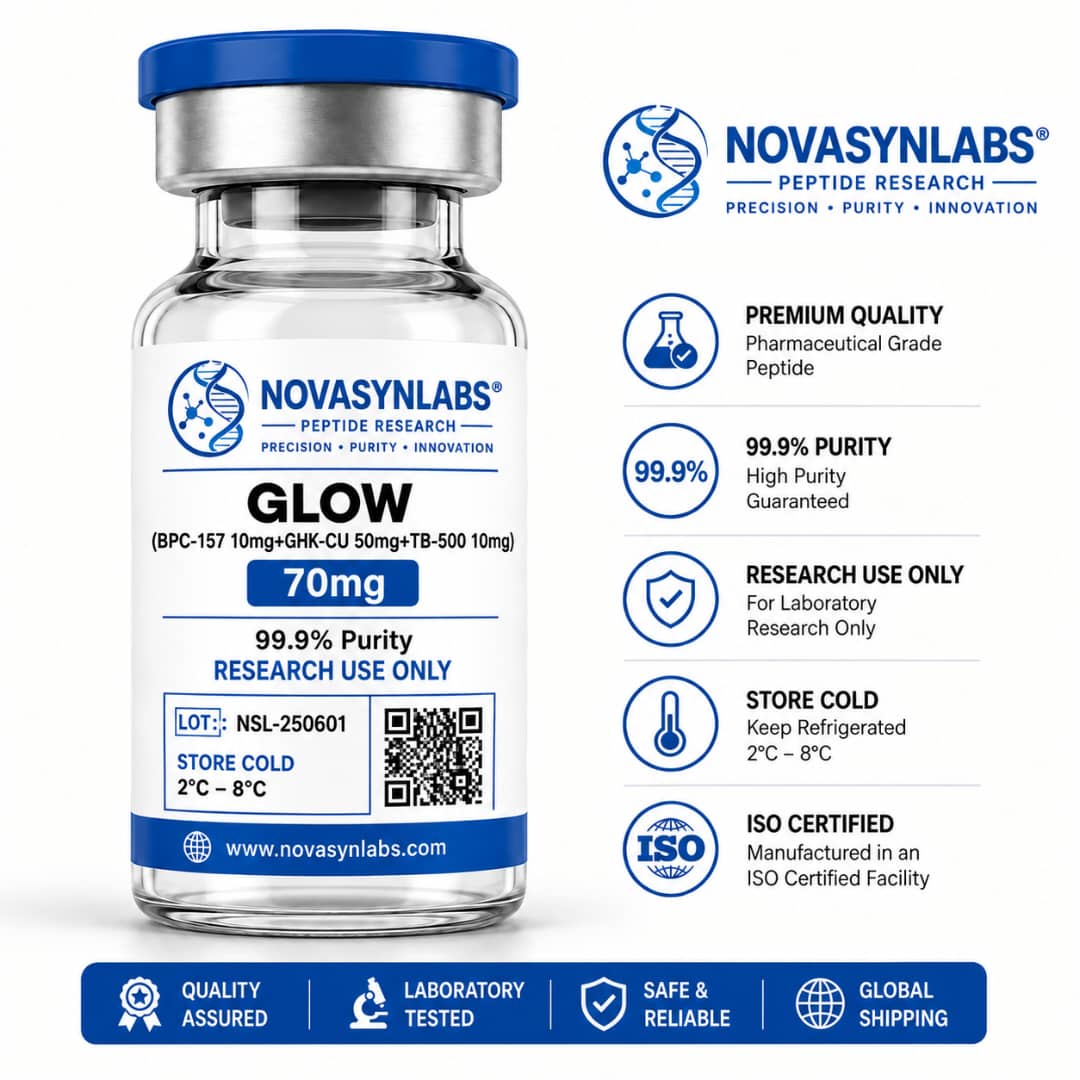
GLOW 70mg Peptide Blend — Research-Grade GHK-Cu, BPC-157 & TB-500
Overview
GLOW is a three-component research peptide formulation combining GHK-Cu, BPC-157, and TB-500.
The commonly listed 70mg composition contains 50mg GHK-Cu, 10mg BPC-157, and 10mg TB-500.
Each component represents a separate research molecule with its own scientific literature and biological properties. The blend is therefore best viewed as a co-formulated research material rather than a new single peptide.
NovasynLabs GLOW 70mg is intended for laboratory and analytical research involving peptide biology, cellular signaling, extracellular-matrix research, and tissue-related pathways.
Composition
Component| Quantity
GHK-Cu| 50mg
BPC-157| 10mg
TB-500| 10mg
Total| 70mg
GHK-Cu represents the majority of the formulation by mass.
GHK-Cu
GHK-Cu is a copper-associated peptide extensively studied in skin biology, extracellular-matrix research, collagen-related processes, cellular signaling, and tissue remodeling.
Its inclusion makes GLOW relevant to research investigating copper-peptide biology and matrix-related cellular responses.
BPC-157
BPC-157 is a synthetic pentadecapeptide investigated predominantly in preclinical models.
Research has explored BPC-157 in relation to vascular signaling, connective-tissue models, gastrointestinal biology, and cellular responses.
These findings are primarily experimental and should not be interpreted as evidence of established clinical effectiveness.
TB-500
TB-500 is commonly studied in connection with thymosin-beta-4-related biology. Research involving thymosin beta-4 has examined actin regulation, cell migration, angiogenesis, wound-related biology, and tissue remodeling.
Researchers should carefully distinguish between studies involving full-length thymosin beta-4 and studies involving specific TB-500 preparations.
GLOW Research Applications
GLOW may be relevant to laboratory studies involving:
– Peptide signaling
– Extracellular-matrix biology
– Copper-peptide research
– Cell migration
– Tissue biology
– Cellular repair pathways
– Peptide structure-function studies
– Protein and peptide characterization
– Analytical chemistry
The individual components have separate research histories, while the specific three-component GLOW formulation has substantially less direct experimental literature.
GLOW and KLOW
The primary compositional difference between GLOW and KLOW is KPV.
GLOW commonly contains:
50mg GHK-Cu + 10mg BPC-157 + 10mg TB-500 = 70mg.
KLOW commonly contains the same three components plus 10mg KPV, producing an 80mg total formulation.
This distinction should be clearly reflected in product descriptions, labels, and COA documentation.
Quality Documentation
Research laboratories should evaluate multi-component formulations using appropriate analytical documentation.
HPLC can be used to examine chromatographic profiles, while mass spectrometry can support identity testing. A batch-specific COA provides useful information for laboratory records and quality assessment.
NovasynLabs recommends reviewing the documentation associated with the actual lot being purchased.
Research-Use Statement
GLOW 70mg is supplied for laboratory research and analytical purposes only. It is not intended for human or veterinary use and should not be represented as a therapeutic product.
Research findings involving individual GLOW components should not automatically be interpreted as evidence for the combined formulation.
Summary
GLOW 70mg is a commonly listed three-component research blend consisting of GHK-Cu 50mg, BPC-157 10mg, and TB-500 10mg.
Its composition makes it relevant to research involving peptide signaling, extracellular-matrix biology, cellular responses, and tissue-related mechanisms.
NovasynLabs GLOW 70mg is positioned as a research material for controlled laboratory and analytical applications.


Reviews
There are no reviews yet.