


Description
Kisspeptin-10 Peptide — 5mg & 10mg Research-Grade Kisspeptin
Overview
Kisspeptin-10, commonly abbreviated as KP-10, is a biologically active decapeptide belonging to the kisspeptin family of signaling peptides. It is derived from the KISS1 gene product and represents the smallest naturally occurring kisspeptin fragment known to retain activity at the kisspeptin receptor, KISS1R.
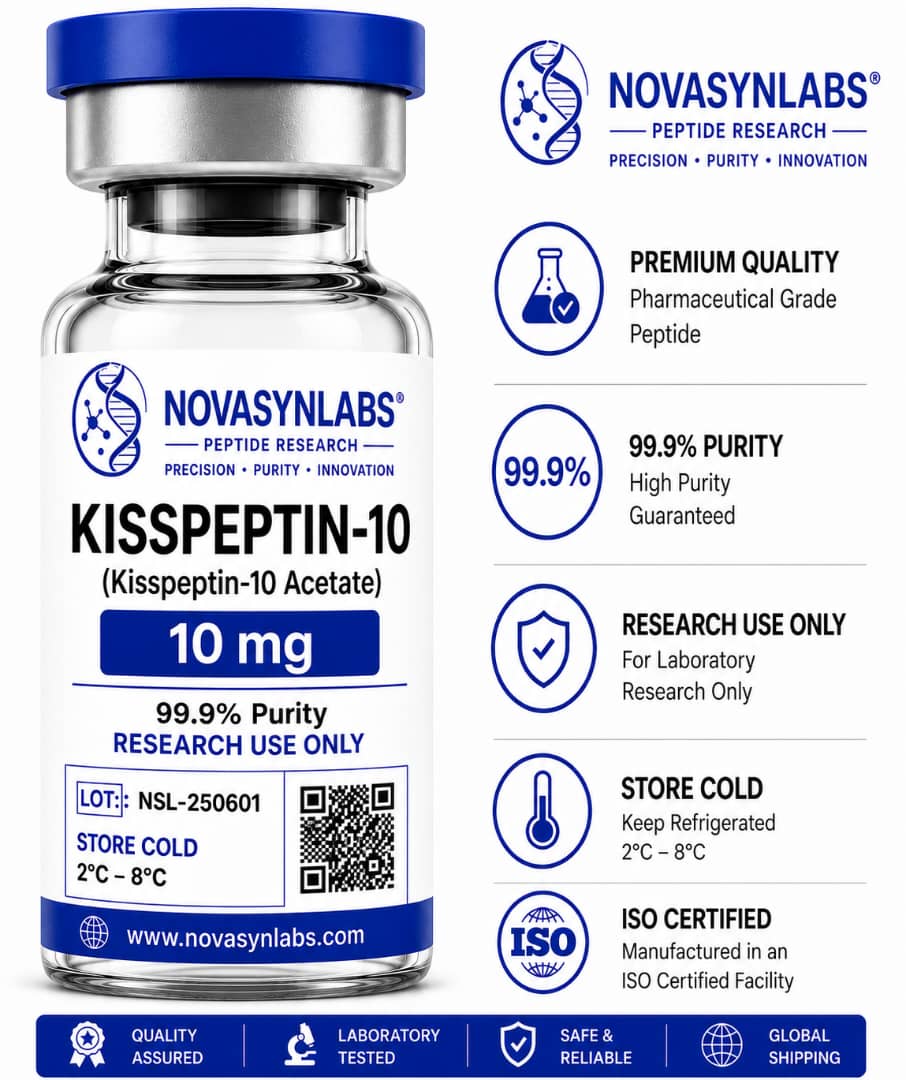
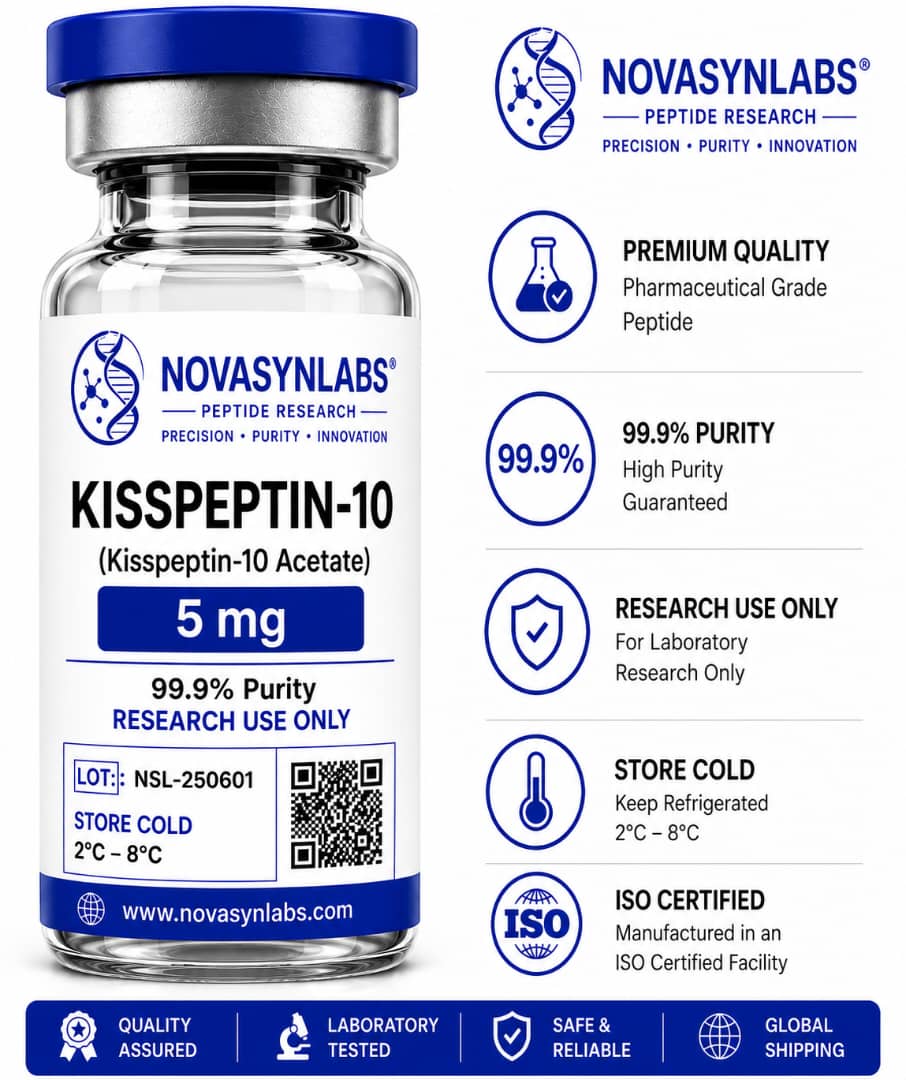
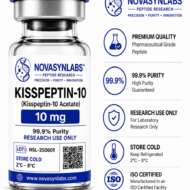
NovasynLabs Kisspeptin-10 is offered in two research presentations: 5mg and 10mg. These quantities are intended for laboratory research, analytical investigation, and controlled peptide studies.
Kisspeptin signaling has attracted significant scientific attention because the KISS1/KISS1R system is involved in neuroendocrine signaling and regulation of the hypothalamic-pituitary-gonadal axis. Research has also investigated kisspeptin signaling in areas including reproductive biology, endocrine physiology, cancer biology, and GPCR signaling.
What Is Kisspeptin-10?
Kisspeptin-10 is a ten-amino-acid peptide derived from the larger kisspeptin precursor encoded by the KISS1 gene.
Kisspeptins are endogenous ligands of KISS1R, a G-protein-coupled receptor also historically referred to as GPR54. Among the naturally occurring kisspeptin fragments, KP-10 contains the core C-terminal sequence required for receptor activity.
Scientific research has established that the kisspeptin/KISS1R system plays an important role in neuroendocrine regulation. In particular, KISS1R signaling has been studied in relation to gonadotropin-releasing hormone (GnRH) neurons and downstream regulation of the hypothalamic-pituitary-gonadal axis.
This makes Kisspeptin-10 a valuable research molecule for investigating peptide-receptor interactions and endocrine signaling pathways.
Kisspeptin-10 and KISS1R
One of the defining characteristics of Kisspeptin-10 is its interaction with KISS1R.
KISS1R is a G-protein-coupled receptor that responds to endogenous kisspeptin peptides. When Kisspeptin-10 interacts with KISS1R, researchers can investigate downstream signaling events associated with receptor activation.
Modern structural research has provided additional insight into this interaction. A 2024 structural study used cryo-electron microscopy to examine KISS1R bound to kisspeptin-10 and reported details concerning peptide recognition and receptor activation. The study also examined the distinctive Gq coupling characteristics of KISS1R.
These findings contribute to a growing understanding of how peptide ligands interact with GPCRs at the molecular level.
Neuroendocrine Research
Kisspeptin-10 has been extensively investigated in neuroendocrine research.
The KISS1/KISS1R system participates in signaling associated with the hypothalamic-pituitary-gonadal axis. Experimental studies have examined how kisspeptin signaling influences GnRH neurons and subsequent endocrine responses.
Researchers have also investigated different kisspeptin fragments and analogs to understand how peptide sequence, receptor affinity, degradation, and exposure patterns influence biological responses.
Studies have shown that Kisspeptin-10 and related peptides can stimulate signaling through KISS1R, while changes to peptide structure can modify receptor activity and biological behavior.
This makes KP-10 particularly relevant for structure-activity relationship studies.
Structure-Activity Research
Kisspeptin-10 has been used extensively in structure-activity relationship research.
Scientists have investigated how individual amino-acid residues contribute to KISS1R binding and receptor activation. Experimental work involving modified KP-10 analogs has examined receptor affinity, intracellular signaling, and downstream endocrine responses.
This type of research can help researchers understand the relationship between peptide sequence and biological function.
The development of kisspeptin analogs is also an active area of scientific investigation. Researchers have explored modified peptide structures designed to alter stability, receptor activity, duration of action, or biological potency.
Research Applications
Kisspeptin-10 may be relevant to laboratory studies involving:
– KISS1/KISS1R signaling
– GPCR research
– Neuroendocrine signaling
– Reproductive biology
– GnRH-related research
– Hypothalamic signaling
– Peptide-receptor interactions
– Structure-activity relationship studies
– Peptide analog development
– Endocrine research
– Cellular signaling
– Molecular pharmacology
Researchers can select the 5mg or 10mg presentation according to their laboratory requirements and validated experimental design.
Kisspeptin-10 and Cellular Signaling
Because KISS1R is a GPCR, Kisspeptin-10 provides a useful research tool for studying receptor-mediated intracellular signaling.
Experimental research has examined pathways including calcium signaling, ERK phosphorylation, and other downstream signaling processes. Researchers have used cellular systems expressing KISS1R to investigate ligand activity and receptor responses.
This makes KP-10 relevant not only to reproductive biology but also to broader studies of GPCR pharmacology and peptide signaling.
Analytical Characterization
As with other synthetic research peptides, analytical characterization is important when evaluating Kisspeptin-10.
Researchers may use HPLC to assess chromatographic purity and LC-MS to support molecular identity. Depending on the laboratory’s objectives, additional analytical techniques may be appropriate for evaluating peptide stability, composition, aggregation, or behavior under controlled conditions.
Batch-specific documentation, including a certificate of analysis where available, can support laboratory recordkeeping and reproducibility.
NovasynLabs encourages researchers to review available analytical documentation for the specific batch before beginning experimental work.
5mg and 10mg Research Presentations
NovasynLabs offers Kisspeptin-10 in:
Kisspeptin-10 5mg
A smaller research presentation suitable for laboratories conducting controlled peptide experiments, analytical testing, receptor studies, and preliminary research.
Kisspeptin-10 10mg
A larger research presentation designed for laboratories requiring additional material for extended experimental workflows or multiple analytical investigations.
Both presentations contain the same research compound, with the primary difference being the quantity supplied.
Research Quality and Handling
Research peptides should be handled according to appropriate laboratory procedures. Storage and handling conditions should be determined according to the manufacturer’s available product documentation and the requirements of the research protocol.
Researchers should minimize unnecessary exposure to environmental conditions that could affect peptide integrity and should use validated laboratory practices when preparing samples for analytical or experimental work.
Because individual research applications vary, NovasynLabs does not provide human-use dosing instructions through this product page.
Why Choose NovasynLabs Kisspeptin-10?
NovasynLabs focuses on research-oriented peptide products for scientific and laboratory applications.
Kisspeptin-10 is offered with a focus on product identification, analytical quality, batch consistency, and research usability. Researchers can use available product documentation and analytical information to assess whether a particular batch meets their experimental requirements.
For laboratories studying KISS1R, GPCR signaling, peptide-receptor interactions, neuroendocrine pathways, or kisspeptin biology, KP-10 provides an established molecular research tool.
Research-Use Statement
NovasynLabs Kisspeptin-10 is intended strictly for laboratory research and analytical applications. It is not intended to diagnose, treat, cure, or prevent any disease or medical condition.
This product should not be represented as an approved pharmaceutical, dietary supplement, or medication. Researchers are responsible for determining appropriate experimental procedures and complying with all applicable institutional, laboratory, and regulatory requirements.
Summary
Kisspeptin-10 is an important research peptide within the KISS1/KISS1R signaling system. As the smallest naturally occurring kisspeptin fragment retaining KISS1R activity, KP-10 has become a valuable molecule for studying peptide-receptor recognition, GPCR signaling, neuroendocrine regulation, and structure-activity relationships.
Published research has investigated Kisspeptin-10 in cellular, molecular, animal, and translational research settings. Studies have examined KISS1R activation, downstream signaling, reproductive neuroendocrinology, peptide structure, and the development of modified kisspeptin analogs.
NovasynLabs Kisspeptin-10 is available in 5mg and 10mg presentations, providing researchers with flexible quantities for laboratory investigation and analytical research.
For laboratories investigating KISS1R biology, peptide signaling, GPCR pharmacology, endocrine research, or peptide structure-function relationships, Kisspeptin-10 represents a well-established research molecule with a substantial scientific literature base.

Reviews
There are no reviews yet.